
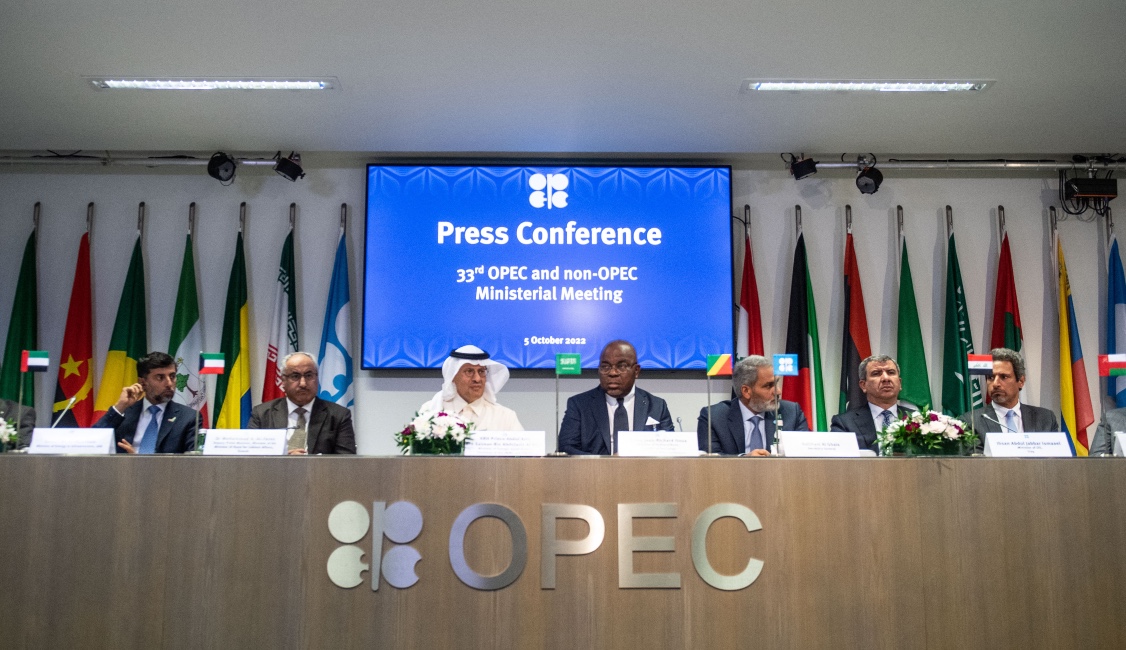
The US pressed Iraq and Venezuela to leave the Saudi-led energy cartel over the summer in a bid to bring down prices Representatives of Opec member countries attend a press conference after the 45th Joint Ministerial Monitoring Committee and the 33rd Opec and non-Opec Ministerial Meeting in Vienna, Austria, on 5 October 2022 (AFP) Published date: 27 November 2026 17:15 GMT | Last update: 6 sec ago The US tried to break the Saudi Arabian-led energy cartel Opec by lobbying Iraq and Venezuela to leave the organisation earlier this year, sparking a direct intervention from the Saudi Crown Prince, according to a report by Reuters. The report, published on Friday, reveals how President Donald Trump’s bid to boost production and lower energy prices amid the war on Iran put the US in direct conflict with Saudi Arabia, one of the US's closest allies in the region, which also sells its oil in US dollars and hosts US troops. The Trump administration’s lobbying over the summer also sheds new light on the decision of the UAE to leave Opec in May. The Trump administration welcomed the move at the time. Washington extended the option of a currency swap line to the UAE to allow the Emirates to access US dollars if its reserves ran dry. The rare gesture came shortly after the height of fighting between the US and Iran, when oil exports through the Strait of Hormuz had plunged. Iraq, Saudi Arabia, Venezuela, Iran and Kuwait were the founding members of Opec in 1960. New MEE newsletter: Jerusalem Dispatch Sign up to get the latest insights and analysis on Israel-Palestine, alongside Turkey Unpacked and other MEE newsletters Iran is already outside the cartel’s purview as a result of US sanctions and its so-called “shadow sale” of oil to China. The withdrawal of Iraq and Venezuela from the alliance would have effectively spelled Opec’s demise, although the alliance has been under pressure for years. Reuters reported that Iraq’s Prime Minister Ali Faleh al-Zaidi, who was endorsed by Trump, raised withdrawing from the alliance over the summer in discussions with US officials, who encouraged the idea. Officials in Iraq’s oil ministry discouraged the idea, saying that Baghdad should push for a higher quota within Opec, allowing them to pump more oil. Trump's Venezuela oil gambit depends on a 'swashbuckling' attitude the market lacks Read More » The discussions came amid Zaidi’s high-profile visit to Washington in July where he unveiled a raft of economic deals that he hoped would overshadow tensions with the US over Iran-aligned militias in Iraq. Middle East Eye was the first to reveal that Iraq planned to resurrect a new oil pipeline through Syria to the Mediterranean with US backing. The US has massive financial leverage over Baghdad because income generated from Iraq’s oil sales is deposited at the Federal Reserve Bank of New York instead of being sent to Iraqi banks. The Trump administration halted dollar shipments to Iraq until Zaidi was named prime minister. He also received the backing of pro-Iran factions. The US’s leverage over Venezuela is even larger since the Trump administration attacked the country and removed former President Nicholas Maduro from power at the start of the year. The US effectively seized control over Venezuela’s finances and oil revenue, and tapped commodities trader Vitol to handle sales. Vitol is an employee-owned trading house headquartered in Switzerland. Venezuela holds the world’s largest proven crude oil reserves, but the country has been unable to tap them due to a lack of investment. Oil is classified by its density and sulfur content. The Venezuelan variety is heavy, which makes it expensive and labourious to extract, whereas Iraqi crude is light, making it cheap and easy to take out of the ground. Venezuela's oil needs to be refined, and while it has some domestic refineries, much of it is refined in the US, China and India. Still, the US’s discussions with Venezuela so unnerved Saudi Arabia that the Crown Prince had to directly intervene to keep Venezuela paying its Opec dues. Middle East Eye delivers independent and unrivalled coverage and analysis of the Middle East, North Africa and beyond. To learn more about republishing this content and the associated fees, please fill out this form. More about MEE can be found here.
US lobbied Iraq and Venezuela to exit Opec, sparking Saudi intervention
Full Article
Original Source
Read the full article at Middleeasteye →KhanList aggregates and links to publicly available news content. We do not host full articles from third-party sources. Always verify important information with original sources.