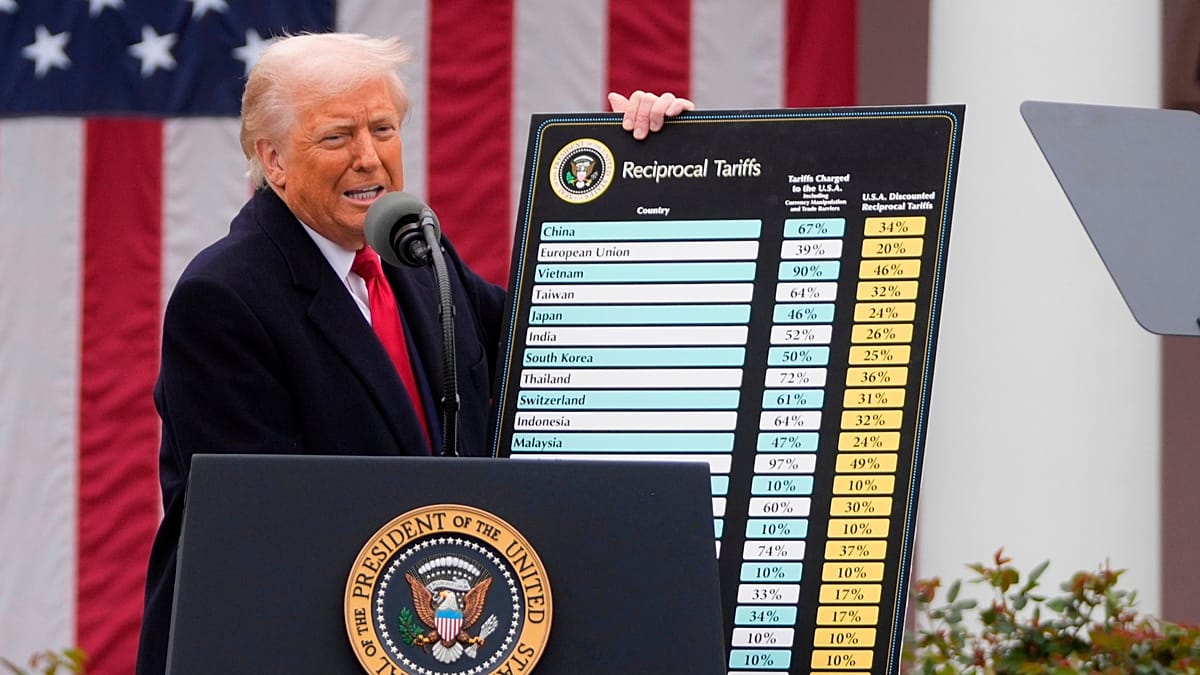
US President Donald Trump will impose new double-digit tariffs on 60 countries over claims they failed to prevent forced labour. ADVERTISEMENT ADVERTISEMENT The new duties, ranging from 10 to 12.5%, take effect Friday and will replace the global 10% tariffs Trump introduced earlier this year, which expire at 12.01AM on the same day. The levies announced on Thursday will affect dozens of US trading partners, including major economies like China, India and the European Union, accounting for 99% of its imports. "The United States has had a forced labour import ban for nearly a century, and rigorously enforces it; it's well past time for our trading partners to do the same," US Trade Representative Jamieson Greer said. Last year, Trump imposed double-digit tariffs on imports from almost every country in the world, arguing that American trade deficits amounted to a national emergency. The Supreme Court ruled in February that Trump did not have the legal authority to impose such tariffs under the 1977 International Emergency Economic Powers Act (IEEPA). As a result, the administration had to pay refunds to importers that had paid the tariffs and Trump announced 10% worldwide tariffs under Section 122 of the Trade Act of 1974 instead. However, these section levies can only remain in force for 150 days and are due to expire on Friday. The expiring 10% duties will now be replaced by the new tariffs, which are considered more resistant to legal challenges than earlier measures. The newly-announced tariffs were imposed under Section 301 of the Trade Act of 1974, which authorises the president to introduce import taxes and other sanctions on countries it deems to engage in "unjustifiable," "unreasonable" or "discriminatory" trade practices. Countries that implemented a forced labour import prohibition or committed to do so, including Canada, the EU, India and the United Kingdom, will receive a 10% rate. Other countries, such as China, Japan and South Korea, will receive a higher 12.5% rate. Some products are exempt from the levies, including oil and gas and fertiliser, as well as products covered under a North American free trade pact between the US, Mexico and Canada. The decision drew widespread criticism from impacted nations. Brazil, which is facing 12.5% tariffs, called the decision “arbitrary and unjustified," and plans to implement retaliatory tariffs on the US. Washington "chose to manipulate an issue of great importance to human rights and the struggles of workers worldwide in order to accuse 59 countries and the European Union of unfair practices," the Brazilian government said. Chile also faces a 12.5% rate. The country's Undersecretary for International Economic Relations Paula Estévez said Chile has “solid labor institutions, a robust regulatory framework and a firm commitment to the prevention and eradication of forced labour.” Human rights advocates say there are reasons to be skeptical of the motivation behind the tariffs. However, they say the levies could help curb the problem of forced labour. Forced labour is defined by the International Labor Organisation Forced Labour Convention of 1930 as “all work or service which is exacted from any person under the menace of any penalty and for which the said person has not offered himself (or herself) voluntarily.” According to UN agency, the International Labour Organisation (ILO), roughly 27.6 million people were in forced labour wolrdwide on any given day in 2021.
US imposes new tariffs on dozens of countries over 'forced labour' claims
Full Article
Original Source
Read the full article at Euronews →KhanList aggregates and links to publicly available news content. We do not host full articles from third-party sources. Always verify important information with original sources.