
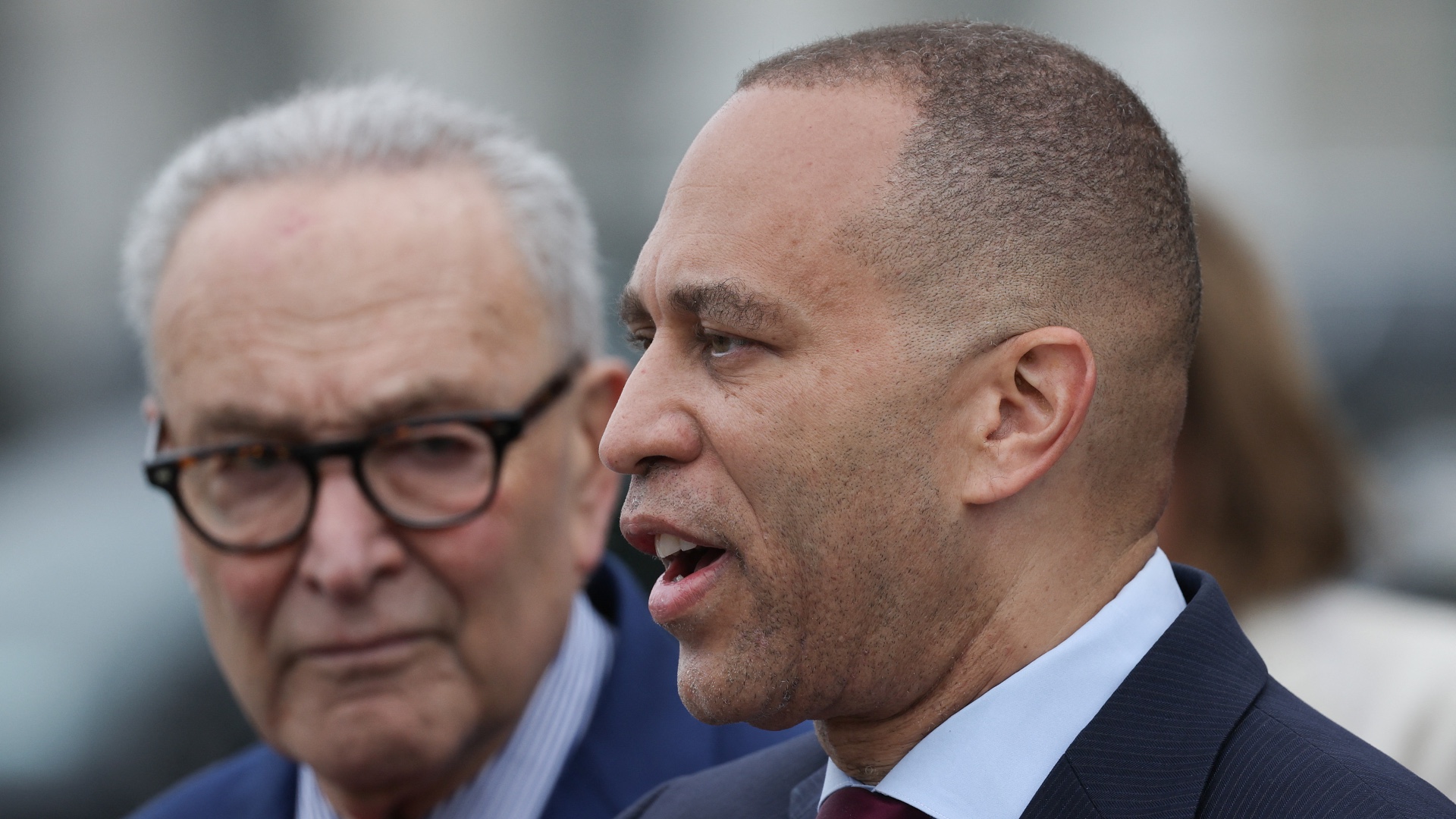
The top Democrat in the House of Representatives, Hakeem Jeffries, is all but certain to become the next Speaker of the House, despite dissatisfaction among some freshman lawmakers and their progressive colleagues in the chamber, sources have told Middle East Eye. There simply is no alternative leader in the running. "It's a cost to go against someone who will eventually be the leader of the caucus. There's not enough people who are willing to do that," one source said. This comes as many voters have expressed their desire to see Jeffries vacate the position, accusing him of being out of step with the party's growing leftist progressive wing, which wants to see money out of politics, and a stop to the transfer of weapons to Israel. New lawmakers are looking to work with him instead, three sources familiar with the internal process on Capitol Hill confirmed to MEE. New MEE newsletter: Jerusalem Dispatch Sign up to get the latest insights and analysis on Israel-Palestine, alongside Turkey Unpacked and other MEE newsletters The 56-year-old Jeffries is backed by pro-Israel lobbying groups and has made it clear he is an avowed protector of Israel. He has also received substantial financial support from a litany of big corporations, including tech and weapons manufacturers. Perhaps most importantly, his candidacy in his New York district and his leadership bid were endorsed by progressive kingmaker and New York City Mayor Zohran Mamdani - much to the chagrin of Mamdani's own supporters. Petition opposing Hakeem Jeffries as US House Speaker passes one million signatures Read More » Mamdani is largely credited with setting off a wave of young Democratic Socialists launching campaigns for office. Just before the 3 November midterm elections, Redbox Research's polling showed only 19 percent of Democratic voters want to keep Jeffries as their leader in Congress. A Change.org petition last week already had one million signatures calling for him to step aside. The Speaker of the House is second in line to the US presidency, after the vice president. Jeffries, in particular, would also become the first Black lawmaker to ever assume the role. "I would suspect most Democrats will think twice about about blocking that historic achievement - even if they have other concerns about Jeffries," Chris Edelson, a constitutional scholar and political science lecturer at the University of Massachusetts at Amherst, told MEE on Tuesday. 'Undecided' The vote, which is done through secret ballot, is set for next week. The 120th Congress will be sworn in on 3 January 2027. Speaking to reporters during their new member onboarding session this week, some of the most progressive, pro-Palestine, political novices made it clear they are willing to work with anyone who shares their goal of delivering for voters - even though they were specifically asked about whether they would back Jeffries. "This was a historic class [of new lawmakers], one that has a lot of firsts," Colorado Representative-elect Melat Kiros said. "We might have different ideas about how to accomplish certain things, but we all agree that we have to reduce costs for families. We all agree that we have to root out corruption in government. We all agree that our foreign policy has to actually reflect our values. In order for us to be able to do that, we need an agenda that's bold enough to meet that vision," she said. JD Vance blames Iran war and support for Israel for failure in US mid-term elections Read More » "And so what we're demanding is an agenda. It's not about the individual. It's about what kind of priorities, what kind of floor votes, what kind of plan do we have to actually fight." New Jersey Representative-elect Adam Hamawy maintained the group is "undecided". "We're not going to rubber stamp anything. We want to sit and have a conversation about the issues and what's the plan going forward. And I think that's what the American people elected us to do, is to have these conversations," he said. Ohio Representative-elect Don Leonard, however, posted a video on Instagram on Monday, making it clear he'd been told there would be consequences for not voting for Jeffries. "I met with... senior members of the Democratic House, who told me in no uncertain terms that the decision as to whether or not I support Jeffries, regardless of his willingness to speak with me and meet the interests of my constituents on a couple of key issues... would basically mean both making my life a living hell for the next two years here in Washington, as well as being sure to lose my election in two years," he said. Those key issues, he explained, were getting corporate money out of politics, and ending US support for Israel and its wars in the region. "The big 'D' Democratic Party needs some little 'd' democracy," Leonard added. On Tuesday, Republicans came together to declare Trump loyalist and Ohio Congressman Jim Jordan as their leader in the House for the next session, and to keep South Dakota Senator John Thune as the minority leader in the Senate. Senate tussle Indeed, ensuring that party members get in line is, in effect, the job of the leader. Building personal relationships is critical in the corridors of power, Neil Sroka, a former progressive strategist, told MEE on Tuesday. "It's not just ideological [matters] that drive decision-making behind who's a [Senate] Majority Leader and who's a Speaker of the House. There are regional concerns, there are state delegation concerns, and so the politics of it are very complicated, and I don't envy any member of Congress or a member of the US Senate who are trying to figure out how to navigate those complicated waters, and especially in an ideologically complicated result as in this election." If someone's leadership bid is potentially threatened, it could be the top Democrat in the Senate, the 75-year-old Chuck Schumer, sources told MEE. At the very least, his support base would be eroded even if he retains his post, and he would have to make room for the left-wing flank to bring their issues to the floor. He is even more unpopular among Democratic voters than Jeffries, polling at just 11 percent favourability. 'Schumer’s foreign policy record is a serious liability for his continued leadership' - Cavan Kharrazian, senior policy adviser, Demand Progress The New York senator is also backed by corporate interests and is a staunch supporter of Israel, as well as a hawk on Iran, even if he didn't like the way President Donald Trump himself carried out a seemingly endless war. "Politics matters to some extent, but it also matters who a senator is going to see in the Senate gym," Sroka explained. "That's what we recalled back from the 2018 race - even though there might have been some agita about Leader Schumer and whether or not he was really in line with the rest of the Senate, he had everyone on speed dial. Everyone knew him really well, and it was very hard to step outside of that lane." On Tuesday, anti-war activists from Code Pink, among other groups, staged a protest outside Schumer's office after being locked out by his staff, they said. They were specifically protesting against the $1.5 trillion budget requested by the Trump administration for the Department of War, which will have to go through the Senate. The bill also includes a provision that would permanently integrate US and Israeli military tech advancements in a way that would - as Israeli Prime Minister Benjamin Netanyahu put it - turn Israel from a foreign aid recipient to a full-scale partner. Only one senator with some limited backing to be speaker has emerged as a vocal advocate of such a move: Maryland Senator Chris Van Hollen. He is perhaps the Senate's most visible progressive voice on foreign policy, after Vermont Senator Bernie Sanders. Michigan Senator-elect Abdul El-Sayed has already said for months he would like to see Van Hollen elected as the top Democrat in the Senate, even though the senator had not shown interest in the position. "I have said that I am in listening mode," Van Hollen told a reporter on Capitol Hill this week. "There are clearly lots of people around the country, and a number of our members, quite a few of our members, who want to have this discussion, and so I'm in active listening mode... I haven't closed the door." Cavan Kharrazian, a senior policy adviser with the group Demand Progress, told MEE that Schumer's record comes into sharper focus now that Van Hollen has emerged as a possibility. "Van Hollen has been at the forefront in the Senate of challenging unconditional support for Israel and has made clear he will oppose funding legislation in the lame duck [session]," he said. "That puts real pressure on Schumer to take a firm stand against war funding... and explain how he can lead his caucus in the direction voters are demanding after spending so much of his career resisting it." Schumer has long been criticised as being too soft on Trump since his first term from 2016-2020, and the backlash against the current administration in the midterm elections has, if anything, shown that Democrats want fighters to represent them. “Schumer’s foreign policy record is a serious liability for his continued leadership," Kharrazian said. "The midterms underscored the need for leaders who will confront Trump’s reckless wars and forge a new foreign policy grounded in diplomacy, human rights, and people’s needs at home," Kharrazian added.
US House Democrat leader Jeffries will retain position despite opposition, sources say
Full Article
Original Source
Read the full article at Middleeasteye →KhanList aggregates and links to publicly available news content. We do not host full articles from third-party sources. Always verify important information with original sources.