
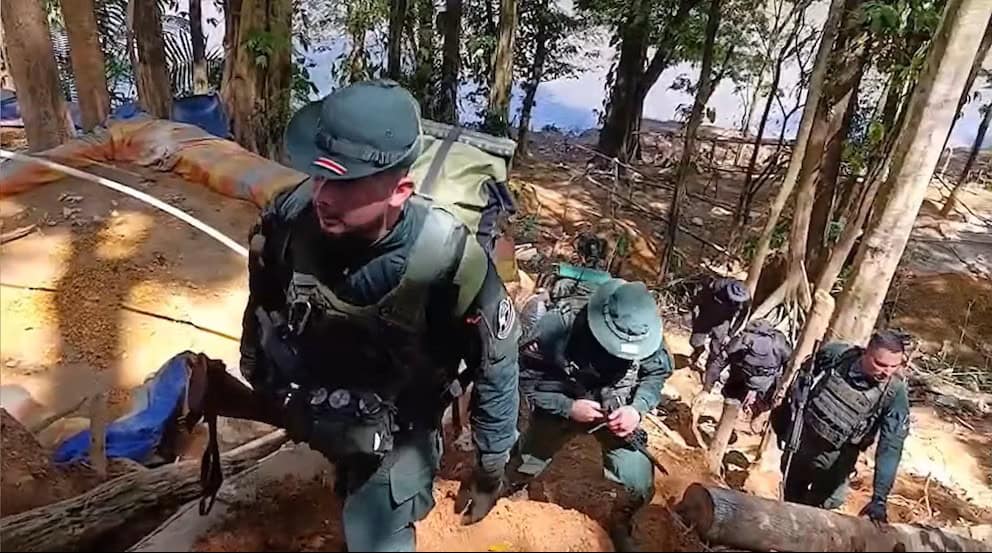
Costa Rican police have found about 2,000 sacks of sediment and 50 processing pools on Cerro Conchuditas, a hill near the Nicaraguan border, during an air and ground operation against illegal gold mining that is being supported by helicopters from a United States government aviation program. The Ministry of Public Security reported the findings on Saturday, two days after officers moved into the area in Cutris, a district of San Carlos in the northern part of Alajuela province. Officers remain on the hill to guard the sites, seize equipment and detain anyone found working them, the ministry said. Alongside the sacks and pools, police reported finding 20 makeshift shelters, six tents, seven drums, 30 jerrycans, 10 hoses, an electric generator and a water pump. They also recovered rotary hammers, shovels, wheelbarrows and gasoline. The operation brings together the Public Force, the Border Police, the Migration Police and the Intelligence and National Security Directorate (DIS). Air support comes from helicopters belonging to the US government’s Aviation Program, which works in coordination with the Air Surveillance Service (SVA), the ministry’s air wing. The ministry did not say how many aircraft are taking part or describe the role, if any, of US personnel. The SVA received four UH-1ST helicopters from the United States in 2019 under a training and maintenance program run through the State Department’s Bureau of International Narcotics and Law Enforcement Affairs. Security Minister Gerald Campos traveled to the site on Thursday to direct the deployment, joined by the heads of the Public Force and the DIS. Much of the terrain is difficult to reach on foot, which is why the ministry combined ground patrols with flights. Gerald Camacho, director general of the Border Police, said patrols along the border corridor run throughout the year and concentrate on the areas where illegal mining takes place. He described the current deployment as a special reinforcement operation carried out at this time of year. Today, police said officers had moved on to nearby Cerro Fortuna, in Crucitas, where they found several extraction points in use and detained three men. The three, who police said were in the country irregularly, were referred to the San Carlos prosecutor’s office on suspicion of illegal mining. Officers seized three sacks of sediment, carpets used to wash the material and digging tools. Ministry figures put the number of people arrested in connection with these operations at 528 so far in 2026. Of those, 239 were held over their migration status, 194 on suspicion of violating the Mining Code, 17 in drug-related cases and six under the Arms and Explosives Law. Cerro Conchuditas lies close to the San Juan River, which marks the border with Nicaragua, and has become one of the main points for extracting and processing gold-bearing material taken from the Crucitas area. The ministry has said since 2024 that organized crime is present in the zone. The environmental stakes are a central part of the dispute. Police have previously reported that sediment from the hill is processed with mercury or cyanide to separate the gold, and in May the Public Force said it had seized 50 kilograms (110 pounds) of cyanide and 115 kilograms (254 pounds) of activated carbon from a camp on the same hill, along with 25 active pools. Both substances can contaminate soil and the streams that drain toward the San Juan. Campos used the visit to call on the Legislative Assembly to approve a government bill on mining in the area. He said the legal tools now available limit what police can achieve and described the work as exhausting for officers without producing lasting results. The executive branch’s proposal, submitted in 2024, would authorize gold exploration and open-pit extraction in Cutris and remains under discussion in the legislature. The Broad Front and the National Liberation Party oppose it, arguing that reopening Crucitas to gold mining would cause environmental damage of its own. The ministry said officers will stay on Cerro Conchuditas and in Crucitas to find further processing sites and seize materials.
US Helicopters Support Costa Rica Crackdown on Illegal Gold Mining
Full Article
Original Source
Read the full article at Ticotimes →KhanList aggregates and links to publicly available news content. We do not host full articles from third-party sources. Always verify important information with original sources.