
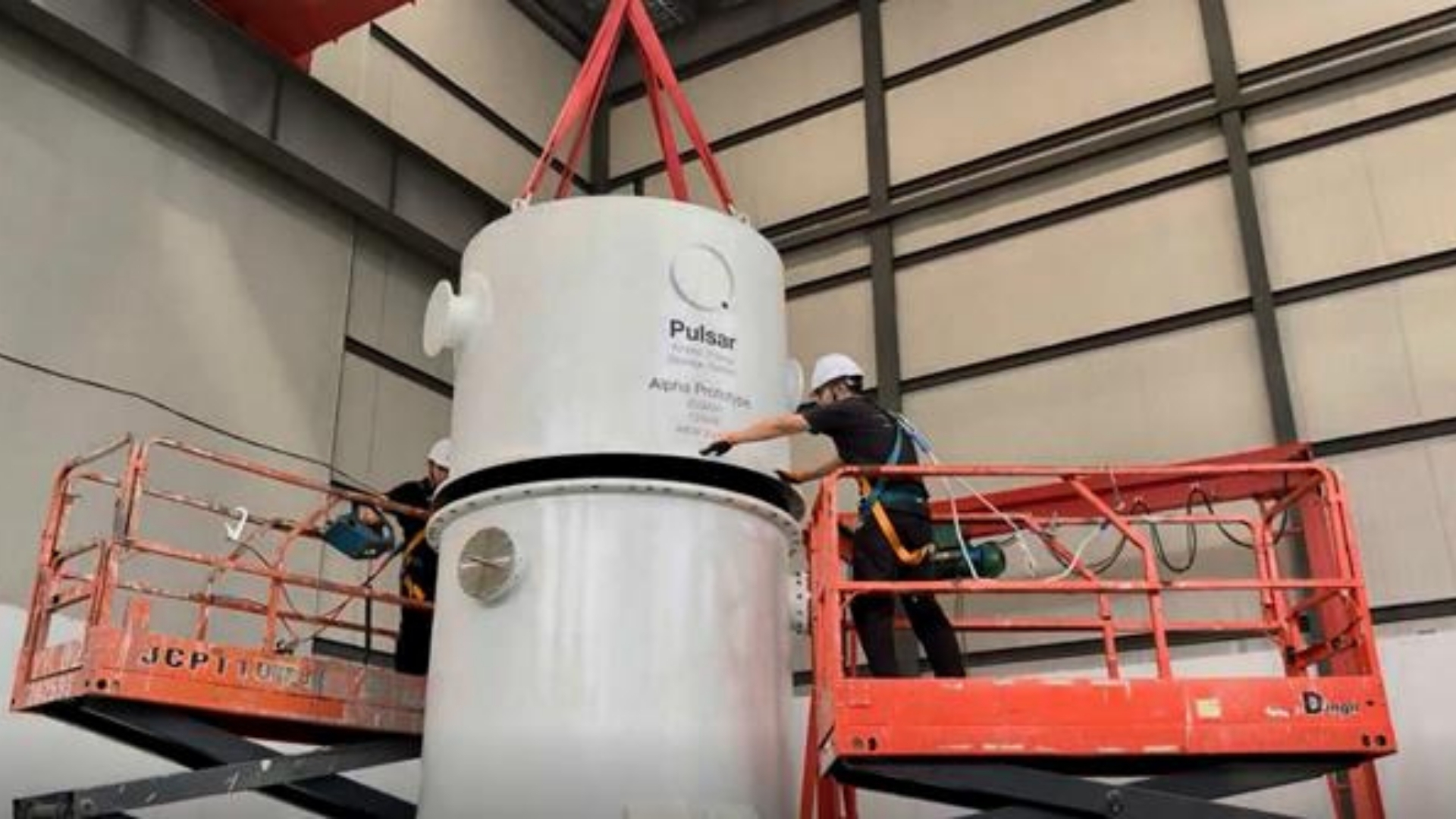
A US-developed flywheel designed to store electricity without lithium-ion batteries is heading for an independent technical assessment covering its performance, safety, reliability, and commercial readiness. New York-based Qnetic announced on August 18 that its grid-scale Pulsar flywheel system has entered the Electric Power Research Institute’s deRISKED program. Sponsored by the Sacramento Municipal Utility District (SMUD), the evaluation will combine prototype data, performance modelling, and pilot-scale testing to help utilities assess the emerging technology using independently reviewed evidence. Flywheel stores electricity mechanically Unlike batteries that store energy through chemical reactions, the Pulsar system stores electricity as mechanical energy. It uses a high-speed composite rotor suspended inside a vacuum enclosure. Electricity supplied to the system accelerates the rotor, retaining energy through its rotation. When electricity is required, the stored mechanical energy can be converted back into electrical power. Qnetic says the technology is designed to operate for decades with minimal performance degradation. The company also claims that it can provide virtually unlimited cycling, rapid response times, and predictable lifetime economics compared with conventional battery systems. However, these characteristics will now be examined through EPRI’s established evaluation process rather than being assessed solely through information supplied by the developer. Qnetic is developing Pulsar for several grid-scale applications, including renewable energy integration, grid balancing, microgrids, industrial sites, and energy-intensive data centers. The system is intended to serve markets requiring long-duration energy storage and frequent charging and discharging. Pilot data to undergo independent assessment Qnetic will submit its prototype testing records and a complete set of pilot-system performance data to EPRI. The material will be used alongside standardized testing, technical assessment, and performance modelling. The deRISKED program, whose name stands for Readiness Informed by Shared Knowhow, Evaluation, and Data, was established to assess pre-commercial energy-storage technologies consistently. Its process combines laboratory tests, field demonstrations, and data analysis. “Utilities need objective evidence when evaluating emerging energy storage technologies. Independent validation has become just as important as technical innovation,” said Michael Pratt, CEO of Qnetic. “By participating in EPRI’s deRISKED program and sharing extensive prototype and pilot data, we’re giving utilities the transparency they need to evaluate our technology on its technical merits and better understand where flywheel energy storage delivers the greatest value,” he added. The evaluation is intended to give utilities technical information that can be considered separately from vendor claims when examining possible storage deployments. EPRI’s program evaluates the performance, functionality, safety, and reliability of emerging storage systems as they move towards commercialization. Its findings are intended to reduce uncertainty for utilities considering technologies that have not yet reached broad commercial deployment. “Independent technology evaluations using consistent analysis methodologies help energy storage stakeholders to objectively contextualize the landscape of pre-commercial energy storage technologies,” said Taylor Kelly, principal technical leader at EPRI. “The deRISKED program supports our participants by sharing information that helps informed decision-making as emerging energy storage technologies move toward commercialization,” he added. The resulting findings will be presented to utilities participating in the deRISKED program. Get the latest in engineering, tech, space & science - delivered daily to your inbox.Atharva is a full-time content writer with a post-graduate degree in media & amp; entertainment and a graduate degree in electronics & telecommunications. He has written in the sports and technology domains respectively. In his leisure time, Atharva loves learning about digital marketing and watching soccer matches. His main goal behind joining Interesting Engineering is to learn more about how the recent technological advancements are helping human beings on both societal and individual levels in their daily lives.
US explores long duration flywheel energy storage for data centers and power grids
Full Article
Original Source
Read the full article at Interestingengineering →KhanList aggregates and links to publicly available news content. We do not host full articles from third-party sources. Always verify important information with original sources.