
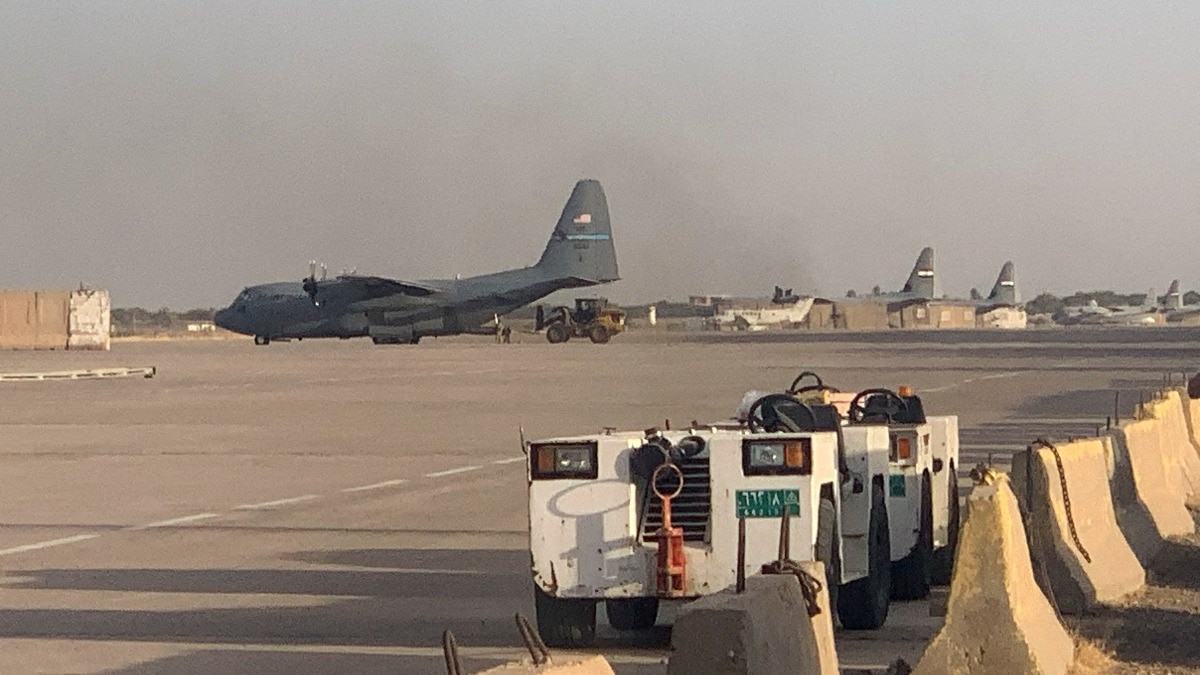
US forces are leaving their remaining bases in Iraq on Wednesday, ending a military presence that began in 2003. The withdrawal has sharpened concerns over a security vacuum, stronger Iran-backed militias and an Islamic State regrouping.A US military transport aircraft stands at Camp Victory near Baghdad International Airport. US forces are set to withdraw from their last bases in Iraq by September 30, ending more than two decades of military presence in the country. (Reuters)US forces are set to leave their remaining bases in Iraq on Wednesday, ending a military presence that began with the 2003 invasion and lasted more than two decades. The withdrawal is raising concerns in Baghdad that it could create a security vacuum, strengthen Iran-backed militias and give the Islamic State group an opportunity to rebuild.The pull-out was agreed in 2024 under then-President Joe Biden and is being completed by President Donald Trump's administration even as Washington is engaged in a war with Iran, which maintains significant influence in Iraq through allied armed groups.The departure comes 23 years after US-led forces toppled Saddam Hussein, an intervention that was followed by years of insurgency and sectarian violence and eventually the rise of Islamic State.The withdrawal is broadly welcomed by Iraqis, but some security officials and analysts remain concerned about whether Iraqi forces can independently handle threats after years of relying on US support. Around 4,500 American troops died during more than two decades of war in Iraq, Reuters reported."The lesson from the past two decades is that security vacuums can be extremely dangerous," Iraqi analyst Jassim al-Bahadli, who advises security forces, told Reuters.FROM SADDAM'S FALL TO ISLAMIC STATE US forces invaded Iraq in 2003, overthrew Saddam Hussein and helped establish a new government dominated by Shi'ite political forces.American troops subsequently fought a prolonged insurgency involving Saddam loyalists and al-Qaeda-linked militants before withdrawing at the end of 2011.The US returned to Iraq less than three years later after Islamic State seized large parts of the country and declared a self-styled caliphate. American forces supported Iraqi troops in a campaign that ultimately drove the militant group from its territorial strongholds between 2014 and 2017.Around twice as many US service members died in the Iraq war, formally known as Operation Iraqi Freedom, as in the parallel US war in Afghanistan, according to Reuters.Seven of the 18 US service members killed during this year's conflict with Iran were in Iraq. The most recent was an Army sergeant who died in July during the controlled detonation of a drone at a base near Erbil.IRAN AND ITS ALLIES SEE US EXIT AS VICTORYIran has long called for American forces to leave the Middle East and has portrayed the US withdrawal from Iraq as a victory for its network of allied armed groups, known as the "axis of resistance".The departure could also increase the influence of Iranian-backed militias inside Iraq, analysts said."What is further concerning is not necessarily direct Iranian intervention, but the possibility that Iran's proxies will feel increasingly empowered in the absence of a Western military presence," Baghdad-based political analyst Ahmed Younis told Reuters.He said such groups could seek to expand their influence over state policy and strengthen their position inside key institutions.Iran's influence in Iraq has grown through political and armed groups that maintain close ties with Tehran, although Iraq's government has also sought to maintain relations with both Iran and the United States.FEARS ISLAMIC STATE COULD REGROUPIraqi security officials in Baghdad and the semi-autonomous Kurdistan region have raised another concern: the withdrawal could give Islamic State sleeper cells more room to operate.The group lost the last remnants of its territorial control in Iraq nearly a decade ago, but its fighters have continued to operate through clandestine networks.At its peak, Islamic State controlled roughly one-third of Iraq and carried out mass killings. Hundreds of people were also killed inside a former US military base in an attack recorded and released by the militants.US forces have continued to provide Iraqi security forces with intelligence on Islamic State movements, as well as aerial surveillance and reconnaissance.Retired Iraqi Army General Mohammed al-Jubouri, who commanded a brigade during the campaign against Islamic State, said the country's security institutions now face a critical test."The most important question now is whether Iraq's security institutions have prepared a viable Plan B for the post-coalition phase," al-Jubouri told Reuters.He warned that a particularly serious scenario would be Islamic State gaining access to armed drones or improvised explosive drones while Iraq remains short of effective air-defence capabilities.The US withdrawal therefore marks the end of a major chapter in Iraq's post-Saddam history, but questions remain over how Baghdad will manage the competing threats posed by Islamic State, Iran-backed armed groups and the wider regional conflict without the same level of American military support.- EndsWith inputs from Reuters
US exits Iraq as Iran-backed groups gain, Islamic State threat returns
Full Article
Original Source
Read the full article at Indiatoday →KhanList aggregates and links to publicly available news content. We do not host full articles from third-party sources. Always verify important information with original sources.