
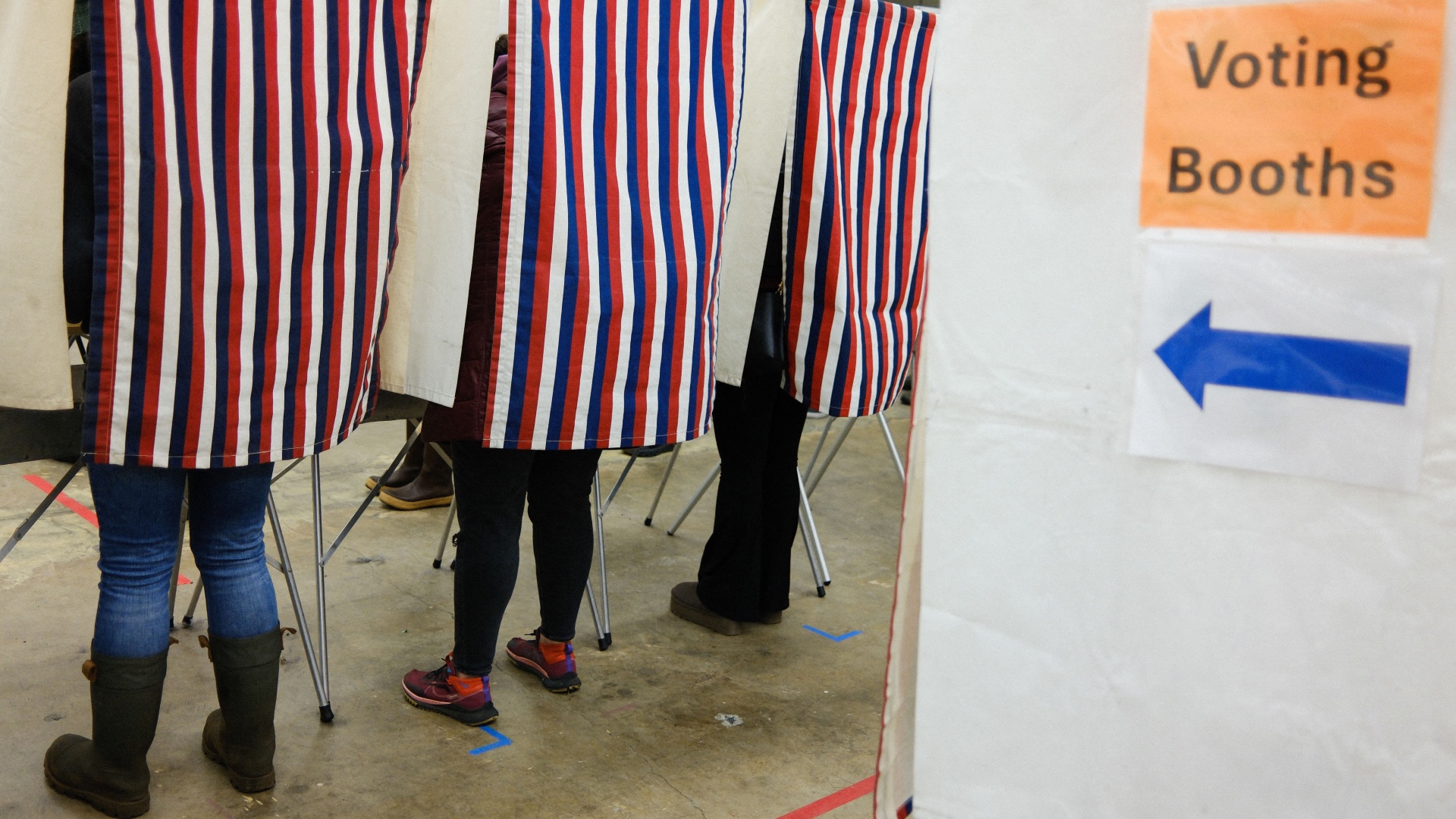
American voters are fed up, as almost every conversation with them will demonstrate, regardless of party affiliation. In the lead-up to the 3 November midterm elections, early voting has seen an unprecedented turnout of 56 million Americans, a stunning figure considering non-presidential election years have traditionally had low turnout rates. President Donald Trump's approval rating is lower than that of his last three predecessors when their first midterm election season rolled around, including his own first term in office. If both the polling and the predictions of Republican analysts are anything to go by, Democrats will not only retake the House after Tuesday's midterm elections, but also take the powerful Senate, and boast the most governors across the 50 states. But there may be little change in actual legislation, and a lot more change in narrative and framing in the US legislature. New MEE newsletter: Jerusalem Dispatch Sign up to get the latest insights and analysis on Israel-Palestine, alongside Turkey Unpacked and other MEE newsletters Rina Shah, a former Republican congressional adviser, told Middle East Eye that in the Senate, the workable strategy will be refusal - not reversal - of administration policy. For example, as Trump and his party try to appoint conservative judges to federal courts, liberal senators could block them. Federal judges have been crucial to the release of several critics of Israel from immigration detention, after Secretary of State Marco Rubio cancelled their visas and US Green Cards. "The Senate majority controls the calendar, committee gavels, and confirmations. That means it can slow-walk or block ambassadors and national security nominees, hold oversight hearings with subpoena power, and use appropriations and the National Defense Authorisation Act to put conditions on things like arms sales, troop deployments, and war powers," she said. But Trump will almost certainly veto any bills that he doesn't agree with. "That's partly the point," Shah said. "Even a vetoed bill forces Republicans to go on the record and frames the 2028 debate. The real teeth are in must-pass bills like government funding and defence authorisation, which he can't easily veto without owning a [government] shutdown or a lapse in defence funding." What power looks like But Trump hasn't been afraid to allow for the government to shut down, as he dukes it out with Democratic lawmakers. He has done it twice. To make a real dent in the Senate that can overcome a presidential veto, as well as account for a couple of defections from their party on certain issues - and even convict a US president or members of his cabinet in an impeachment trial - Democrats will need to secure at least 60 seats, which is not going to happen this cycle. That means there will still need to be some heavy negotiating - and compromising - to try to bring the opposition on side. US elections: Races to watch in the 2026 midterms Read More » "It's going to be a matter of how they frame issues and what questions they put to the [Senate], as to whether or not they can convince Republicans to come on board with any particular measure," Jennifer Hendrixson White, a former House Foreign Affairs Committee staffer, told MEE. She is now a visiting scholar in the American Statecraft programme at the Carnegie Endowment for International Peace. "Whereas Republicans may have been less likely to challenge the president in the early part of his term, perhaps there will be a little more willingness to do so" now, given their terms will outlast Trump's remaining time in office, Hendrixson White explained. "Additionally, if Congress really focuses on addressing and reclaiming some of their traditional Article One responsibilities, and they frame the questions before the Senate in those types of terms, they may be able to convince Republicans to support those measures." Article One of the US Constitution lays out the design and responsibilities of US lawmakers as a check and balance on the powers of the president. In the Senate, Democrats will need to hold onto all 47 of their current seats and also flip four Republican seats to win. Texas, Maine, North Carolina, and Alaska are likely to fill those slots, with Iowa and Ohio also hotly contested. There is near-universal agreement that Democrats will gain control of the lower chamber of Congress, which is the House of Representatives. The upper chamber, however, is where the heavyweights sit, because senators have six-year terms that untether them from the four-year presidency or a two-year House term. YouGov's survey on the Senate races on Monday shows many are neck and neck, but that Democrats have the advantage. On Polymarket, nearly 75 percent of those putting money on control of the Senate predict a Democratic sweep of both chambers. On ABC News on Sunday, former New Jersey Governor Chris Christie and former House Speaker Kevin McCarthy - both Republicans - said they expect the same. Christie also predicted a final outcome of 27 Democratic governors out of 36 states that have gubernatorial elections. There has been consensus from voters across the political spectrum that prices are too high, and that the Trump administration's agenda is overly aggressive, owing to violent encounters with immigration agents on the streets, and a joint war with Israel on Iran that has, by all accounts, continued into its ninth month with no end in sight. Trump very specifically pledged affordability, safety, and an end to all wars in his 2024 campaign. The Israel problem On some questions that have become important to voters across the political spectrum - like the necessity of an unconditional US-Israel relationship - change will take time, but it will begin with open discussion on the Senate floor. 'There will be a push to conditionalise military aid to Israel' - David McCuan, professor at Sonoma State University "There will be a push to conditionalise military aid to Israel. That's much more of a 'hot potato'" than trying to sanction the war on Iran, for example, David McCuan, a political science professor at Sonoma State University, told MEE. "But if you see some elements of the Democratic left feeling emboldened, whether that's [Abdul] El-Sayed winning in Michigan, coupled with Bernie [Sanders], all of a sudden you have a few votes where you can get over a hurdle to at least have the debate." Israel's current unfavourability in the US, particularly among liberal youth, "cannot be ignored or punted", Wajahat Ali, a Daily Beast columnist and author of the book Go Back to Where You Came From, told MEE. "This will be a litmus test issue. I've been saying it for two years. Any Democrat that thinks they have national aspirations and they could still be a pro-Israel hawk is sorely mistaken," he said. "Democratic leaders and donors have to make a decision. Do we go scorched earth and burn everything down for Israel, or do we evolve and reform and meet the moment and the people?" Revenge or move forward? Since the Hamas-led attacks on southern Israel on 7 October 2023, and the subsequent Israeli assault on Gaza that the United Nations and Holocaust scholars have called a genocide, positive views of Israel have sunk to an all-time low in the US. "This administration has been relatively less susceptible to political pressure than previous administrations might have been demonstrated to be," Hendrixson White told MEE. "I would like to believe that Congress will absolutely be clever and creative in the way that they're framing debates, and that they're able to generate a degree of consensus on the most important matters," she said. "Where I think there's a risk is if Congress does what's easy: The non-binding political statements. You end up spending a lot of legislative time on issues that ultimately don't force the president's hand... How much time is going to be put into anti-corruption and investigation-type efforts?" That's where Democrats will also be under tremendous pressure. 'Despicable betrayal': Haley Stevens endorses Republican candidate over party nominee Abdul El-Sayed Read More » Critics of the president have been demanding investigations into his financial dealings at home and abroad, such as his acceptance of a plane as a gift from Qatar; his connection to the convicted child sex trafficker Jeffrey Epstein; and how Trump's son-in-law Jared Kushner's voluntary role as a peace negotiator for the administration has benefited him personally. Trump, his family, and his cabinet deny any wrongdoing. McCuan, who frequently explains US election outcomes and implications to foreign diplomats, said a Democrat-controlled Senate will likely be forward-facing rather than focused on accountability for the past. "There's two ways of thinking about midterms. You can think about midterms as referendums or as backlash. Most of the data in political science, most of the quality studies, are that midterms are a backlash," he said. This "means Democrats need a counter-programme on Capitol Hill, principally within the Senate, that advances an agenda that's important for 2028". Given how the US political calendar works, candidates who want to run for president have to start their exploratory committees now so they can gauge support levels, fundraise, and hire staff. "The 2028 election starts on November 4th, and so that means you have to meet voters on issues of affordability, on gas prices, on diesel, on what's happening with groceries," McCuan told MEE. "It's less about investigations and impeachment. Not an absence of those things, but much less about those things, and much more about an agenda that meets voters where they're at and concerns over their pocketbooks." Ali called such a move "a major fear". "I do not have faith in the current leadership of the Democratic Party," he told MEE. "I'm not talking about all Democrats, and I say that based on their own actions and rhetoric. I do not believe that [top Senate Democrat Chuck] Schumer and [top House Democrat Hakeem] Jeffries are made for this moment or built for this fight. They spend their time attacking Medicare-For-All, attacking Democratic Socialists, taking money from Aipac, punching to the left, having secret meetings with Jared Kushner," he said. "If they do win on Tuesday night, they are sorely mistaken if they believe this is a realignment of America towards Democrats. Oh no. This is a realignment from MAGA, and a rental. This is a very brief rental." The 120th Congress will be sworn in on 3 January 2027.
US elections 2026: Can a Democrat-controlled Senate thwart Trump's agenda?
Full Article
Original Source
Read the full article at Middleeasteye →KhanList aggregates and links to publicly available news content. We do not host full articles from third-party sources. Always verify important information with original sources.