
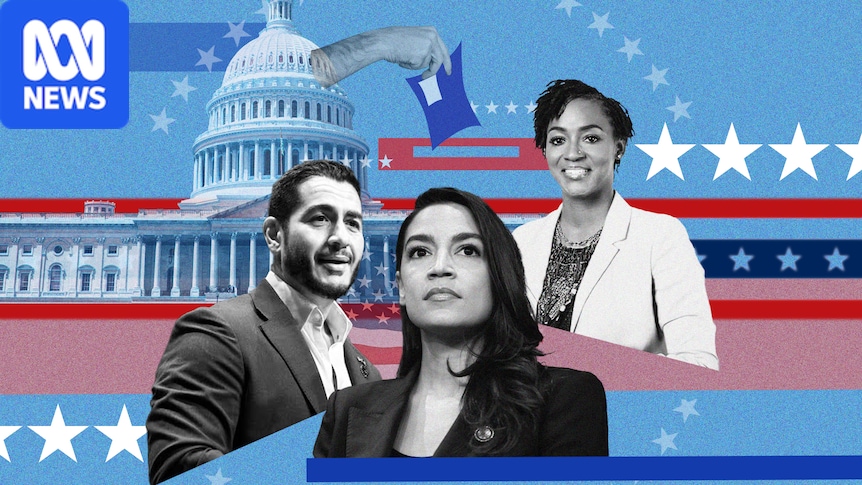
When Hillary Clinton went toe-to-toe with Bernie Sanders in 2016, she walked away with "a new appreciation for the galvanising power of big, simple ideas".Now, it seems more Democrats are learning that lesson.In the lead-up to the midterm, the US wrapped up its primary elections, in which several career politicians across the country were ousted from their offices by insurgent newcomers whose campaigns prioritised economic equality and expanded healthcare and housing access. Once again, the Democratic Party finds itself vying with a decades-old question: is America ready for a hard left turn?Feeling the BernMr Sanders ran for president in 2016 and 2020. Both times he fell short in his party's primaries. The problem, he said, came down to "electability" — the perceived ability of a candidate to win a general election. He acknowledged many Democratic voters believed his party rival, Joe Biden, had a better chance of going on to beat Donald Trump, amid frequent speculation that Mr Sanders's democratic socialist policy positions would alienate moderate voters who might otherwise support the party.It was that same perception he failed to outrun in 2016.Still, Mr Sanders left a mark, with supporters saying the campaigns kickstarted a progressive movement. "A society grows great when old men plant trees whose shade they know they shall never sit in," captions read alongside photos of Mr Sanders with Zohran Mamdani, after the progressive surged to victory in New York City's mayoral race last year.Bernie Sanders heavily backed Zohran Mamdani's historic mayoral campaign. (Reuters: Eduardo Munoz)When progressive firebrand Alexandria Ocasio-Cortez (often called AOC) defeated long-term incumbent Democrat Joe Crowley in New York's 14th Congressional District just two years later, her win was at least partly attributed to the momentum of a movement Mr Sanders started.But Ms Ocasio-Cortez was seen as an exception when many other progressives had failed to get a foot in the door.A decade on, Mr Sanders's legacy is growing.Progressives have found increasing success with Democratic voters, running campaigns on taxing the rich, cutting military spending, and pushing for government-funded programs such as universal health care. Speculation is rising over Ms Ocasio-Cortez mounting her own presidential campaign, and progressives have racked up a string of wins over establishment Democrats in primary elections.In November, there will be dozens of candidates endorsed by at least one progressive organisation vying for seats in the House and Senate, a marked increase compared with recent years.Michigan and Maine's Senate races (involving Abdul El-Sayed and Troy Jackson respectively) are among the races tipped to be key opportunities for the progressive movement. Elsewhere, several races will feature outsiders who successfully pushed incumbent Democrats out of their seats during the primaries. Headlines have described the trend as a "progressive wave", but Bruce Wolpe, a senior fellow at the United States Studies Centre, preferred the softer description of a "current". "Where most of these candidates are winning is in deep blue Democratic states and cities," he said."Those who have won have generally won against older incumbents who are seen as not being active enough in taking down Trump." He pointed to House races in Colorado, where Melat Kiros defeated 30-year representative Diana DeGette, and New York state. While the number of progressive candidates on the ballot has increased, analysts for Washington-based think tank Brookings Institution found mainstream Democrats were still far more likely to win competitive primary races. "This outcome was to be expected in competitive races, since voters tend to be more sensitive to electability there than in safe districts," Elaine Kamarck and Jordan Muchnick wrote for the research paper, Electability over ideology: Takeaways from the 2026 primaries.Why now?The wins come as Democratic voters increasingly consider themselves "liberal" and seek a similar shift in their party's candidates.A Reuters/Ipsos poll of 4,505 people released in early August showed the proportion of self-identified liberal Democrats had risen to 71 per cent from 55 per cent in 2012, while the share of those who considered themselves "conservative" had dwindled from 33 per cent to 16 per cent.In the same survey, more than seven in 10 liberal Democrats said it was "essential" for the party's candidates to support increasing taxes on corporations and billionaires, and universal government health care.Voters are fed up with the status quo, according to Mr Sanders."What we are seeing is that people are sick and tired of establishment politics and establishment policies," he told The Associated Press in light of the progressive victories at the primaries.Supporters of the progressive movement say establishment leaders have for too long been weak on, or overlooked, the day-to-day struggles of everyday Americans."It's impatience with this political system that feels disconnected from the urgency voters feel," national Democratic strategist Lis Smith told the Associated Press.Many progressive challengers tapped that discontentment directly during their primary races."If leaders in our party don't recognise that we need to make changes, then the changes are going to come from the ground up," Luke Bronin, a former mayor who defeated 14-term Connecticut representative John Larson, said in his victory speech on August 11.But are they electable?Even as the Democratic Party base moves further left, establishment members remain concerned that progressive candidates will undermine chances to win at the midterms.John Cowan, the president of moderate Democratic think tank Third Way, said in March the party's drift left had "badly tainted" the Democratic brand, and the party was increasingly seen as "extreme"."Democrats running in red and purple places must define themselves as moderates and normies," he said.That's a theory many voters subscribe to, as well. Despite the progressive push, several hopefuls still failed to advance past the primaries, including democratic socialist Francesca Hong, who ran for governor in Wisconsin. Voter Sarah Atkins Hoggatt, 61, said she agreed with Ms Hong on some issues, but told the Associated Press she was concerned the candidate's deeply progressive politics would make it harder for her to defeat Republican Tom Tiffany. She voted for a more moderate Democrat instead, but admitted she "didn't vote [her] heart". Democrats are divided over how to attract more moderate voters. (Reuters: Erica Dischino)Experts say that's what makes the nomination of several progressives in battleground states and districts, such as Mr El-Sayed in Michigan and Angie Nixon in Florida, all the more remarkable. "An El-Sayed win would be seen as a green light for the most progressive wing of the party to aggressively go after nominations in swing states and districts, not just in safely blue ones," pollster and analyst Charlie Cook wrote. "But El-Sayed coming up short even in a great year for Democrats would send the message to be careful."Mr Wolpe agreed the question of electability could ultimately be answered next week. "The progressives will be seen as more powerful when they can win moderate states in important elections," he said.
US Democrats forced to face left-wing momentum as midterms loom
Full Article
Original Source
Read the full article at Abc →KhanList aggregates and links to publicly available news content. We do not host full articles from third-party sources. Always verify important information with original sources.