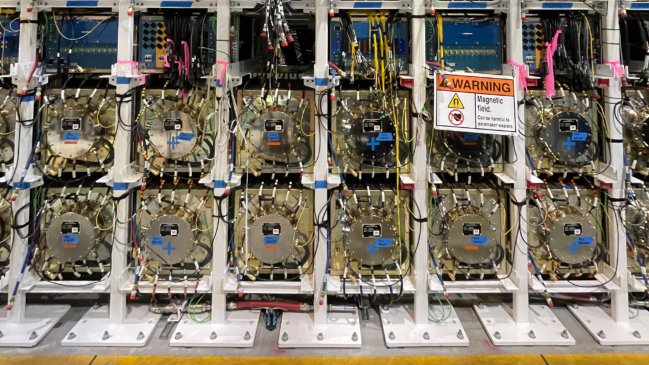
The Lawrence Livermore National Laboratory has delivered the first 220 line-replaceable units (LRUs) for the Integrated Test Stand at Nevada National Security Sites, along with the first 100 units planned for the underground Principal Underground Laboratory for Subcritical Experimentation (PULSE) facility. The deliveries represent a major milestone for Scorpius, a next-gen US accelerator designed to support advanced nuclear research and improve scientists’ ability to study subcritical experiments. The newly delivered hardware will enable full-scale system testing at the Integrated Test Stand before the accelerator is installed and commissioned underground, marking the completion of the first production sets of LRUs and moving the multi-laboratory Scorpius programme closer to its integrated testing phase. Scorpius moves US nuclear science into a new era of precision imaging Developed by a team of US national laboratories, Scorpius is designed to expand the capabilities used in the country’s nuclear stockpile stewardship and modernization efforts. The more than 330-foot-long linear-induction accelerator will capture multiple, precisely timed X-ray images of subcritical plutonium experiments, allowing scientists to better understand how materials behave during the final stages of a nuclear implosion. The accelerator relies on line-replaceable units (LRUs) to generate short, high-energy pulses that power the electron beam used to create X-rays. Built on LLNL’s solid-state pulsed-power technology, the system offers greater control over the timing, length and shape of accelerator pulses than previous designs. The modular LRUs can also be quickly replaced or upgraded when needed, helping improve the accelerator’s flexibility, reliability and long-term maintenance. When completed at the PULSE facility, Scorpius will consist of nearly 1,000 line-replaceable units (LRUs). The first 220 delivered units will support the Integrated Test Stand (ITS), where engineers will assemble and test key parts of the accelerator before underground installation. The testing phase will focus on validating the injector, a major subsystem developed by Sandia National Laboratories, along with the first two accelerator modules. These tests will help confirm system performance and identify any issues before the full Scorpius accelerator is completed underground. After years of design, prototyping, production-line development and quality testing with suppliers, Scorpius reached another milestone with the completion of its first major hardware deliveries. The first 220 line-replaceable units (LRUs) were delivered in September 2025, followed by an additional 100 LRUs in January 2026. Hardware undergoes extensive testing before moving underground Ensuring the reliability of every line-replaceable unit (LRU) has been a key focus throughout the Scorpius project. Engineers worked closely with suppliers, regularly visiting production sites to monitor manufacturing processes, maintain quality standards and resolve issues during development. Each LRU undergoes functional testing and mechanical inspections to confirm that all components meet strict performance requirements. The quality-control process has been continuously improved through feedback from assembly teams and technical specialists, helping ensure the accelerator’s systems are ready for integrated testing. Scorpius reached the milestone through close coordination between procurement teams, engineers and suppliers, including many small businesses. Together, they managed the production and delivery of millions of components while keeping the programme on schedule. The procurement team has now awarded the final line-replaceable unit (LRU) contract, with production continuing into early 2027.Furthermore, Livermore engineers supported the production process by sharing expertise from earlier prototype builds and helping vendors resolve challenges during assembly and testing. Their involvement helped ensure the LRUs met performance requirements while reflecting years of collaboration and refinement.Recommended ArticlesGet the latest in engineering, tech, space & science - delivered daily to your inbox.Bojan Stojkovski is a freelance journalist based in Skopje, North Macedonia, covering foreign policy and technology for more than a decade. His work has appeared in Foreign Policy, ZDNet, and Nature.
US delivers key hardware for one of its most advanced accelerator projects
Full Article
Original Source
Read the full article at Interestingengineering →KhanList aggregates and links to publicly available news content. We do not host full articles from third-party sources. Always verify important information with original sources.