
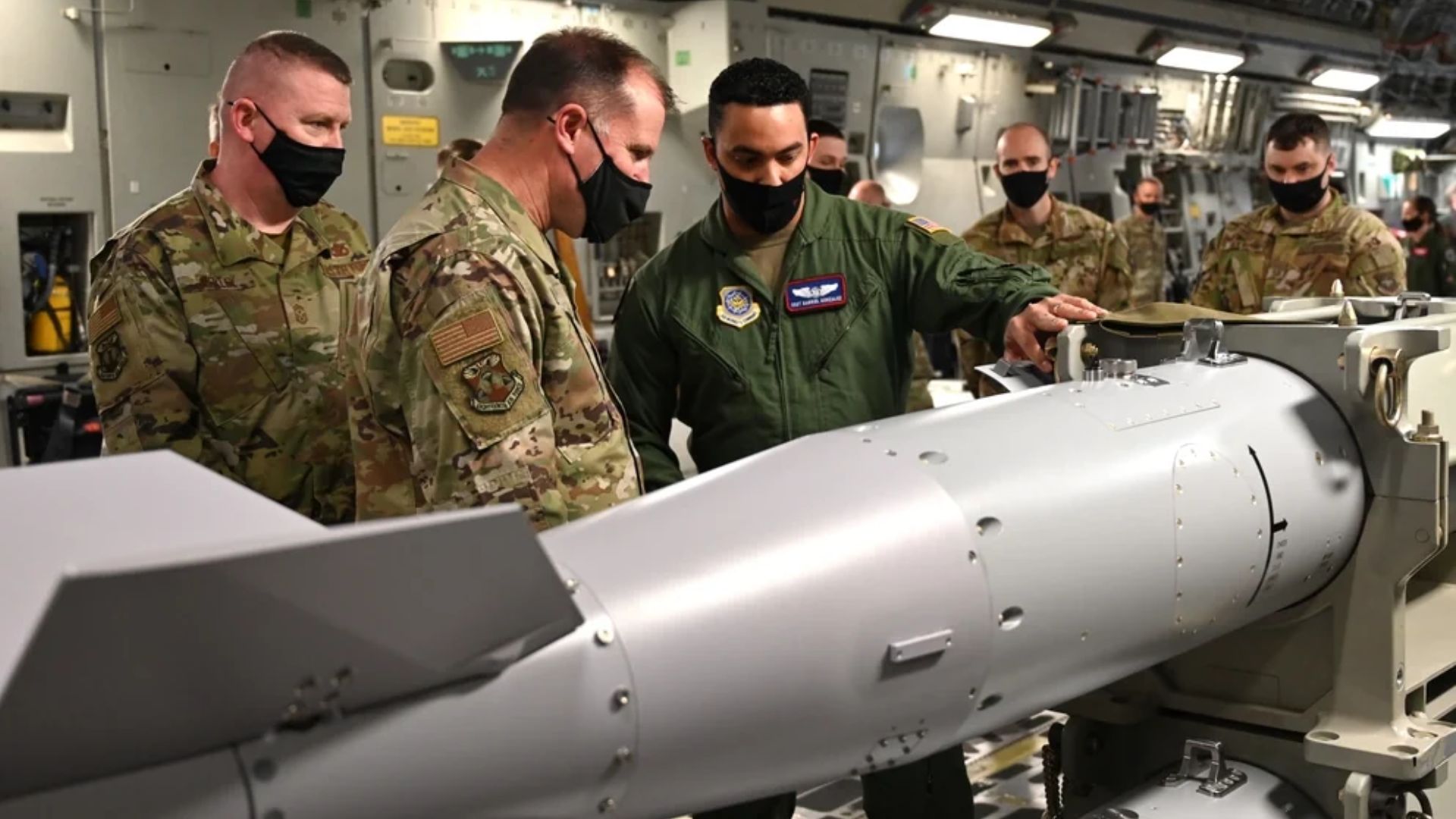
Key TakeawaysA Senate Appropriations Committee draft bill for fiscal year 2027 recommends $77.108 million for a newly designated B94 nuclear gravity bomb, the first new U.S. aerial bomb designation since 1991.The budget filing includes no technical description of the weapon, though nuclear policy analysts suspect B94 may be the formal designation for the air-delivered NDS-A nuclear bunker-buster program.Funding for the B94 remains a draft committee recommendation that must still pass the full Senate, be reconciled with the House, and receive Presidential approval before taking effect. A previously undisclosed U.S. nuclear bomb designation, labeled B94, has surfaced in federal budget documentation for the first time in more than three decades. Recommended for $77.108 million in initial fiscal year 2027 funding, the single line item represents the first entirely new designation for an American air-dropped nuclear gravity bomb since the end of the Cold War. Under the Department of Defense and Department of Energy alphanumeric naming system, a “B” prefix denotes an aerial gravity bomb delivered by aircraft, whereas a “W” prefix identifies a warhead mounted on a missile, torpedo, or artillery shell. While the United States has continuously upgraded existing weapons, such as the B61-12 and the recently completed B61-13, those efforts retained legacy family numbers. The last completely new bomb designation was the B90 nuclear depth and strike bomb, which was canceled in September 1991 during post-Cold War arms reductions. What the Senate budget filing reveals The B94 entry appeared on page 143 of the 179-page explanatory statement accompanying the Senate Appropriations Committee’s fiscal year 2027 Energy and Water Development appropriations bill, released on November 12, 2026. Listed under the National Nuclear Security Administration’s (NNSA) Stockpile Modernization account, the table recommends $77.108 million for the B94 against a blank column for fiscal year 2026, confirming it as a newly funded line item. First flagged publicly by nonproliferation researchers, including Eliana Johns of the Federation of American Scientists and Jeffrey Lewis of Stanford University, the filing contains no accompanying narrative explaining the weapon’s design, yield, delivery aircraft, or deployment timeline. In the same budget table, funding for the legacy B61 Life Extension Program drops to zero, while the newer B61-13 variant is slated for $46.428 million. Because the Senate draft still requires full chamber approval, reconciliation with the House of Representatives, and presidential signature, the $77.108 million figure remains a committee recommendation rather than enacted funding. Potential links to a new nuclear bunker buster Although neither the Senate committee nor the NNSA has officially defined what weapon carries the B94 label, nuclear policy analysts point toward the Nuclear Deterrent System–Air-delivered (NDS-A). In development since at least 2022, the NDS-A is the only new air-dropped nuclear munition publicly acknowledged in the U.S. modernization pipeline. Earlier in 2026, the Department of Energy requested roughly $100 million to advance the program, which the NNSA said is intended to give additional options against “hard and deeply buried targets.” The U.S. stockpile currently relies on two aging gravity bombs for fortified underground facilities. The earth-penetrating B61-11, which has an estimated maximum yield between 340 and 400 kilotons, and the megaton-class B83-1. While the newer B61-13 adds precision tail-kit guidance to a higher-yield B61 physics package, it lacks the hardened casing required for deep earth penetration. Analysts suggest the B94 could formalize the NDS-A program as a dedicated successor to the B61-11, the B83-1, or both, though officials have not ruled out a separate, unannounced gravity bomb. Broader nuclear modernization push If enacted, the B94 effort will join an expansive overhaul of the entire U.S. nuclear triad. Alongside air-dropped gravity bombs designed for stealth platforms like the B-2 Spirit and upcoming B-21 Raider, the NNSA and Pentagon are simultaneously developing the W93 submarine-launched warhead, the LGM-35A Sentinel intercontinental ballistic missile, new nuclear-armed cruise missiles, and the Columbia-class ballistic missile submarine fleet. Get the latest in engineering, tech, space & science - delivered daily to your inbox.Kaif Shaikh is a journalist and writer passionate about turning complex information into clear, impactful stories. His writing covers technology, sustainability, geopolitics, and occasionally fiction. A graduate in Journalism and Mass Communication, his work has appeared in the Times of India and beyond. After a near-fatal experience, Kaif began seeing both stories and silences differently. Outside work, he juggles far too many projects and passions, but always makes time to read, reflect, and hold onto the thread of wonder.
US could get first new nuclear gravity bomb since Cold War soon, Senate draft budget suggests
Full Article
Original Source
Read the full article at Interestingengineering →KhanList aggregates and links to publicly available news content. We do not host full articles from third-party sources. Always verify important information with original sources.