
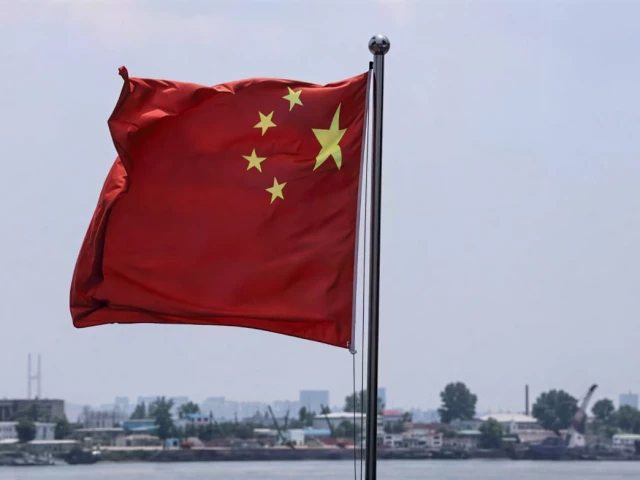
US could carry out further strikes on Iran if needed: Hegseth China is also seeking to expand domestic semiconductor manufacturing capacity and reduce the industry's reliance on advanced Nvidia chips that are subject to US export controls. PHOTO: REUTERS China on Tuesday urged the US not to disrupt its cooperation with Iran after Washington announced “Operation Economic Outcast,” a sweeping campaign intended to completely isolate Tehran from the global financial system. “China’s cooperation with Iran is conducted within the framework of international law and should not be disrupted,” Foreign Ministry spokesman Lin Jian told reporters in Beijing. He warned that the new US sanctions risk disrupting the global financial order, stressing the need for the warring sides to hold talks to end the conflict. “Economic wars and maximum pressure are not the solution,” Lin said, when asked about the new sanctions regime launched by US Treasury Secretary Scott Bessent on Monday. Lin said such moves “will only lead to escalation and risks of spillover, which will disrupt the global economic and financial order and harm the legitimate interests of other countries.” “The pressing task is to facilitate de-escalation and return to dialogue and negotiations as soon as possible,” said the spokesman, stressing that China “will take necessary measures to safeguard its rights and interests.” China is one of the largest importers of Iranian oil as the two countries maintain a “comprehensive strategic partnership,” driven primarily by economic ties and discounted energy imports. Bilateral trade volume climbed to over $41 billion last year. Stating that China "is closely monitoring the developments," Lin reiterated China’s “firm opposition to illicit, unilateral sanctions that have no basis in international law or the authorization of the UN Security Council.” US Treasury Secretary Bessent said the US “objective is to sever every economic lifeline that sustains this tyrannical regime until Tehran stands alone.” The US is “no longer managing the Iranian threat” but rather “ending it,” Bessent said, adding that the “strength of America's economy” enabled Washington to conduct such a financial offensive alongside military operations. Also on China, Bessent said: “The best way to engage with countries is through quiet diplomacy,” adding that the US was currently “level setting” expectations with Beijing. Iran state broadcaster says over 50 facilities targeted in recent war with US, Israel More than 50 facilities belonging to Iran’s state broadcaster were targeted across the country during the recent 40-day war with the US and Israel that began on February 28, the head of the Islamic Republic of Iran Broadcasting (IRIB) said Tuesday. Peyman Jebelli said in an interview with Iran’s semi-official Tasnim News Agency that the broadcaster’s landmark Glass Building in Tehran was also bombed for the second time, after previously being hit during the 12-day war in June 2025. “In addition to the Glass Building, more than 50 other IRIB sites across the country were targeted by the enemy,” Jebelli said. He did not provide a detailed figure for the overall damage but said losses suffered by IRIB during the latest conflict were several times greater than those recorded during the 12-day war last year. Jebelli said the Glass Building was hit with more powerful bombs during the latest conflict. Unlike last year’s attack, when the building’s ceilings did not collapse, the latest strikes hit two sides of the structure and caused two or three floors to collapse, he said, adding that a concrete wall was also brought down. Jebelli said debris from the previous attack had already been cleared and contracts for reconstruction signed before the latest war began, but the work was postponed due to renewed hostilities. He said reconstruction of the Glass Building would begin once conditions stabilise, noting that IRIB must also allocate financial resources to repairing dozens of other facilities damaged across the country. The Glass Building, a prominent high-rise within the IRIB complex in northern Tehran, houses parts of Iran’s state broadcasting operations and is one of the most recognisable structures associated with the broadcaster. The building was first hit by Israel on June 16, 2025, during a live broadcast. The attack came during the 12-day Iran-Israel war, which began with Israeli attacks on Iran on June 13 and ended with a ceasefire on June 24. US could carry out further strikes on Iran if needed: Hegseth US Defence Secretary Pete Hegseth said on Monday that Washington is not ruling out further military strikes on Iran, even as the Trump administration intensifies economic pressure on Tehran. Asked whether kinetic strikes were currently on pause, Hegseth said: “No. If we need to use kinetic strikes, we'll use them.” “If Iran is foolish enough to overplay their hand or mess with the American military, we'll do what we need to do,” he told reporters after a speech to defence industrial workers in Oshkosh, Wisconsin, where he urged US defence contractors to "pivot to a wartime footing." Hegseth said economic pressure was currently hurting Iran the most but added that the US was “by no means” ruling out strikes “anywhere in the Strait of Hormuz or around Iran.” He also claimed the US maintains control of the Strait of Hormuz, saying Washington’s blockade was “ironclad” and that Iran was unable to move oil through the waterway, while the US could protect shipping. Hegseth said the administration expected Congress to provide the full $1.5 trillion sought for defence, even if approval came during a lame-duck session after November midterm elections but before the newly elected Congress takes office in January. Asked whether munitions purchases could be cut if the full amount was not approved, he called them “pretty sacred,” saying the Pentagon had entered long-term agreements aimed at increasing supplies of some priority munitions two-, three- or fourfold. Also read: US senator demands answers on USS Abraham Lincoln’s extended deployment Hegseth also declined to discuss reports that US stocks of ATACMS long-range missiles had been significantly depleted in ongoing conflicts, saying the military had “plenty” available. Hegseth also confirmed that the USS Abraham Lincoln is returning home after an extended deployment. “To the sailors and families of the Lincoln, I say godspeed on a historic mission. Congratulations, you're on your way home,” he said, describing the deployment as “tough” and longer than most. The Lincoln has spent more than eight months without making a port call, setting a US Navy record. Families of sailors have reported worsening conditions and morale aboard the carrier, though Hegseth has said such claims have been “completely misrepresented.” Iran vows to retaliate after US widens sanctions Iran promised to retaliate against expanded US sanctions that the Americans said would cut Iran's economic lifeline, with Tehran expressing confidence that major trading partners would resist Washington's pressure campaign. US Treasury Secretary Scott Bessent unveiled the measures on Monday but stopped short of the most punishing sanctions, saying countries that continued trading with Iran risked being forced out of the dollar-based financial system. Bessent declined to identify the countries that would be targeted or reveal when the penalties would take effect, saying he would instead give them time to comply with the new directive. The Treasury Department did announce new sanctions on 60 individuals, entities and vessels, but the list did not feature any of the Chinese financial institutions suspected of facilitating Iran's oil trade. Iran and the United States signed an interim deal in June aimed at ending the war that began with US and Israeli attacks on Iran, but the Islamabad memorandum, as it is known, quickly faltered. Mediator Pakistan made "significant progress" in the latest talks with Tehran that focused on measures such as prevention of further escalation of the conflict and the reopening of the Strait of Hormuz, the Pakistani military said in a statement on Tuesday. Read: CDF presses for end to US-Iran stalemate "The Iranian president candidly shared his government's perspective, and we had a very constructive exchange on the issues involved," Interior Minister Mohsin Naqvi, who accompanied Chief of Army Staff and Chief of Defence Forces Asim Munir to Tehran, said on X. Field Marshal Syed Asim Munir and I had a very positive and productive meeting with the President of Iran. Our discussion focused on the Iran US conflict, tensions in the Middle East and the way forward, as well as the steps needed by both sides for restoration of the Islamabad… https://t.co/jt1wtlESCa — Mohsin Naqvi (@MohsinnaqviC42) August 24, 2026 The White House and the State Department did not immediately respond to requests for comment made outside business hours. Iran has not yet commented on the latest talks with Pakistan. Before news of the latest sanctions, Iran threatened both a possible military response and further reduction in oil exports from the Gulf in retaliation for any US economic measures. After they were unveiled, Iranian Economy Minister Ali Madanizadeh said, "We are fully prepared for the US sanctions." He told state television, "Naturally, the enemies intend to launch an economic terrorist attack on us, but we also have our own tools and know how to play the game. Our defence is no longer so defensive; the enemies should wait for an attack." Neither China nor Russia had "accepted" the US measures, he added, predicting that other countries would resist them. Brigadier General Hossein Mohebbi, a spokesperson for Iran's Islamic Revolutionary Guard Corps, vowed heavy blows to US vital interests and energy chokepoints if Iran's infrastructure is threatened, Press TV reported. Little sign of diplomatic solution Struggling to resolve an unpopular war that has pushed up energy prices, the administration of US President Donald Trump appears to be counting on further economic pressure, even though Iran has spent decades under layers of US and international sanctions that have battered its economy but have not deterred its leadership. Despite no major strikes by either side in weeks, the war shows little sign of reaching a diplomatic solution. The United States is seeking new ways to end Iranian attacks on ships in the Gulf and, more recently, via its allies, in the Red Sea. Just two commodity vessels transited the key energy chokepoint of the Strait of Hormuz on Monday, for the lowest daily tally since early May, shipping data showed. Before the conflict, the strait carried about a fifth of global flows of crude oil and liquefied natural gas. Almost six months have passed since the US and Israel launched strikes on Iran. Thousands of people have died, most of them in Iran and Lebanon. Read more: Oil steadies as investors weigh impact of latest US sanctions on Iran While the war has degraded much of Iran's conventional military capacity, inflicted economic pain and killed then-Supreme Leader Ayatollah Ali Khamenei, Iran has preserved enough missile and drone capability to attack Gulf neighbours and threaten oil tankers in the Strait of Hormuz. The exact state of Iran's nuclear program, which the Americans and Israelis aim to wipe out, remains unknown. Oil prices steadied on Tuesday, having fallen more than $2 a barrel a day earlier. Chinese oil trade Asked why he stopped short of imposing penalties on Iran and declined to identify targeted countries, Bessent responded, "Why would I want to blow up the global financial system?" He said he wanted to give countries and companies time to sever ties. Bessent previously urged cooperation from China, the biggest buyer of Iranian oil for several years, although the US blockade of Iran's ports, renewed in mid-July, has already cut Iranian oil flows to China. Experts say Washington is wary of Chinese retaliation for any sanctions on its banks ahead of expected talks next month between Trump and Chinese President Xi Jinping, with any curbs on China's exports of critical minerals especially sensitive. Asked about Chinese banks on Monday, Bessent said, "We want to make clear here today that no one is above the reach of US sanctions." The Chinese Foreign Ministry said sanctions and pressure tactics do not help and Beijing would do what was necessary to protect China's interests.
US could carry out further strikes on Iran if needed: Hegseth
Full Article
Original Source
Read the full article at Tribune →KhanList aggregates and links to publicly available news content. We do not host full articles from third-party sources. Always verify important information with original sources.