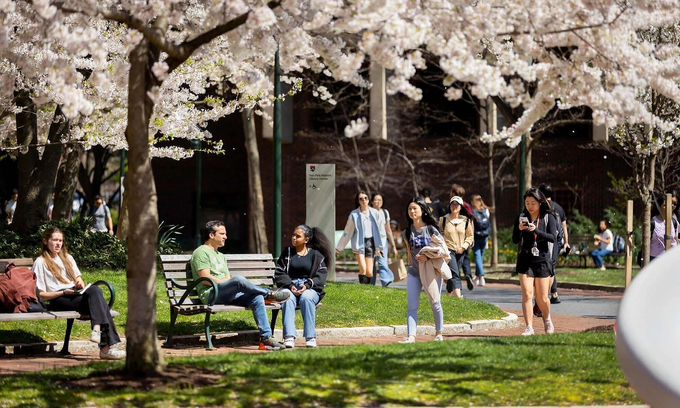
International students who want to remain in the United States after graduation to work could face a US$100,000 fee under immigration tightening measures. The U.S. government is weighing the fee for the Optional Practical Training (OPT) program, which allows international students to work in the country for one to three years after completing their degrees. The program is widely used as a pathway from the F-1 student visa to the H-1B work visa, according to The Wall Street Journal.The proposal is under discussion at the Department of Homeland Security (DHS). It remains unclear whether the fee would be paid by students, universities or employers.A White House official familiar with the matter told The Independent that the administration is not expected to announce any changes to the OPT program in the near term. Students at the University of Pennsylvania. Photo from the university's Facebook page The proposal reflects the administration's broader strategy of raising fees to discourage foreign nationals from working in the United States. If approved, the new rule would further tighten the country's immigration system.It follows the administration's broader push to introduce a $100,000 fee for H-1B visas, which are widely used by U.S. employers to recruit international talent, particularly in science, technology, engineering and mathematics, according to Bloomberg.A federal judge ruled the fee illegal last month, a decision the White House is appealing.Administration officials have also singled out the OPT program, arguing that it can facilitate visa fraud and overstays.On May 12, 2026, Acting ICE Director Todd Lyons announced a nationwide crackdown on OPT, calling it "a magnet for fraud" during a Homeland Security Investigations (HSI) briefing.He said investigators had identified more than 10,000 foreign students claiming employment with "highly suspect employers" and warned that "more actions are forthcoming," as quoted by ICEF Monitor.The remarks are among the clearest public statements from DHS leadership indicating that the administration is targeting the OPT program.According to the Institute of International Education, nearly 300,000 international students were participating in OPT as of last fall, representing about one-quarter of all foreign students in the United States.OPT has long been regarded as one of the main attractions for international students choosing to study in the United States. Supporters argue that without the program, most graduates would be forced to leave immediately after completing their studies, taking their U.S.-acquired skills to other countries.NAFSA (Association of International Educators) described it as "a key tool to maintain America's standing as the leading destination for global talent" in a report last year, citing survey data showing that post-study work opportunities have become an important factor in students' decisions about where to study abroad.In calendar year 2024, there were 1.58 million F-1 and M-1 students and recent graduates in the United States. Twenty-six percent (418,781) were authorized to work through OPT, according to official data released on the congressional website on May 30 last year.The Congressional Research Service (CRS) notes that critics argue OPT disadvantages U.S. workers because it does not require employers to meet labor certification or prevailing wage requirements that apply to some other visa programs.The Washington Alliance of Technology Workers (WashTech), which has repeatedly challenged OPT in court, argues that the program allows employers to hire foreign graduates at a lower cost because employers are exempt from paying certain payroll taxes for many OPT workers and are not subject to prevailing wage requirements, according to Congress.According to the Open Doors report, the United States hosted about 1.18 million international students during the 2024-2025 academic year. Nearly 25,600 were Vietnamese, up about 16% from the previous year, making Vietnam the fifth biggest source of international students in the country, following India, China, South Korea and Canada.
US considers charging $100,000 fee for international graduates seeking to work
Full Article
Original Source
Read the full article at E →KhanList aggregates and links to publicly available news content. We do not host full articles from third-party sources. Always verify important information with original sources.