
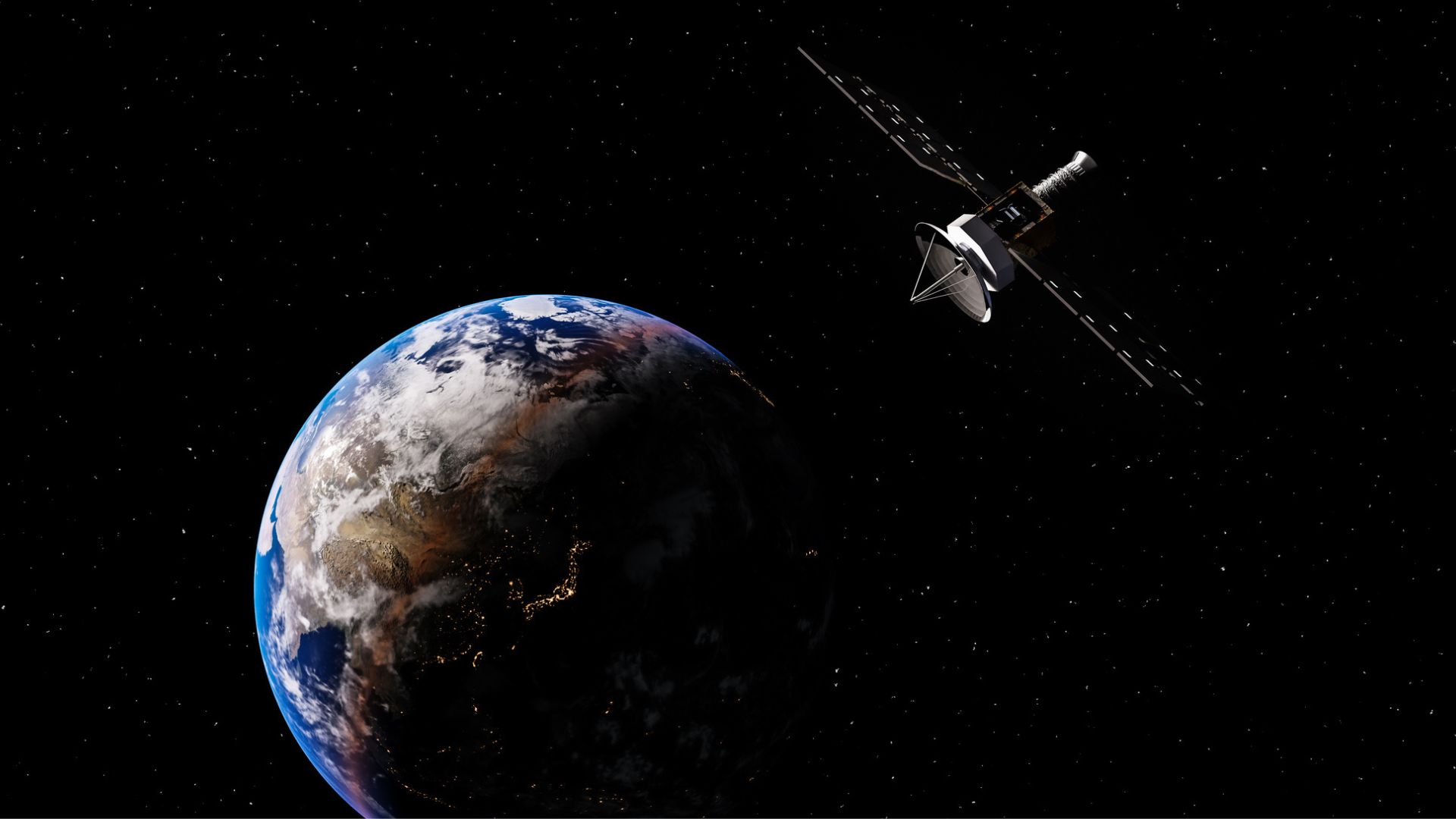
The U.S. has publicly disclosed that it deployed an “on-orbit” space weapon for the first time. Reportedly, the nation has framed it as a necessary step to counter growing counterspace threats from Russia and China, while Beijing has warned against inciting a space arms race. At an Air Force conference in Maryland, U.S. Air Force Secretary Troy Meink carefully announced the explosive news to warn potential rivals. After the announcement, China urged the United States to stop expanding its outer-space military and to stop preparing for war, warning that such moves risk triggering an orbital arms race. “Today we continue to ensure we remain ready to meet the challenges of evolving threats wherever they exist,” Meink stated at the conference. “This is why the United States now has on-orbit space control weapons capable of defending the joint force against hostile adversary action.” He refused to provide details. He would not say when the hardware was launched, how many systems circle the globe, or precisely what they do. The message, however, was clear. The cosmos is no longer just for reconnaissance and GPS, but it could become an active battlefield. Orbital standoff Citing Chinese and Russian efforts to target American satellites in potential future conflicts, senior US military leaders previously signaled plans to strengthen their orbital defense posture. Washington has now confirmed the existence of its space weapon, but the officials have kept all operational details strictly classified. “Space control encapsulates the mission areas required to contest and control the space domain – employing kinetic and non-kinetic means to affect adversary capabilities through disruption, degradation and even destruction, if necessary,” BBC quoted a U.S. Space Force spokesperson. “These capabilities can be employed for offensive and defensive purposes at the direction of combatant commands.” While the 1967 Outer Space Treaty strictly bans weapons of mass destruction in Earth’s orbit, it leaves a wide opening for conventional military hardware. Defense analyst Dr. Bleddyn Bowen of the Royal United Services Institute told the BBC that very little public information exists regarding the deployed technology, which could encompass several distinct weapon systems. He speculated that the asset is most likely an orbital electronic warfare or radio-jamming platform, similar to terrestrial technology used to block communications. A kinetic kill vehicle that physically impacts and destroys satellites remains a possibility; however, this scenario is far less plausible because it would produce a dangerous volume of space debris. Growing threat Yet, the rapid reveal coincides with accelerated momentum behind the administration’s “Golden Dome” missile defense framework, which includes space-based interceptors. Beijing reacted almost immediately. Chinese Foreign Ministry spokesperson Guo Jiakun urged Washington to stop expanding its military footprint off the planet, warning against a catastrophic space arms race. Washington counters that it had no choice. Revelations from early February indicate that two Russian satellites likely intercepted signals from at least twelve European spacecraft following the 2022 invasion of Ukraine. Experts warn that these interceptions could have allowed Russian intelligence services to read sensitive transmitted data or potentially take direct control of the satellites. This follows a 2024 U.S. warning regarding a separate Russian satellite launch believed to possess offensive counterspace capabilities, an allegation Moscow has not publicly addressed. “China develops and operates space and counterspace capabilities as part of a military modernization strategy,” the U.S. Space Force’s website noted. On the other hand, “Russia views space as a warfighting domain and believes space supremacy will be a decisive factor in future conflicts.” By stepping through that legal opening so publicly, the U.S. has officially fired the starting gun on a new era of orbital brinkmanship. Get the latest in engineering, tech, space & science - delivered daily to your inbox.Mrigakshi is a science journalist who enjoys writing about space exploration, biology, and technological innovations. Her work has been featured in well-known publications including Nature India, Supercluster, The Weather Channel and Astronomy magazine. If you have pitches in mind, please do not hesitate to email her.
US confirms operational weapon in orbit as China warns of dangerous space arms race
Full Article
Original Source
Read the full article at Interestingengineering →KhanList aggregates and links to publicly available news content. We do not host full articles from third-party sources. Always verify important information with original sources.