
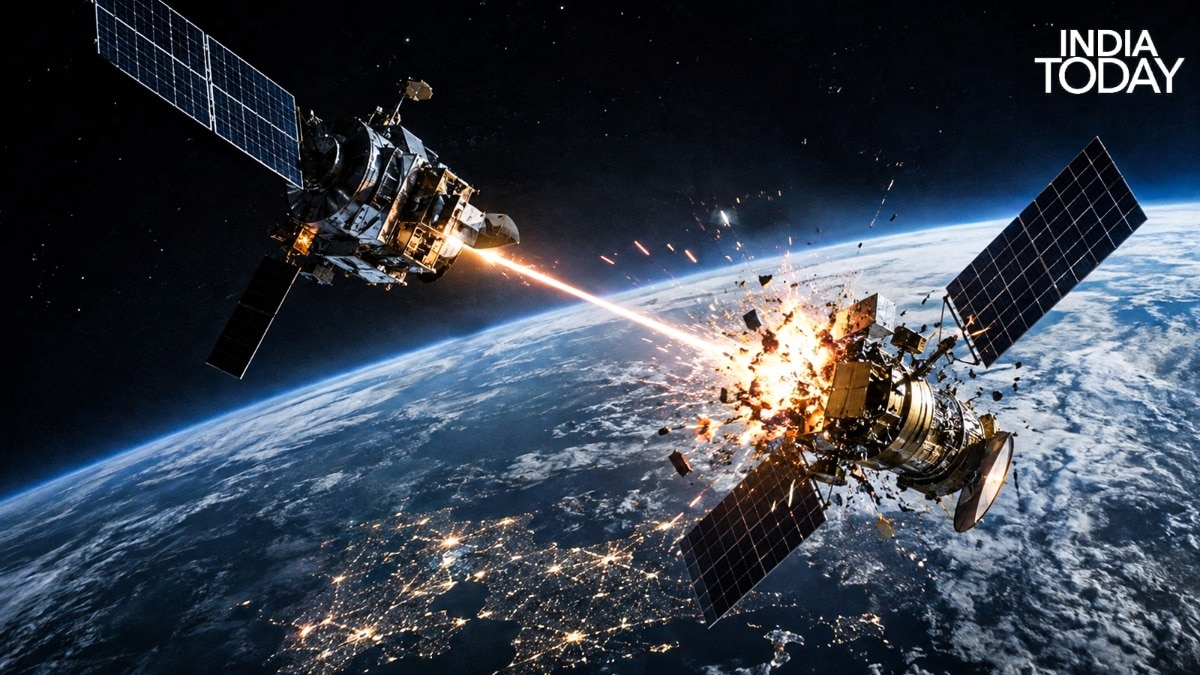
A new kind of military contest is taking shape hundreds of kilometres above Earth, where US and China, two global superpowers, are developing satellites that can manoeuvre, approach other spacecraft and potentially interfere with or disable them.In June, a secretive Chinese unmanned spaceplane released a small satellite into an orbital region crowded with commercial and military spacecraft, news agency Reuters reported. US Space Force Guardians assigned monitor computer workstations at Vandenberg Space Force Base. (Photo: Reuters) According to space-tracking company LeoLabs, the satellite then moved around another Chinese satellite before heading back towards the spaceplane.Reuters, in a review of space-tracking data, documents and interviews with current and former military officials, said the activity reflects how both Washington and Beijing are preparing for the possibility of conflict extending into space. MORE THAN EYES IN THE SKYSatellites have long been crucial to modern militaries, providing communications, navigation, weather information and intelligence that help forces on Earth operate over vast distances.But that sole functioning is now changing. A Falcon 9 rocket carrying the USSF-36 mission successfully launches from Nasa space centre. (Photo: Reuters) Instead of satellites simply following fixed paths, militaries are developing spacecraft that can move closer to, inspect, follow or potentially interfere with other satellites.Reuters reported that Chinese researchers linked to the military are working on technologies including satellites designed to pursue and capture other spacecraft, as well as systems that could extend their operating lives through refuelling.Chinese spacecraft have also demonstrated coordinated movements that US officials describe as orbital "dogfighting".China's growing capabilities are also reflected in US military assessments.The Pentagon said that Beijing is developing several types of counterspace systems, including anti-satellite missiles, manoeuvrable spacecraft, electronic warfare and directed-energy systems.PREPARING FOR A FUTURE WAR?The US is not simply watching from the sidelines. The US Space Force’s X-37B Orbital Test Vehicle Mission Seven. (Photo: Reuters) Both countries operate secretive spaceplanes.Reuters reported that the US has a reusable, uncrewed spaceplane resembling a small shuttle, capable of carrying out classified missions in orbit.The US is also developing ways to disrupt hostile satellites without necessarily destroying them.In June, the US Space Force operationally accepted Meadowlands, a mobile electromagnetic warfare system designed to disrupt satellite communications from the ground.US Space Force officials have also warned that China is rapidly expanding its space capabilities.General Chance Saltzman, the service's Chief of Space Operations, said in July that China was rapidly developing ground- and space-based weapons capable of interfering with or destroying targets.Reuters quoted him describing the Chinese threat as "substantial." A US Space Command officer gives a lecture on space as a warfighting domain. (Photo: Reuters) WHY IS A WAR IN SPACE BAD NEWS?A conflict in space would not necessarily look like science fiction, with spacecraft firing weapons at each other.A satellite could be attacked by jamming its signals, blinding its sensors, disrupting its electronics, hacking its systems or physically interfering with it.Destroying a satellite could also create large amounts of debris, potentially threatening other spacecraft.The stakes are high because modern militaries depend on space for everything from battlefield communications to navigation and surveillance. US Space Command Joint Operations Center at Peterson Space Force Base. (Photo: Reuters) China's expanding satellite fleet is therefore a particular concern for Washington.The US Space Force says China had more than 1,500 payloads in orbit by June 2026, including more than 510 intelligence, surveillance and reconnaissance-capable satellites.The emerging contest is consequently less about putting weapons in orbit for their own sake and more about controlling the systems that make modern warfare possible.In other words, as the world changes, satellites are increasingly being viewed not just as support systems, but as potential weapons and targets, turning Earth's orbit into another contested domain of military power.- EndsPublished On: Sep 3, 2026 13:11 IST
US-China edging closer to space war: Satellites becoming weapons and targets
Full Article
Original Source
Read the full article at Indiatoday →KhanList aggregates and links to publicly available news content. We do not host full articles from third-party sources. Always verify important information with original sources.