
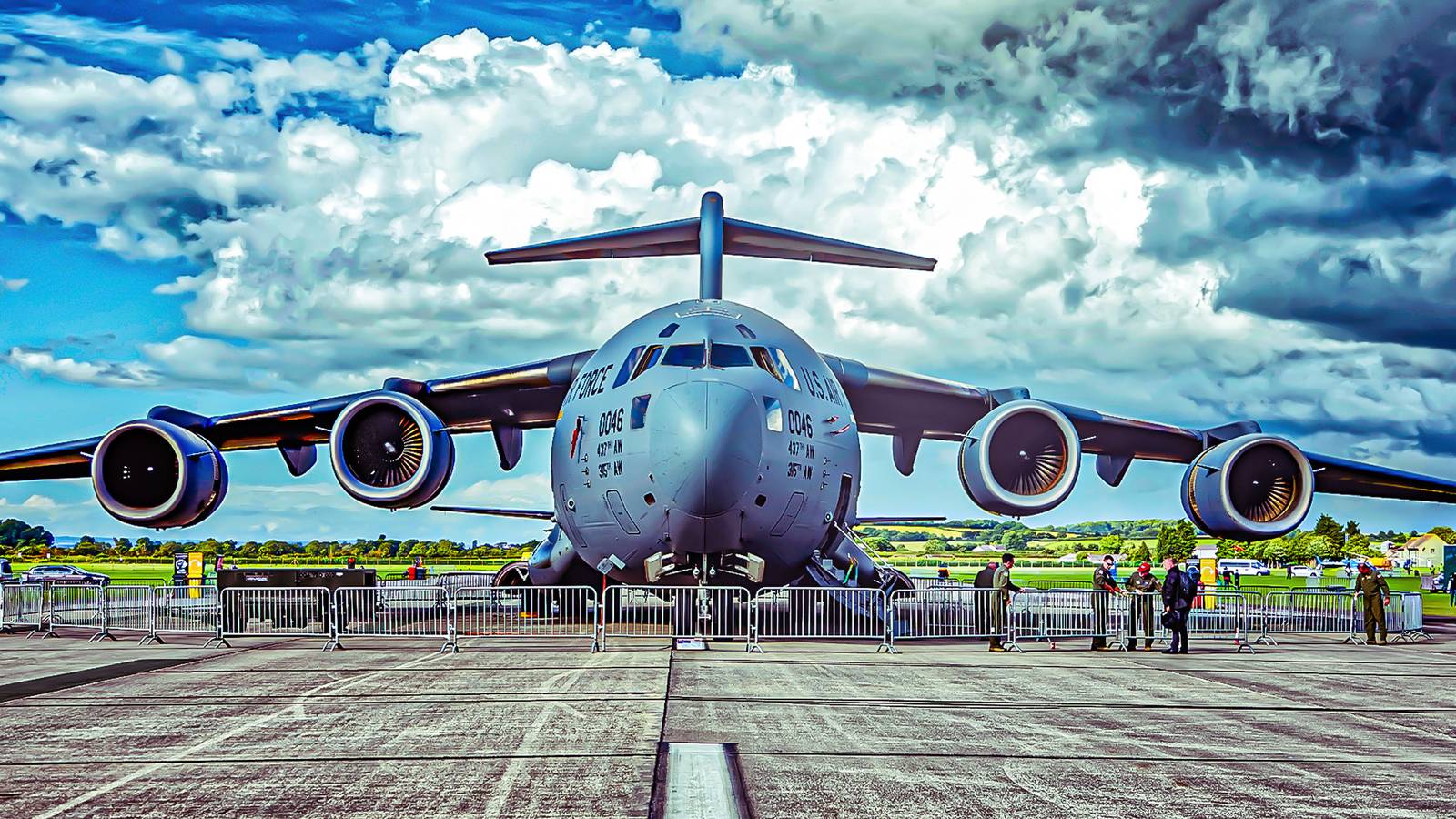
Published Aug 25, 2026, 1:53 PM EDT Paul has had a career of 25+ years focused on the international technology sector, which has taken him to over 100 countries. Along the way, he developed a deep love for aviation, with a travel bucket list measured by aircraft types flown rather than destinations reached. Now he brings that avgeek passion, along with the journalism experience he accumulated early in his career, to write insightful pieces for Simple Flying. A United States Air Force Boeing C-17 Globemaster made an exceptionally rare flight into Moscow on Tuesday, August 25, carrying CIA Director John Ratcliffe from Riga to Vnukovo International Airport (VKO). The aircraft, 07-7181, operated as RCH4555 and landed at 10:04 AM local time after departing Riga International Airport (RIX) at 8:50 AM. Ratcliffe's presence in Moscow was subsequently confirmed by multiple US media outlets, while Axios specifically reported that he traveled from Latvia to Russia aboard the C-17. However, the C-17 was only half of an intriguing aviation story. A second USAF aircraft — Boeing C-40B 02-0042, operating as RCH790 — also flew from Joint Base Andrews to Riga. Flightradar24 records show the C-40 arriving in Latvia after the C-17, while public tracking shows no corresponding C-40 flight onward to Moscow. Since Axios says Ratcliffe first traveled from Washington to Latvia aboard a US government aircraft, it seems that he arrived on the C-40B and then changed aircraft in Riga. If so, the question is why a CIA director would leave an aircraft purpose-built for senior-government travel, and board a 585,000-pound military transport instead. Two USAF Aircraft Staged Through Riga Credit: Shutterstock The unusual movement was first spotted through open-source flight tracking. Flightradar24 posted on X that RCH4555 had flown from Riga to Moscow, while other flight watchers then traced 07-7181 back through Joint Base Andrews, Joint Base Charleston and Joint Base McGuire-Dix-Lakehurst. TWZ reported that the C-17 flew McGuire-Charleston on August 22, Charleston-Andrews and Andrews-Riga on August 23, before remaining in Latvia until its Moscow flight this morning. Attention then turned to RCH790. Flightradar24 identifies 02-0042 as a USAF Boeing C-40 and recorded its flight from Andrews to Riga, while OSINTdefender highlighted on X that the aircraft had followed the C-17 to Latvia. Another flight-tracking account identified the aircraft and callsign and reported it parked at Riga. AeroTime subsequently verified the movement using Flightradar24 data and noted that no onward C-40B leg to Moscow appeared in public tracking. In summary then, the flight movements have been as follows: Aircraft Type Callsign Tracked routing Apparent role 02-0042 Boeing C-40B RCH790 Andrews → Riga Likely senior-official transport 07-7181 Boeing C-17A RCH4555 Andrews → Riga → Moscow Carried Ratcliffe Riga–Moscow The final piece of the puzzle came when Axios reported that Ratcliffe had departed Washington on Sunday aboard a US government aircraft, traveled first to Latvia, and then flew Riga-Moscow aboard the C-17 on Tuesday. Axios did not identify his first aircraft, so it cannot be stated definitively that Ratcliffe arrived aboard 02-0042. Nevertheless, the timing, routing and C-40B's normal mission make that explanation compelling. Military flights between the United States and Russia are themselves highly unusual. Reuters noted that the Globemaster's arrival was sufficiently conspicuous for the Kremlin to say it had no information about it, while AeroTime said recent US government missions into Russia have generally involved much smaller C-37 Gulfstreams. The C-17's appearance is therefore unusual not simply because Ratcliffe was aboard, but because Washington chose such a large strategic airlifter for the mission. Why Switch From A C-40B To A C-17? Credit: Shutterstock The reasons for Ratcliffe's trip to Moscow will be picked apart by mainstream media, but from an aviation perspective, the compelling question is about the choice of two aircraft and why he chose to switch aircraft in Riga. That question becomes more interesting when considering what a C-40B actually is. Derived from the Boeing 737-700 business jet, its primary function is high-priority personnel transport. It accommodates between 26 and 32 passengers, and provides broadband data and video transmission alongside secure voice and data communications, satellite connectivity and onboard networks. The 89th Airlift Wing has operated the type from Andrews since 2002, and recently got rebuffed by Congress in its attempts to procure more aircraft. The USAF describes the C-40B as follows: “The C-40B provides safe, comfortable and reliable transportation for US leaders to locations around the world. It is designed to be an ‘office in the sky’ for senior military and government leaders.” — US Air Force The C-17 is almost the opposite. Its primary role is cargo and troop transport, with an 88-foot-long cargo compartment, 18 pallet positions and a maximum payload of 170,900 pounds (77,519 kg). It can carry military vehicles and equipment that would be impossible to accommodate aboard a C-40. Its mix of strategic range and tactical airfield performance has kept the type indispensable more than three decades after entering service, with the USAF planning to keep its Globemasters flying for decades to come. Boeing C-40B Boeing C-17A Globemaster III Primary role High-priority personnel transport Strategic cargo and troop transport Based on Boeing 737-700/BBJ Purpose-built military airlifter Typical passengers 26–32 Up to 102 troops Maximum payload Primarily passengers/baggage 170,900 lb / 77,519 kg Cargo capacity Conventional passenger-aircraft holds 88-ft cargo compartment; 18 pallet positions Secure communications Yes — secure voice/data, broadband and video Available through specialized roll-on systems such as ROCC VIP accommodation Dedicated distinguished-visitor compartment, sleeping accommodation and worktables Not standard, but ROCC can provide executive suite, bed, lavatory and conference room Normal suitability for CIA director Excellent — specifically designed for senior leaders Unusual unless additional mission capability is required Possible advantage for Moscow mission Comfortable, discreet VIP transport ROCC + larger staff + communications equipment + security/support cargo on one aircraft That suggests the switch probably involved more than transportation. If Ratcliffe simply needed a comfortable aircraft with secure communications to take him from Riga to Moscow, the C-40B already fulfills that requirement extremely well. A C-17 could instead bring a much larger support team, communications hardware, security equipment, vehicles or other mission-specific cargo into Russia together with the principal. None of those items has been confirmed as being aboard 07-7181, but the C-17's enormous cargo capacity makes such a mission package possible in a way the C-40 cannot. There is also a more intriguing possibility. Just five months before Ratcliffe's trip, the Air Force fielded a new system designed specifically to turn a C-17 from a cargo aircraft into a secure flying headquarters for senior government leaders. If 07-7181 was equipped with the new Roll-On Conference Capsule, or ROCC, that could provide a particularly persuasive reason why Ratcliffe changed aircraft for the sensitive final leg into Moscow. Was The New ROCC Behind The Aircraft Switch? Credit: US Air Force The Air Force officially fielded the ROCC in March this year, describing it as a “state-of-the-art mobile command center” designed specifically to roll aboard a C-17. The system consists of two capsules that connect inside the cargo hold: one contains the senior leader's private suite, while the other provides a conference and staff area with a large monitor, four workstations and six swivel chairs. The executive section adds a private workstation, seating, a divan that converts into a bed and its own lavatory. Connected through the Steel Eagle pallet, it provides highly secure worldwide voice, data and video teleconferencing. That capability has a surprisingly long history. The ROCC replaced the legendary “Silver Bullet,” modified Airstream trailers loaded into C-17s so senior US officials could work, communicate and sleep during long journeys. Defense secretaries have used them for years: CBS described Robert Gates traveling inside one during a 2009 C-17 flight from Afghanistan, while Defense Secretary Pete Hegseth was filmed using a Silver Bullet during his first overseas trip in 2025. The old solution had a significant drawback: Because of the Silver Bullet's lack of rigorous safety certification, Air Mobility Command did not endorse occupancy during takeoff, landing, aerial refueling or moderate turbulence. Its replacement was deliberately engineered to solve that problem. The ROCC underwent seat testing, crash-load analysis, rapid decompression and other evaluations and is certified for occupation during all phases of flight. The original replacement program dates to 2019, when the USAF awarded an $8.5 million contract for two new capsules. Silver Bullet Roll-On Conference Capsule (ROCC) Basic concept Modified Airstream trailer carried inside C-17 Purpose-built modular C-17 command center Era Used for decades until 2026 Fielded March 2026 Primary users Senior military and government leaders Senior military and government leaders Executive accommodation Private workspace/rest facilities Executive suite with workstation, seating and convertible bed Conference area Yes Dedicated staff/conference module with four workstations and six seats Private lavatory Yes Yes Secure communications Secure communications via associated equipment Secure worldwide voice, data and video teleconferencing Takeoff/landing occupancy AMC did not endorse occupancy during takeoff or landing Designed and certified for occupancy during all phases of flight Turbulence restrictions Occupancy discouraged during moderate turbulence Significantly improved safety certification Design philosophy Adapted commercial trailer Purpose-designed aviation system Relevance to Moscow flight Shows long history of turning C-17s into VIP command aircraft Could explain why Ratcliffe switched from a C-40B to a C-17 Whether 07-7181 actually carried a ROCC on Tuesday remains speculation, but the circumstances fit unusually well. Ratcliffe apparently had access to a C-40B — an aircraft already optimized for senior-official transport — yet transferred in Riga to a C-17 that had been positioned there in advance. A ROCC-equipped Globemaster would provide a secure command center combined with space for a larger team and substantial mission-support equipment, essentially allowing the CIA director to bring a self-contained flying headquarters into Moscow. If that was the plan, the apparently strange aircraft change suddenly makes considerably more sense.
US C-17, C-40B Spotted Making Rare Moscow Visit With CIA Director Onboard
Full Article
Original Source
Read the full article at Simpleflying →KhanList aggregates and links to publicly available news content. We do not host full articles from third-party sources. Always verify important information with original sources.