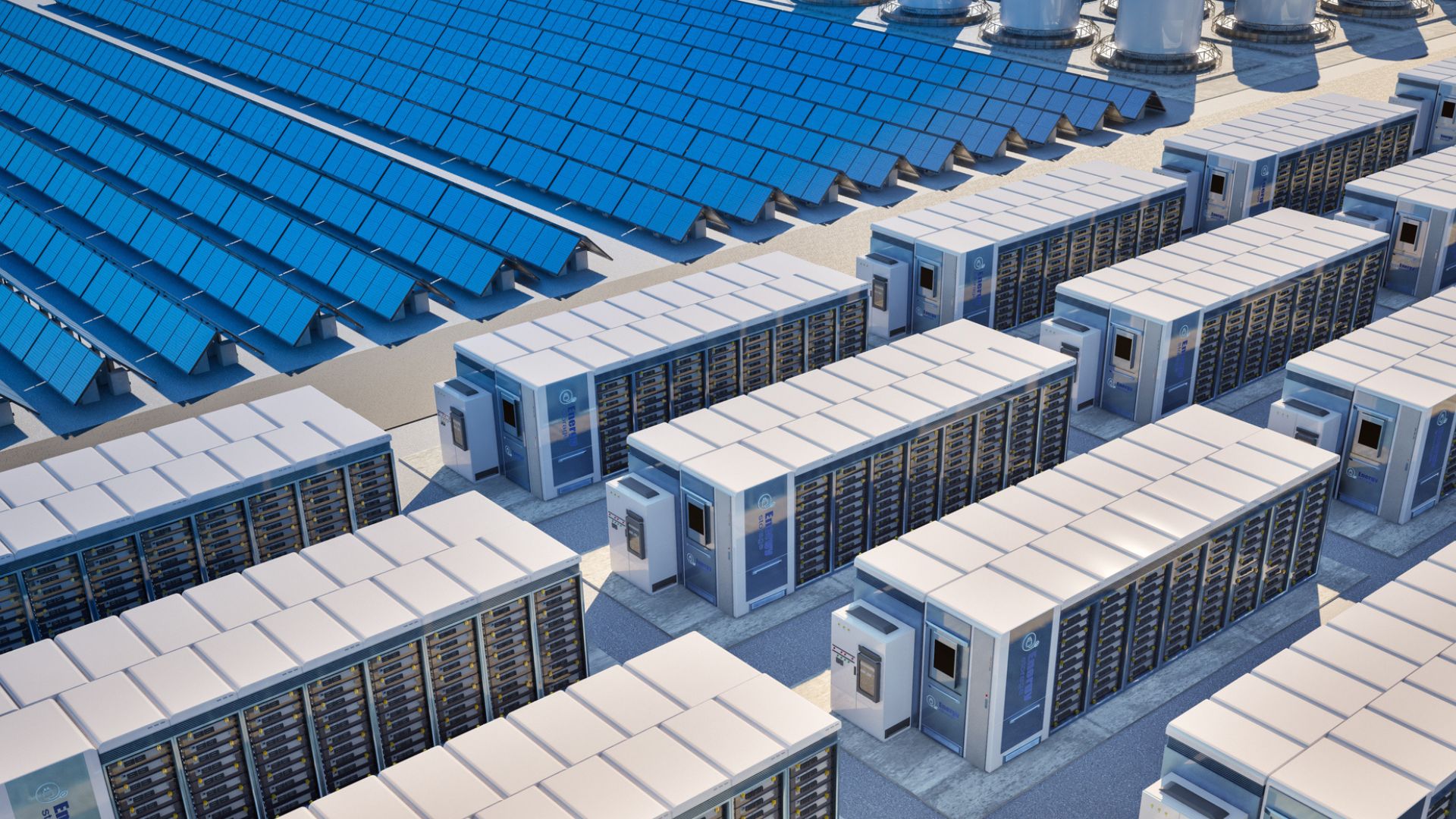
America’s power grid is executing a quiet, high-tech transformation. Over the past three years, utility-scale battery storage capacity in the U.S. expanded at a rapid average pace of 70 percent per year. By the end of 2025, the national grid held 43.6 gigawatts (GW) of operational battery capacity. Energy operators expanded national capacity to nearly 52 GW by adding an extra 8.3 GW during the first half of 2026. This expansion depends mostly on co-locating batteries with solar photovoltaic (PV) plants to capitalize on wholesale price arbitrage across major energy markets. Rapid capacity growth Driven by standard market arbitrage, utility-scale battery storage has rapidly evolved from a niche technology into a core pillar of the American power grid. Solar panels produce massive bursts of cheap electricity during midday. Demand spikes later when the sun goes down. Coupling utility-scale battery banks directly with solar PV farms enables operators to absorb low-cost power at noon and sell it back to the grid at premium evening rates. This lucrative business model has sparked a massive construction boom across solar-heavy states, turning temporary energy storage into a primary driver of modern grid infrastructure. California leads the pack. The Bellefield Solar and Energy Storage Farm went online in December 2025, pairing 500 megawatts (MW) of solar capacity with 500 MW of power storage for California’s main grid. Now, developers plan to double both its solar and storage capacities by November 2026. If completed on schedule, Bellefield will become the single largest power storage facility in the United States. It is not alone. Florida’s Manatee Solar Energy Center pairs 75 MW of solar with a massive 409 MW of battery storage. Operational since 2024, Nevada’s Gemini Solar Hybrid facility integrates 690 MW of photovoltaic capacity with a 380 MW battery storage system. Despite ongoing hurdles around interconnection queues and grid congestion, the scale of deployment shows developers are overcoming technical and regulatory barriers to support rising electricity demand from data centers and electrification. Adding more battery capacity Huge projects are setting the pace, but the pipeline ahead is even bigger. According to industry filings tracked by the U.S. Energy Information Administration (EIA), grid operators plan to add another 54 GW of battery capacity over the next two and a half years. That includes 14 GW slated for the second half of 2026, a massive 26 GW influx in 2027, and another 14 GW in 2028. If brought online as planned, U.S. energy storage capacity will double again by 2030. Apart from energy arbitrage, battery storage assets unlock additional revenue streams by delivering crucial grid-firming services that maintain overall power stability. With fast-frequency response, voltage control, and black-start capabilities, batteries can instantly counter abrupt shifts in supply and demand, reinforcing grid reliability while diversifying income for project owners. Reportedly, these EIA-tracked plans represent operator intentions rather than guarantees, but signal robust and continued momentum across the energy sector. However, the timeline still faces potential hurdles, including supply chain issues, permitting delays, and interconnection queues. Get the latest in engineering, tech, space & science - delivered daily to your inbox.Mrigakshi is a science journalist who enjoys writing about space exploration, biology, and technological innovations. Her work has been featured in well-known publications including Nature India, Supercluster, The Weather Channel and Astronomy magazine. If you have pitches in mind, please do not hesitate to email her.
US battery storage hits 52 GW as capacity reaches a record-high level in 2026
Full Article
Original Source
Read the full article at Interestingengineering →KhanList aggregates and links to publicly available news content. We do not host full articles from third-party sources. Always verify important information with original sources.