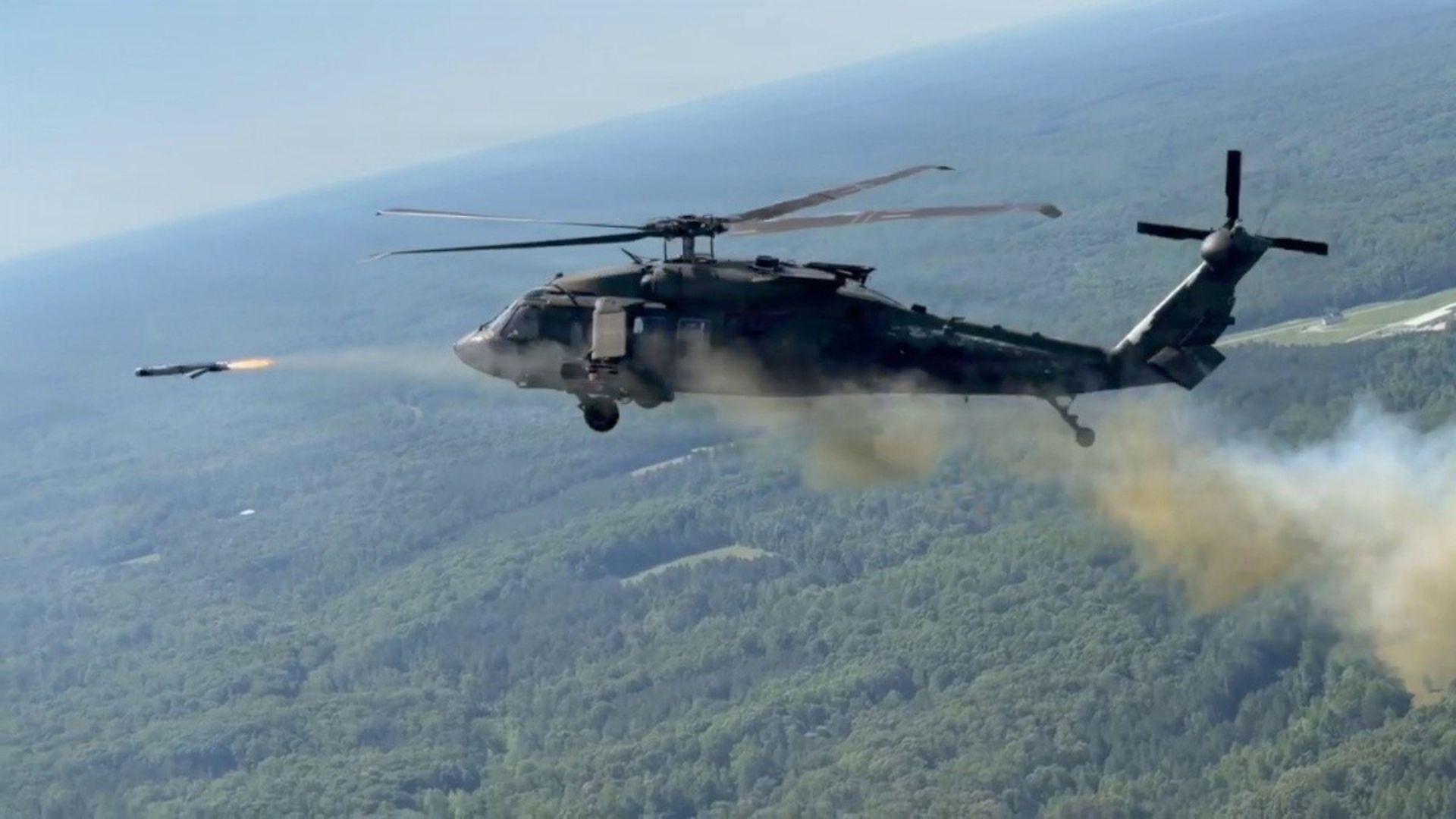
The U.S. Army completed a major flight demonstration recently, showing that an H-60M Black Hawk helicopter can launch and control multiple air-launched effects (ALEs) during Project Convergence Capstone 6. Conducted over three days in California’s Mojave Desert, the tests marked another step toward giving Army helicopters greater reach in contested environments while allowing them to remain at safer stand-off distances. This demonstration followed earlier tests at A.P. Hill, Virginia, in June. Aircrews were able to operate several launched effects in the intense desert heat, proving the system works well in tough conditions. Government-owned system expands Black Hawk capabilities The Army stated that the Increment 1 capability was completely designed and owned by the U.S. government. It was developed through collaboration between the Utility Helicopters Project Office and the DEVCOM Aviation and Missile Center, with help from Army technical programs and industry partners for integration and flight testing. The upgraded H-60M can launch and control several air-launched effects using a fully networked system. This feature helps the helicopter operate farther away from enemy defenses while still reaching its targets. “It’s truly remarkable when dedicated Americans from government and industry collaborate to deliver results,” said Dr. Stephanie Reitmeier, Director for DEVCOM AvMC Maneuver Air Directorate and Maneuver Air System Center. “Moving with speed and embracing experimentation as a unified team is driving transformational change across Army capabilities.” Flight campaign advances precision strike program The July demonstration also helped develop the Long-Range Precision Munition (LRPM), which is the Army’s lethal version of the Launched Effects program. The LRPM, managed by the Capability Program Executive for Offensive Fires, is built for autonomous operation, controlling several units at once, and focusing attacks on a target. During the event, soldiers and allied partners inspected the modified Black Hawk and met directly with program specialists to better understand the system’s capabilities. According to the Army, the configuration could help ground forces operate in contested airspace while the helicopter remains farther from hostile threats. “Successfully launching Air-Launched Effects from a Black Hawk is more than a milestone; it is a leap forward,” said Brig. Gen. Kevin Chaney, Deputy Portfolio Acquisition Executive for Maneuver Air. “By extending their reach and increasing lethality, we are changing the battlefield geometry and delivering a decisive advantage to our Soldiers.” Networking role strengthens battlefield coordination In addition to launching air-launched effects, the modified H-60M acts as a communications link between aviation units and ground forces. Its network system helps manage the battlespace and allows aircraft and ground troops to communicate over long distances. The Army believes these features could help keep communication strong during large-scale combat, even when forces are spread out and fighting at long range. Officials said more testing and evaluation are planned further to develop the Black Hawk’s air-launched effects capability. This work aims to make the aircraft more survivable and effective in combat as the Army builds new battlefield networking and precision strike systems. Recommended ArticlesGet the latest in engineering, tech, space & science - delivered daily to your inbox.A versatile writer, Sujita has worked with Mashable Middle East and News Daily 24. When she isn't writing, you can find her glued to the latest web series and movies.
US Army’s Black Hawk helicopter launches, controls multiple combat drones in test
Full Article
Original Source
Read the full article at Interestingengineering →KhanList aggregates and links to publicly available news content. We do not host full articles from third-party sources. Always verify important information with original sources.