
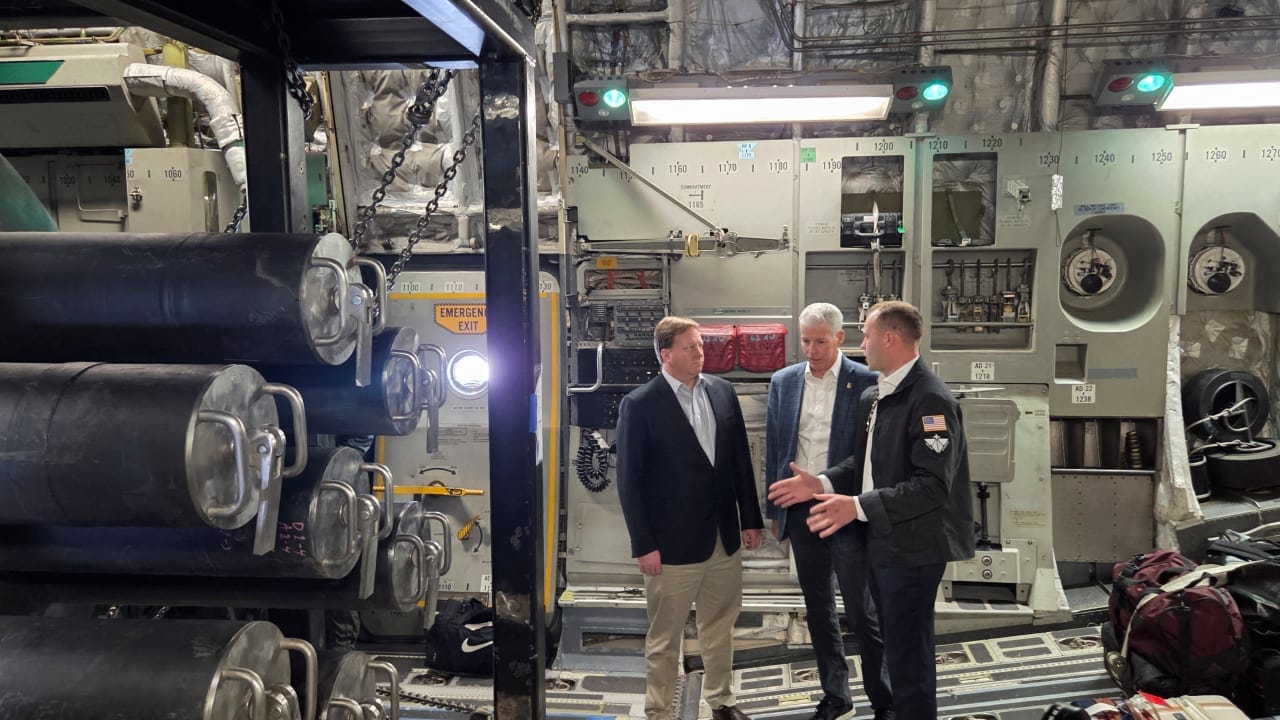
So-called microreactors are tiny factory-built nuclear plants that developers say will be easily transported and generate up to 20 megawatts of power each.Follow us on GoogleUS Energy Secretary Chris Wright and US Under Secretary of Defense for Acquisition and Sustainment Michael Duffey on board a C-17 cargo plane that transported Valar Atomics' Ward nuclear microreactor from March Air Force Base in California to Hill Air Force Base in Utah, at Hill Air Force Base.(photo credit: REUTERS/Valerie Volcovici)AUGUST 27, 2026 09:08The US Army said on Wednesday it is awarding up to $2.2 billion to five companies to build and operate tiny nuclear reactors on military bases, which it hopes will one day power remote installations.So-called microreactors are tiny factory-built nuclear plants that developers say will be easily transported and generate up to 20 megawatts of power each.The Army believes that developing them through a program called Janus could one day help power remote military installations such as those in Alaska or on islands. The program has a goal of deploying the first reactor by September 2028.The companies and bases the Army selected were: Antares Nuclear Inc in Fort Bragg, North Carolina; BWXT Advanced Technologies LLC in Fort Campbell, Kentucky; General Atomics Electromagnetic Systems in Fort Hood, Texas; Radiant Industries Inc in Fort Benning, Georgia; and Westinghouse Government Services in Fort Drum, New York.The Army did not detail how much money would be distributed to each company. But Radiant said it will get up to $750 million to develop and deploy 15 of its Kaleidos reactors in the program.US President Donald Trump viewing a military exercise at Fort Bragg in North Carolina. (credit: EVELYN HOCKSTEIN/REUTERS)Regulated by US Army, not US Nuclear Regulatory CommissionAn Army official said reactors will have to follow all environmental and safety rules that apply to commercial reactors but added that they would be regulated by the Army, not the US Nuclear Regulatory Commission, which regulates commercial reactors."The whole idea here is that at the back end of this we want a commercial product," said Jeff Waksman, the principal deputy assistant secretary of the Army for Installations, Energy and Environment.Radiant's Chief Commercial Officer Mike Starrett told Reuters in an interview that the Janus award is key to the company scaling up its business to eventually meet the needs of commercial customers like data centers in about 2030.Critics of microreactors say they will be expensive compared to conventional reactors. Waksman said nobody thinks that microreactors will be lower in cost than conventional plants. "What we are trying to do here with Janus... is to flesh out how we can get those prices down," Waksman said.The military currently pays about 40 cents a kilowatt-hour to power Arctic installations, a cost it hopes to cut, Waksman said. The Army also expects that the private sector will raise more money for the reactors than the federal government, and the program will help attract that capital.Starrett said that because Radiant's containerized reactors can be brought to the customer, eliminating energy transmission fees, their delivered cost will be between 20 and 30 cents per kilowatt-hour.Follow us on Google
US Army to build nuclear microreactors on military bases, $2.2 billion awarded to five companies
Full Article
Original Source
Read the full article at Jpost →KhanList aggregates and links to publicly available news content. We do not host full articles from third-party sources. Always verify important information with original sources.