
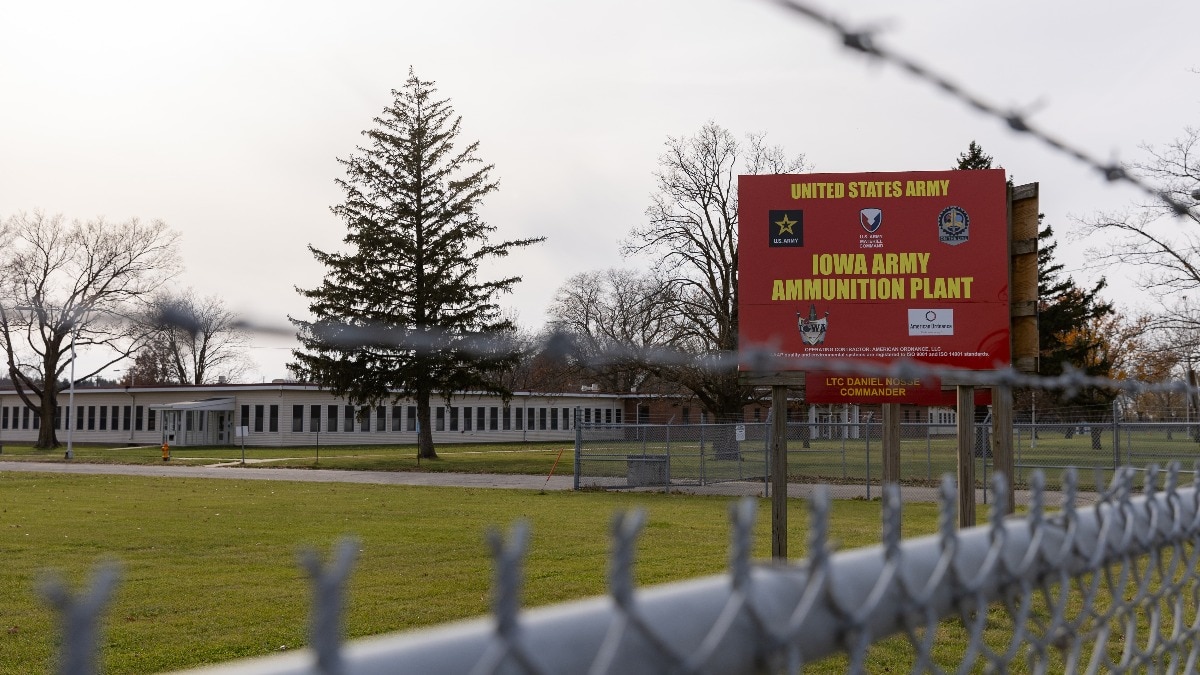
The planned explosion at the Iowa Army Ammunition Plant involves 68 barrels containing around 4,355 kg of highly unstable lead azide. While authorities have safeguards in place, a blast could send a cloud of toxic, lead-containing dust across homes and farmland.US Army to blow up 9,600 pounds of toxic explosive, putting thousands at risk in Iowa. (AP photo)New Delhi,Nov 25, 2026 09:56 ISTThousands of Americans have a ticking time bomb on their hands -- devised not by Iran or any other foreign adversary, but by their own armed forces. The US Army is preparing to detonate ageing explosives at an ammunition plant in the rural belt of Iowa on Wednesday, raising fears of a toxic fallout that could spread across homes and farmland.In a statement, the US Army said it would carry out a controlled disposal of 68 barrels containing around 9,600 pounds (4,355 kg) of lead azide -- the country's entire stockpile of the highly volatile explosive. The blast could send a plume of hazardous lead dust into the air for a hundred miles, exposing thousands of people, as well as pets and livestock.The operation is going ahead after a federal appeals court on Monday rejected environmental groups' attempt to stop it, lifting a temporary stay that had threatened to delay the blast.The US Army says it has put extensive safeguards in place for the controlled explosion, which would be carried out in coordination with state, local and federal authorities. Environmental groups and residents, however, are still up in arms. Army secretary Adam Telle defended the decision, saying, "A controlled, mitigated detonation of the lead azide here at Iowa Army Ammunition Plant is far preferable to an uncontrolled, spontaneous detonation of that substance."WHAT IS LEAD AZIDE AND WHY IS IT DANGEROUS?Lead azide is a compound made up of lead and nitrogen. It is used in military ammunition as an initiating explosive, essentially acting as a primer or detonator that sets off a larger explosive charge. But it belongs to a particularly dangerous category known as primary explosives. These substances are extremely sensitive to physical impact, friction and other sudden stimuli. Even a relatively small disturbance can trigger an explosion.Scientists say primary explosives such as lead azide as "very dangerous" and "basically unhandle-able".The compound is particularly hazardous because of its sensitivity and its lead content. Lead is a potent neurotoxin that can damage the brain, nervous system and other organs. Children and pregnant women are especially vulnerable.Exposure during pregnancy can interfere with foetal development and increase the risk of premature birth and miscarriage. In children, lead exposure can cause lasting developmental and neurological damage.There is no known safe level of lead exposure.The Army has warned that heating lead azide can also produce hazardous byproducts, including lead metal oxides and fumes, hydrazoic acid vapours and nitrogen oxides.WHY IS US ARMY BLOWING UP ITS OWN STOCKPILE?The lead azide stockpile is a legacy of an earlier era of military production.According to the Army's emergency application seeking permission to detonate the material, production of lead azide increased sharply during the Vietnam War, particularly for use in gravel mines.Mass production began declining in the early 1980s and eventually stopped. The military subsequently moved away from the compound because of the dangers associated with handling and storing it. Officials have also said it is no longer required for ammunition production.However, the Army continued to hold substantial quantities at its Iowa facility. The 68 barrels have been stored at the ammunition plant since 2009, in two underground concrete storage areas. The material was submerged in a mixture of ethanol and water.Over time, however, the storage conditions appear to have made an already dangerous substance even more unstable.Temperature fluctuations and other environmental conditions caused the lead azide to partially dissolve in the storage mixture before slowly recrystallising. This change in its physical form has increased its sensitivity to shock and friction.As a result, moving the barrels or attempting conventional disposal could trigger an accidental explosion.In March, the Department of Defense classified the material as "unserviceable hazardous waste". Last week, the Environmental Protection Agency issued an emergency permit allowing the Army to dispose of it through controlled detonation.Now, here's the shady part. In the Army's emergency permit application, a section titled ‘Brief Description of Waste Involved’ contains two points. The first describes lead azide and its potential hazards; the second, spanning four or five lines, has been redacted.This has left the public in the dark about what other waste may be involved and whether it poses additional risks to human health or the environment.HOW WILL THE TOXIC FALLOUT BE CONTAINED?According to Army officials, the operation will use a combination of C-4 explosives, additional explosive charges and diesel fuel.Army Colonel Aaron Teller, a munitions emergency response specialist, said in a court filing that the diesel would help consume the lead azide, while the explosive charges would direct the blast effects downward.The 68 barrels are housed in reinforced underground storage structures known as magazines. Authorities have erected sand barriers approximately two stories high around them, along with walls made from four water tanks, each holding 16,000 gallons.Special screening has also been installed to contain lead particles. A two-foot layer of foam will flood the area, helping dissipate the blast and capture particles dislodged by the explosion.The ground above and around the storage magazines will be saturated with water before and during the detonation to minimise the dispersal of dust.The Army also plans extensive drone surveillance to monitor lead levels before and after the explosion, identify areas where concentrations may rise and determine whether additional cleanup is required.Officials expect most of the particles to remain contained within the ammunition plant.The Army has said it will clean up any soil contamination exceeding federal thresholds. Residents will also be able to file claims for damage resulting from the operation.The Iowa Farm Bureau has advised its members to collect soil samples before and after the explosion to document any potential contamination and protect themselves in future liability claims.- Ends
US Army is about to set off a toxic blast. Americans are in its path
Full Article
Original Source
Read the full article at Indiatoday →KhanList aggregates and links to publicly available news content. We do not host full articles from third-party sources. Always verify important information with original sources.