
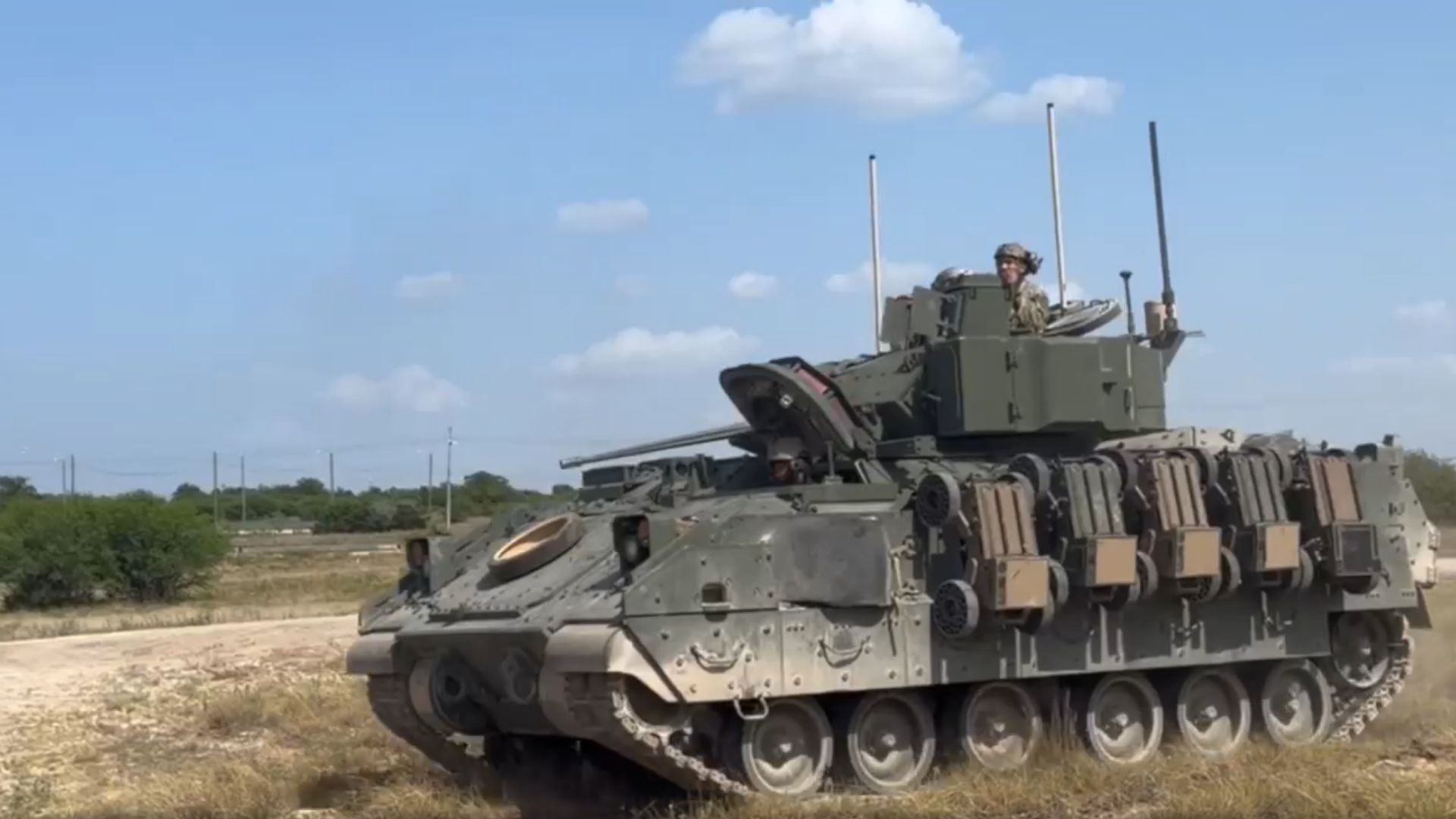
The U.S. Army is experimenting with a new way to bring small unmanned ground vehicles into armored formations. Carrying them directly on an M2A4 Bradley infantry fighting vehicle. Footage released by Swarmbotics AI on August 25, 2026, shows a Bradley carrying at least five FireAnt unmanned ground vehicles (UGVs) during the U.S. Army’s Pegasus Charge 3 experiment with the 1st Cavalry Division. The demonstration offers a glimpse of how existing armored vehicles could potentially transport and deploy multiple small robotic systems alongside their traditional crewed roles. In this Video, the FireAnts are visible on the Bradley’s external storage area, with five identifiable on the vehicle’s left side. The available footage does not establish whether another group of robots was mounted on the opposite side, nor does it show precisely how the vehicles would be removed and deployed. What is clear is that the Army is experimenting with physically integrating several small UGVs onto an existing frontline combat platform rather than relying on a purpose-built robotic carrier. Swarmbotics AI described the activity as “Ground swarms making movement to contact during Pegasus Charge 3 with the 1st Cavalry Division.” The experiment forms part of the 1st Cavalry Division’s broader work with emerging autonomous technologies under the Army’s Transformation in Contact initiative. FireAnt is designed for different missions FireAnt is a small, modular and attritable UGV developed by Swarmbotics AI for swarm operations. The company has described the platform as capable of supporting missions including intelligence, surveillance and reconnaissance, electronic warfare and counter-uncrewed aircraft operations. According to Army Recognition, FireAnt has also previously been shown in configurations designed for one-way attack and anti-armor missions. However, the vehicles visible in the new Bradley footage do not appear to feature the prominent anti-armor warhead configuration shown in earlier imagery. That leaves their specific role during Pegasus Charge 3 unclear. The modular design nevertheless means the same basic robotic platform could potentially be configured for different missions depending on the payload it carries. The Army is testing more than the robots The Bradley-FireAnt combination is significant not simply because the Army can physically carry several robots on an armored vehicle, but because it highlights a larger question. How should robotic systems actually become part of combat formations? Swarmbotics AI CEO and co-founder Stephen Houghton said, “Getting robots into the fight requires innovation and the flexibility to rethink doctrine.” That means determining how robots are transported, controlled, tasked, and integrated with soldiers and existing command structures. Using a Bradley as a carrier provides one way to explore those questions without waiting for an entirely new generation of specialized robotic vehicles. It could eventually allow armored formations to carry additional unmanned systems forward with them, giving commanders more options for reconnaissance, sensing or other missions in areas where exposing soldiers or larger crewed vehicles may carry greater risk. The video provides a particularly tangible glimpse of the Army’s approach to human-machine teaming. Instead of viewing small UGVs as independent systems operating separately from armored formations, the Pegasus Charge 3 demonstration shows them being physically integrated with a vehicle already used by soldiers.How effectively such systems can be controlled, sustained, and employed alongside soldiers will determine whether this unusual configuration becomes a recurring feature of future armored warfare.Get the latest in engineering, tech, space & science - delivered daily to your inbox.Kaif Shaikh is a journalist and writer passionate about turning complex information into clear, impactful stories. His writing covers technology, sustainability, geopolitics, and occasionally fiction. A graduate in Journalism and Mass Communication, his work has appeared in the Times of India and beyond. After a near-fatal experience, Kaif began seeing both stories and silences differently. Outside work, he juggles far too many projects and passions, but always makes time to read, reflect, and hold onto the thread of wonder.
US Army gives 28-ton Bradley armoured vehicle a robotic boost with FireAnt UGV swarms
Full Article
Original Source
Read the full article at Interestingengineering →KhanList aggregates and links to publicly available news content. We do not host full articles from third-party sources. Always verify important information with original sources.