
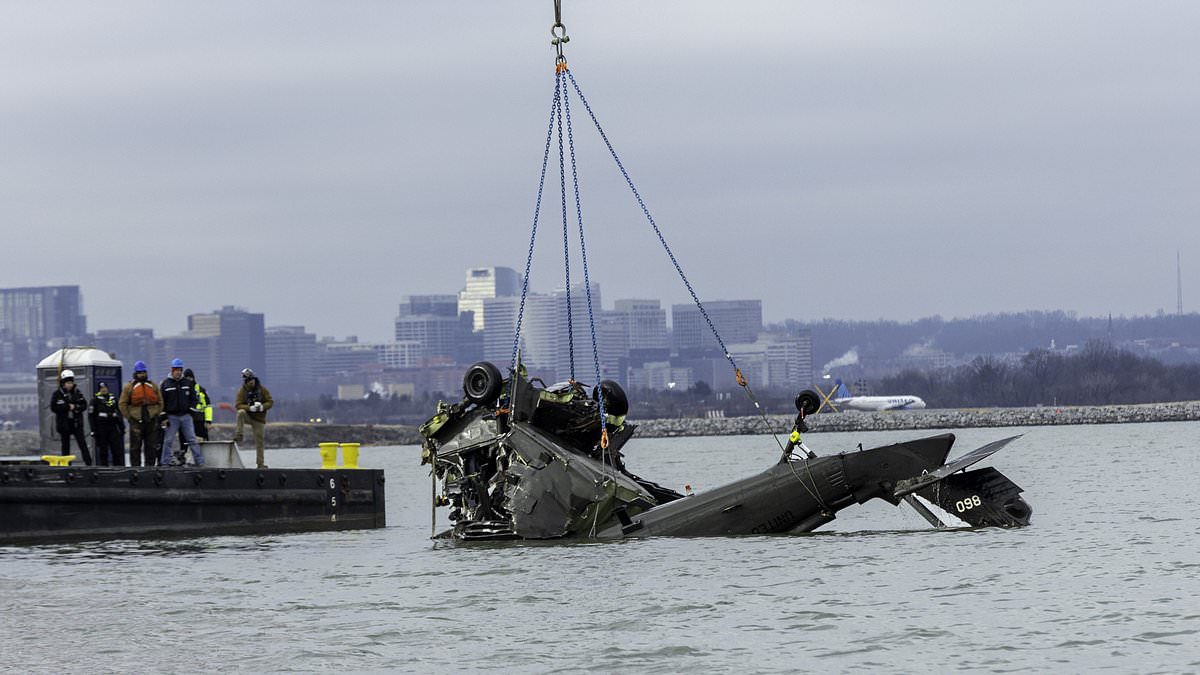
Military leadership failed to fix flaws with the Black Hawk helicopter involved in the deadly Washington, DC, midair collision last year, an Army report found. An American Airlines flight and a US Army helicopter collided over the Potomac River near Ronald Reagan National Airport in the nation's capital on January 29, 2025, killing 67 people. The tragic incident unfolded when Army Black Hawk pilot Captain Rebecca Lobach was undergoing an annual flight evaluation overseen by her co-pilot, Chief Warrant Officer Andrew Loyd Eaves, and crew member Staff Sergeant Ryan O'Hara.The jet was American Airlines flight 5342, a CRJ700 Bombardier flying from Wichita, Kansas, carrying 60 passengers, many of whom were part of the US figure skating community, and four crew members.A previously undisclosed Army report completed in May found that the crash, which was the deadliest commercial aviation accident in the US in almost 25 years, resulted from several systemic failures.The key factor was two broken radio transmissions that prevented the helicopter crew from receiving critical details from air traffic control.Several other issues included technical issues with the Black Hawk and a pattern of helicopter crews failing to fly semi-annual minimum hours.The report claims Army leadership knew about faulty altitude-reading instruments on old Black Hawk models – including the one involved in the crash – but failed to fix them or make pilots aware of the problem, according to a copy of the report The Washington Post obtained. An American Airlines flight and a Black Hawk helicopter collided over Reagan National Airport last year The crash on January 29, 2025 over the Ronald Reagan National Airport in Washington DC was the deadliest commercial aviation accident in the US in almost 25 years It also said the Army failed to collect data on near misses or train pilots for the dangers of busy Washington airspace, according to documents the newspaper obtained.The routes traveled by military and civilian aircraft were separated by just 75 feet, according to the Army report, which is similar to the National Transportation Safety Board (NTSB) report released earlier this year.In the report, the Army admitted it 'must implement and continue to grow as a learning organization and strengthen its safety culture.'The NTSB released a terrifying animation with its report that showed the view from inside the jet's cockpit in the moments before it collided with the military chopper.It showed pilots navigating dark skies and landing with the help of night vision, while air traffic controllers appeared not to warn them they were on course to hit the helicopter.It appeared suddenly to the left of the plane's windshield, hitting the jet in a flash and leaving no time for the pilots to swerve out of the way.That night, an air traffic controller was left to handle both helicopter traffic and manage planes, which should have been a divided duty, according to The New York Times.Both Lobach and Eaves acknowledged the message before requesting permission to fly by 'visual separation' – a practice that allows aircraft to avoid collisions based on their own observations instead of following instructions from the ATC tower.The tragic incident unfolded when Army Black Hawk pilot Captain Rebecca Lobach was undergoing an annual flight evaluation overseen by her co-pilot, Chief Warrant Officer Andrew Lloyd Eaves, and crew member Staff Sergeant Ryan O'Hara This suggests Lobach had spotted the plane herself, and her request was granted – but the Black Hawk helicopter continued to stray dangerously close to the flight path of the American Airlines jet, which was descending from a higher altitude.Just 15 seconds before colliding with the commercial aeroplane, ATC instructed Lobach to make a left turn after issuing a command to 'pass behind' the oncoming aircraft.The Black Hawk did not change course.Then, just a few seconds before impact, co-pilot Eaves turned to Lobach in the cockpit and reiterated the instruction from air traffic control.His order fell on deaf ears, and at 8:47.59pm ET, the night sky above Washington DC was briefly illuminated by the fireball that erupted as the two aircraft collided.The families of the victims gathered in DC last month to urge Congress to pass reforms to prevent future collisions. The Federal Aviation Administration (FAA) quickly restricted helicopter traffic around Reagan National Airport when it became clear that a helicopter route in the approach path of the airport's secondary runway didn't ensure enough separation between helicopters and planes. But the NTSB remains unsatisfied with the FAA's response to a third of the 33 safety recommendations it received.FAA Administrator Bryan Bedford testified on Capitol Hill in September that his staff will work to address those concerns, but he also needs guidance from Congress. A US Army report found that military leadership failed to fix flaws with the Black Hawk helicopter involved in the crashSteps have already been taken to prevent helicopters and planes from sharing the same airspace around Reagan Airport, and air traffic controllers are now prohibited from relying only on pilots to see other aircraft and avoid them.But concerning incidents continue, such as when an airline jet was allowed to take off just as President Donald Trump's helicopter was taking off from the White House in August.The Daily Mail contacted the US Army and the Pentagon for comment.
US Army brass knew Black Hawk helicopters were dangerously faulty before DC collision with airliner that killed 67, report shows
Full Article
Original Source
Read the full article at Dailymail →KhanList aggregates and links to publicly available news content. We do not host full articles from third-party sources. Always verify important information with original sources.