
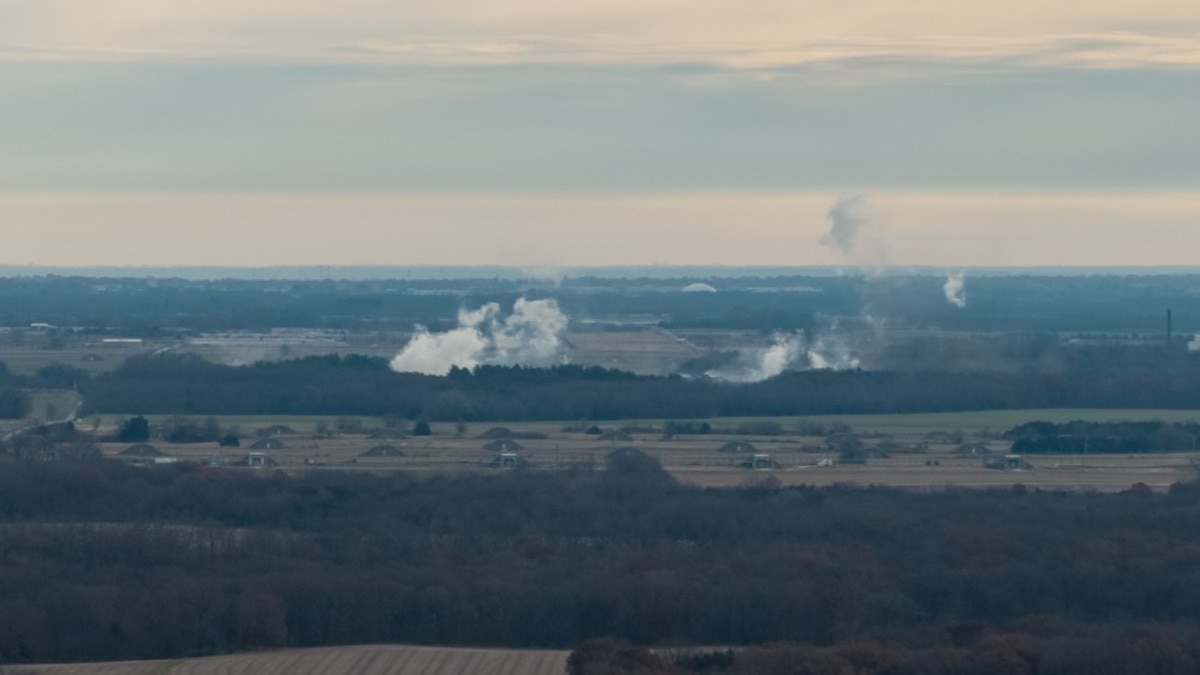
The US Army detonated nearly five tonnes of ageing military explosives at an ammunition plant in southeast Iowa on Wednesday, following the evacuation of residents amid fears of toxic contamination. A plume of grey and white smoke several hundred feet high was seen drifting south after the explosion.Video footage captured from several kilometers away showed two white plumes rising over the detonation site before quickly dissipating. Journalists in the area also reported hearing a loud boom as the explosives were detonated. Despite warnings to remain indoors, some residents pulled over along nearby roads to watch the blast from locations upwind of the ammunition plant.NOW: The exact moment of PLUMES FORMING as the US Army detonates unstable lead azide in Iowa They had INTENSE safeguards to block as much lead dust as possible from flying up and impacting nearby areas The Army said it could have exploded on its own at any time. This was the option against an unplanned, uncontrolled detonation— Eric Daugherty (@EricLDaugh) November 25, 2026The controlled explosion took place at the Iowa Army Ammunition Plant in Middletown, where 68 barrels of highly volatile lead azide had been stored in two earth-covered bunkers for more than two decades. The decision to destroy the chemicals in place, rather than attempt to remove them, prompted evacuations and widespread anxiety among residents over the potential environmental and health risks.Although military officials said they were aiming for "zero release" of toxic compounds, concerns remained over the possibility of lead dust escaping the containment measures and travelling beyond the blast site. According to local media, it could take some time to determine how much of the hazardous material was successfully contained during the explosion. The Army is expected to provide further updates as monitoring continues. NASA is also tracking the smoke plume through satellite imagery, while government agencies and independent researchers are assessing the extent of potential pollution and its environmental impact.The potential dispersal area extended southwest from Middletown towards Missouri, with Army maps warning that a failed detonation could send poisonous lead particles across as much as 150 square miles of farmland. In a worst-case scenario, the particles could travel up to 100 miles.RESIDENTS TOLD TO EVACUATE OR SHELTER IN PLACE Authorities had urged people living within the expected dispersal path, extending up to five miles southwest of the ammunition plant, to evacuate ahead of Wednesday's explosion. Government workers went door to door on Tuesday, distributing information sheets and advising residents to leave their homes. Others who remained were instructed to shut windows and doors, seal gaps and switch their heating systems to recirculation mode to prevent potentially contaminated outdoor air from entering their houses.The uncertainty surrounding the operation intensified shortly before the scheduled detonation. Less than an hour before the blast, an emergency alert sent to mobile phones in the area instructed residents to take shelter immediately."EVACUATION IS NO LONGER SAFE OR ADVISED," the alert read, directing those who had not already left to remain indoors.For many families, the day before Thanksgiving turned into an anxious wait. Some stayed indoors with their children home from school, baked pies and played video games while keeping their furnaces switched off to avoid drawing in outside air. Others had already left the area.WHY US ARMY DECIDED TO DESTROY THE CHEMICALSThe explosives involved in the operation contained lead azide, which is a highly volatile compound used to initiate explosions in military ammunition. The chemicals had remained inside ageing storage bunkers for more than 20 years. However, an inspection revealed that the barrels had deteriorated to such an extent that Army officials considered opening them dangerous.Rather than risk moving the unstable material, the military decided that destroying it through a controlled detonation was the safer option. Officials had also warned that leaving the chemicals in storage carried the risk of a spontaneous explosion. The Army prepared an extensive containment operation to minimise the possibility of toxic material escaping into the surrounding environment.Despite the extensive precautions, questions remained over how effectively the containment measures would prevent toxic particles from escaping.Officials' worst-case assessment was based on an assumption that no more than roughly a quarter of the dangerous material would escape the mitigation efforts. This raised concerns that the potential risks could be underestimated.Lead exposure is particularly dangerous because there is no established safe level of exposure. Children and pregnant women are especially vulnerable to its harmful effects.- Ends
US Army blows up tons of bomb-making chemicals in Iowa, plumes of smoke seen in sky
Full Article
Original Source
Read the full article at Indiatoday →KhanList aggregates and links to publicly available news content. We do not host full articles from third-party sources. Always verify important information with original sources.