
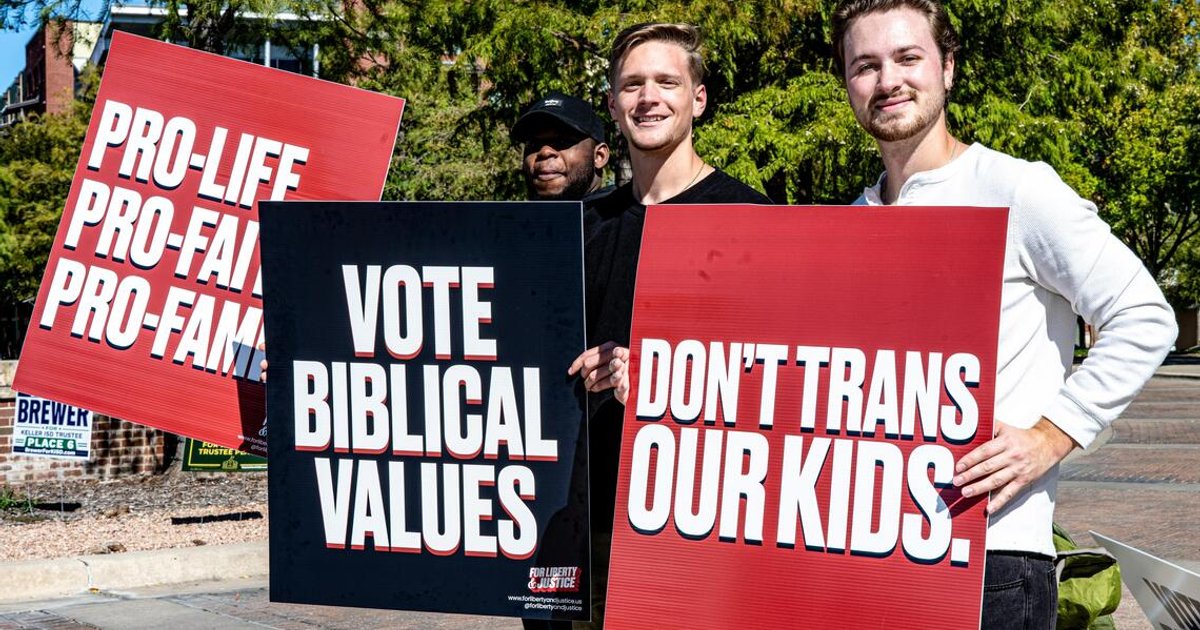
WASHINGTON – Voters in four US states approved ballot measures to restrict transgender rights in the Nov 3 midterm elections, sending a warning to Democrats on an issue that has divided the party and is likely to remain a political challenge heading into the 2028 presidential race.The measures succeeded even as Democrats swept to victory nationwide and retook control of Congress, suggesting voters who backed Democratic candidates were still receptive to some Republican arguments on transgender issues.Republicans hammered Democrats in midterm campaigns with attack ads painting their opponents as overly liberal on issues like the inclusion of transgender girls in sports, and gender-affirming care for minors.Democratic candidates were divided in their responses. Some adopted more conservative postures on the issues, some maintained pro-transgender positions and others sidestepped a topic that Republicans wielded effectively against Democrats in the 2024 election.Voters in Washington, Colorado, Arizona and Nebraska approved ballot measures prohibiting transgender children from playing on sports teams matching their gender identity or banning gender-affirming surgeries for minors.The success of the ballot measures was “disheartening”, said Rachel Tomlinson Dick, executive director of LGBTQ advocacy group Out Nebraska, adding that they expect to see similar measures on future ballots.Democrats were caught flat-footed against Republican attacks on transgender issues in the 2024 presidential campaign. The party’s struggle to deliver a coherent response was widely seen as a contributor to former vice-president Kamala Harris’ loss to Trump.This midterm cycle, candidates responded by emphasising the need for fairness and rules in sports, which diluted Republican attacks, said Lanae Erickson, senior vice-president at Third Way, a think-tank that promotes political centrism.Three of the states that passed anti-trans ballot measures – Washington, Colorado and Arizona – also elected Democrats to a majority of their state and federal seats.But the success of the measures shows the party still needs to hone a message that appeals to a broad public, Erickson said.“This week has shown us that Democrats have found effective ways to counter the anti-trans attacks when it comes to candidates, but that doesn’t necessarily mean that they’ve done the work to persuade voters on the issues,” said Erickson, who consulted with Democratic midterm candidates on their approach to transgender issues.A Reuters/Ipsos poll in April found that 67% of survey respondents supported banning transgender people from competing in female school sports. Ninety-two per cent of Republicans said they supported such bans, compared with just 44% of Democrats.Critics warn, however, that moving towards Republicans on trans issues is unlikely to win Democrats new support, and risks alienating LGBTQ voters and the party’s ascendant progressive wing.The Democratic National Committee did not immediately respond to a request for comment.Measures ban trans athletes, surgeriesSome transgender advocates said the Nov 3 electoral outcome was still promising even with the passage of the ballot measures.The surge of support for Democrats, including some like Michigan’s Abdul El-Sayed, who supported transgender rights, showed the limits of the Republican Party’s anti-trans campaign strategy, said Lexi Koren, a communications consultant for No Hate in WA State, a coalition group that opposed Washington’s two ballot measures on trans issues.“It was a resounding failure,” she said.Several states, including Alabama and Michigan, also elected transgender state lawmakers for the first time on Nov 3.Twenty-seven states had laws in place before Nov 3 restricting trans participation in youth sports, according to the nonprofit think tank Movement Advancement Project. That includes Nebraska, whose ballot initiative enshrined the ban in the state Constitution.Two other ballot measures on transgender issues were defeated on Nov 3.One, in Washington state, would have expanded parental access to school records, potentially enabling parents to learn about a student’s gender identity against the child’s will. Another, in Missouri, would have prohibited gender-affirming care for minors, and also would have repealed the right to abortion.Even where ballot measures lost, transgender people are still harmed by anti-trans rhetoric proliferating in politics, said Rodrigo Heng-Lehtinen, senior vice-president at the Trevor Project, an advocacy group for LGBTQ youth.“That kind of cultural hostility is not going to go away overnight,” he said. REUTERS
US anti-trans ballot wins pose challenge for Democrats ahead of 2028 presidential race
Full Article
Original Source
Read the full article at Straitstimes →KhanList aggregates and links to publicly available news content. We do not host full articles from third-party sources. Always verify important information with original sources.