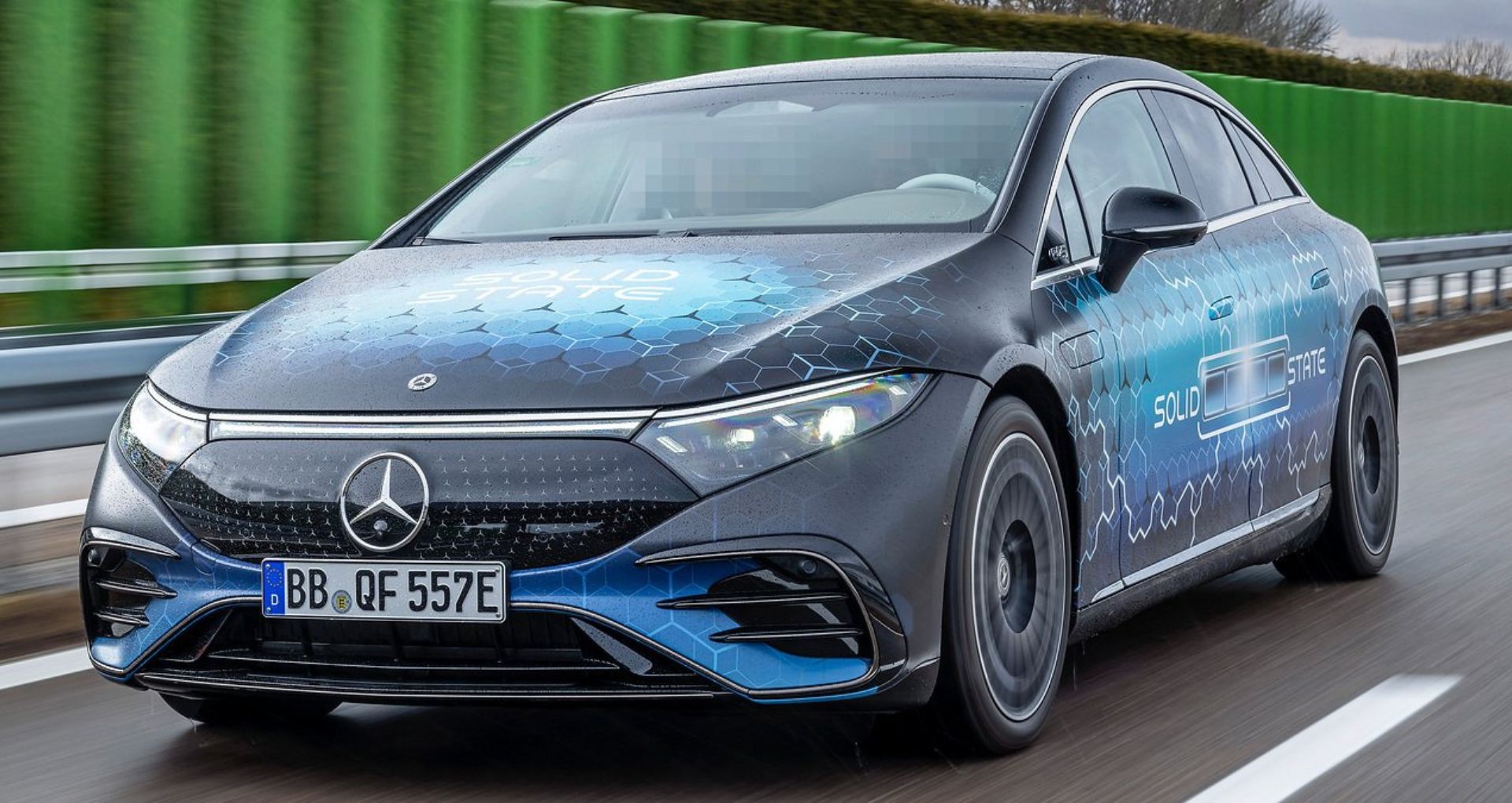
SK On already supplies batteries to Hyundai, Kia, Ford, Volkswagen and Ferrari.Mercedes Benz US battery developer Factorial Energy has partnered with South Korea’s (ROK) SK On to explore the large-scale production of solid-state batteries using existing lithium-ion battery manufacturing lines. The partnership aims to evaluate whether next-generation solid-state battery cells can be manufactured without building entirely new factories, a key challenge to commercial adoption. According to the Massachusetts-based firm, if successful, the approach could reduce production costs, speed up commercialization, and make it easier for automakers to introduce solid-state batteries. Recently, European firm SOLiTHOR unveiled its first 10 Ah solid-state battery cell, achieving 465 Wh/kg and 1,400 Wh/L to advance commercial-scale production. Battery scale evaluation Factorial has signed a memorandum of understanding with SK On to evaluate the production of its FEST solid-state battery technology using SK On’s existing lithium-ion battery manufacturing infrastructure. Under the agreement, the two companies will assess the technical feasibility and manufacturing requirements for scaling Factorial’s solid-state battery cells by combining the company’s battery technology with SK On’s manufacturing expertise and global production network. SK On supplies electric vehicle (EV) batteries to automakers including Hyundai Motor Group, Ford, Volkswagen, and Ferrari. The company operates more than 200 GWh of annual battery production capacity worldwide, including about 100 GWh in the US. The collaboration is intended to determine whether existing lithium-ion production lines can support future solid-state battery manufacturing, aligning with Factorial’s strategy of using established manufacturing infrastructure to accelerate commercialization. “A battery breakthrough only matters if it can be manufactured at scale. That is what makes this partnership with SK On so significant. Their manufacturing footprint spans some of the world’s most advanced battery facilities, and their expertise will be critical in shaping how solid-state battery technology integrates into global production ecosystems,” said Siyu Huang, CEO of Factorial, in a statement. Commercializing solid-state batteries Factorial Energy’s FEST (Factorial Electrolyte System Technology) is a quasi-solid-state lithium-metal battery platform designed to combine the energy density of lithium-metal anodes with the manufacturability of conventional lithium-ion cells. Instead of a liquid electrolyte, FEST uses a proprietary solid electrolyte that improves thermal stability while enabling fast lithium-ion transport. The technology supports high-capacity cathodes and lithium-metal anodes, targeting energy densities above 390 Wh/kg. Factorial says FEST is compatible with existing lithium-ion production lines, reducing manufacturing costs. The platform is already being validated with automotive partners including Mercedes-Benz, Hyundai Motor Group, and Kia for future EV applications. Recently, Stellantis began road testing Factorial Energy‘s solid-state battery technology after integrating the company’s FEST cells into a Dodge Charger Daytona development vehicle. The milestone marks the first time Factorial’s solid-state batteries have been installed in a Stellantis vehicle for real-world evaluation. The companies will assess the batteries’ performance, reliability, safety, and charging characteristics under everyday driving conditions. The development follows successful laboratory validation in 2025, when the partners demonstrated automotive-scale FEST cells delivering an energy density of 375 Wh/kg. The batteries also charged from 15 percent to 90 percent in 18 minutes and operated across temperatures ranging from -22°F to 113°F (-30°C to 45°C). To enable on-road testing, Stellantis redesigned parts of the battery pack, including a patented mechanical architecture that integrates the solid-state cells into its existing STLA Large platform while meeting automotive durability and safety requirements. Recommended ArticlesGet the latest in engineering, tech, space & science - delivered daily to your inbox.Jijo is an automotive and business journalist based in India. Armed with a BA in History (Honors) from St. Stephen's College, Delhi University, and a PG diploma in Journalism from the Indian Institute of Mass Communication, Delhi, he has worked for news agencies, national newspapers, and automotive magazines. In his spare time, he likes to go off-roading, engage in political discourse, travel, and teach languages.
US and ROK firms explore mass-producing solid-state batteries on existing EV lines
Full Article
Original Source
Read the full article at Interestingengineering →KhanList aggregates and links to publicly available news content. We do not host full articles from third-party sources. Always verify important information with original sources.