
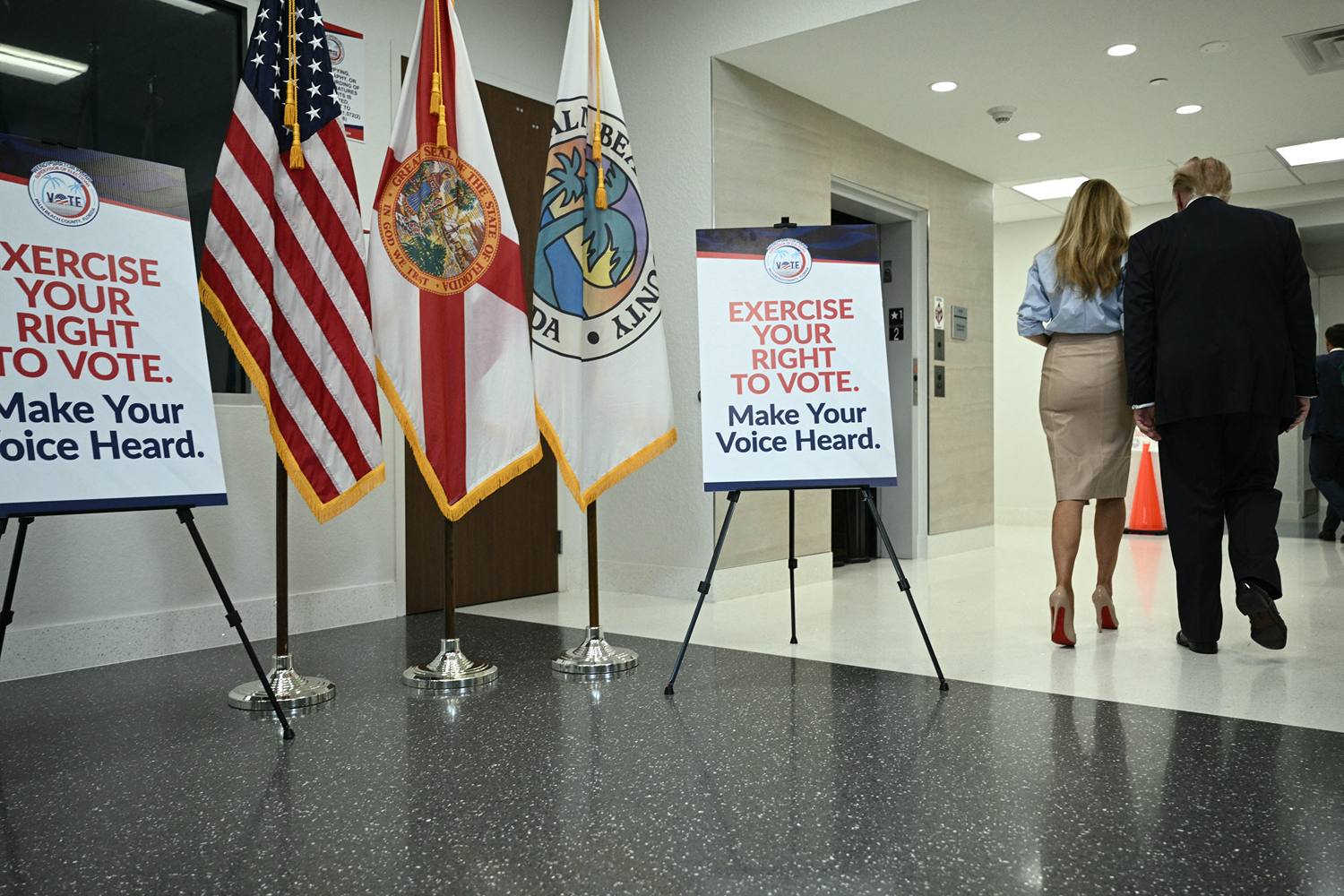
Europeans and Canadians are searching for signs that Americans have grown sick of Trump. The backs of U.S. President Donald Trump and First Lady Melania Trump are seen walking past American flags and voting reminder signs as they leave after voting at a precinct in West Palm Beach, Florida. U.S. President Donald Trump and first lady Melania Trump leave the Palm Beach County Supervisor of Elections office in West Palm Beach, Florida, after voting in the U.S. midterm elections on Oct. 24. Brendan Smialowski/AFP via Getty Images October 30, 2026, 11:52 AM With just days to go until the U.S. midterm elections, many Europeans and Canadians are watching closely to see if Democrats will retake Congress and perhaps begin to rein in U.S. President Donald Trump for his final two years in office. Canadians, who have been on the receiving end of some of Trump’s harshest trade actions, are so hungry for news about the U.S. midterms that they are searching for information at a higher rate than even Americans, according to Google search trends. With just days to go until the U.S. midterm elections, many Europeans and Canadians are watching closely to see if Democrats will retake Congress and perhaps begin to rein in U.S. President Donald Trump for his final two years in office. Canadians, who have been on the receiving end of some of Trump’s harshest trade actions, are so hungry for news about the U.S. midterms that they are searching for information at a higher rate than even Americans, according to Google search trends. “Normal, average Canadians know so much more about the United States and care so much more about the United States,” said retired Royal Canadian Air Force Maj. Gen. Scott Clancy, a former director of operations for the North American Aerospace Defense Command. “Whereas Canada doesn’t even come into the daily [consideration] for the vast, vast majority of Americans in any given day.” Europeans are also gripped by midterm fever. After Canada and the United States, midterm election information searches were the highest in Denmark, Qatar, and Norway—three countries that have also been rocked by Trump’s foreign-policy actions, from his aggressive claims on Greenland to the war against Iran. Damian Murphy, the senior vice president for national security and international policy at the liberal Center for American Progress think tank, said that European officials he’s met with lately are “laser-focused on the midterms.” Murphy said he has been struck by the granular level of knowledge his European interlocutors have shown for the state of play of individual House races. “What I’ve been telling them is that you shouldn’t have super high expectations for what any Congress can affirmatively do,” Murphy said. “In our system, the executive has a lot of power when it comes to the conduct of foreign policy. But what is important is the political message that it will send to the rest of the world: that the American people repudiate all of this—ICE [Immigration and Customs Enforcement], the Iran war, the treatment of allies.” Other foreign observers have cautioned against high expectations of a U.S. reversion to pre-Trump foreign policies even if Democrats win control of Congress. “Let us not overestimate the consequences of a defeat for the Trump administration in the midterm elections,” said former French Ambassador to the United States Gérard Araud in a recent post on X. “An American president holds considerable powers, particularly in foreign policy, and Trump can rely on the Supreme Court to bypass Congress.” The experiences of Trump’s surprise 2016 and 2024 presidential election wins also continue to act as ballast against runaway hopes of a blue tidal wave. “My philosophy of life is to have low expectations, and I apply that to the midterms as well. My mission is to stamp out any glimmer of hope of a return to normalcy after the midterms,” said one European diplomat, who requested anonymity to give an unvarnished take on the U.S. political situation. One outcome with a strong chance of occurring in November, though, is a vote on impeaching U.S. Defense Secretary Pete Hegseth over allegations of violating war powers and war crimes laws. A vote on the defense chief’s impeachment is likely to happen the week after the midterms. Even if Republicans find the votes to protect Hegseth in the impeachment vote, a new impeachment inquiry may be launched in January if Democrats win control of the House, as is predicted. Like the midterms, Canadians are likely to closely follow any impeachment process against Hegseth. The former Fox News host “deeply offended” many Canadians this fall, Clancy said, when he separately appeared to disparage Canadian troop cadets and denigrated the contributions of NATO allied troops who joined the U.S.-led mission in Afghanistan. “Personal friends of mine perished during that conflict,” Clancy said. Sam Skove contributed to this report. Elections United States Europe Rachel Oswald is a staff writer at Foreign Policy. X: @OswaldRachel Read More A black, white, and red graphic collage featuring the dome of the U.S. Capitol at the center, surrounded by smaller images depicting an airplane, law enforcement escorts, political figures, a microchip, and a hand holding a vote card. U.S. Democratic Rep. Mike Levin makes an open handed gesture as he speaks on the stage of a hotel in New York City. Hegseth Could Face Impeachment if Democrats Win in November One lawmaker lays out the case for indicting the defense secretary. Trump, a man in a dark suit and tie stands between dark curtains and American flags, illuminated dimly with the U.S. flag pattern visible in the background. Why the ‘Odds of Mischief Are High’ in These Midterms Is the United States destined for a repeat of Jan. 6 every election now? OTHER SUBSCRIPTION OPTIONS Stories Readers Liked Go to slide 1 Go to slide 2 Go to slide 3 Go to slide 4 Go to slide 5 Go to slide 6 Go to slide 7 Go to slide 8 Go to slide 9 Go to slide 10 Three people rest on a sandy beach while a large, partially submerged and tilted ship sits out in the water in the background. The sky above is a hazy gray with cloud cover. A Taiwanese crowd protests while waving flags of the Republic of China. U.S. Undersecretary of Defense for Policy Elbridge Colby, left, and NATO Secretary-General Mark Rutte, right, stand during a press conference at NATO headquarters. Rutte is looking over at Colby, whose fingers are pressed together in a steeple gesture in front of him. Both men are wearing dark suits and ties, standing in front of a blue backdrop and U.S. and NATO flags. A camera rig and a red light are partially visible in the foreground, slightly obscuring the center of the frame. Xi (left) and Trump (right) are shown up close, with Xi looking at Trump. Putin and Xi are both seen in profile as Putin walks to the right and away from Xi, just a few feet of space between them. Xi, meanwhile, is also faced away from Putin, standing and looking down at his feet or the red carpet beneath them. Both men wear dark suits. A man wearing a dark suit jacket, light blue button-down shirt, and patterned red tie sits on a dark gray couch against a textured dark blue wall. He is looking off to the side with a mild smile, next to a teal pillow. The Twilight of the Francis Fukuyama Era By Jeremi Suri An illustration in red and blue tones depicting five silhouetted figures running forward through a dark corridor flanked by large, textured Russian lettering on the walls and floor. Light radiates from the far end of the tunnel behind them A statue of a seated, bearded man with a bare torso and draped cloth around his waist, holding a scroll in one hand, positioned in front of a row of large classical columns. Negotiators from the United States, Canada, and five European countries converse after finishing the draft of the North Atlantic Treaty in Washington on March 18, 1949. Trans-Atlanticism Isn’t Dead—It’s Being Renegotiated By Alexandra de Hoop Scheffer An aerial photo shows Doha in the booming petrostate of Qatar.
U.S. Allies Have Midterm Fever
Full Article
Original Source
Read the full article at Foreignpolicy →KhanList aggregates and links to publicly available news content. We do not host full articles from third-party sources. Always verify important information with original sources.