
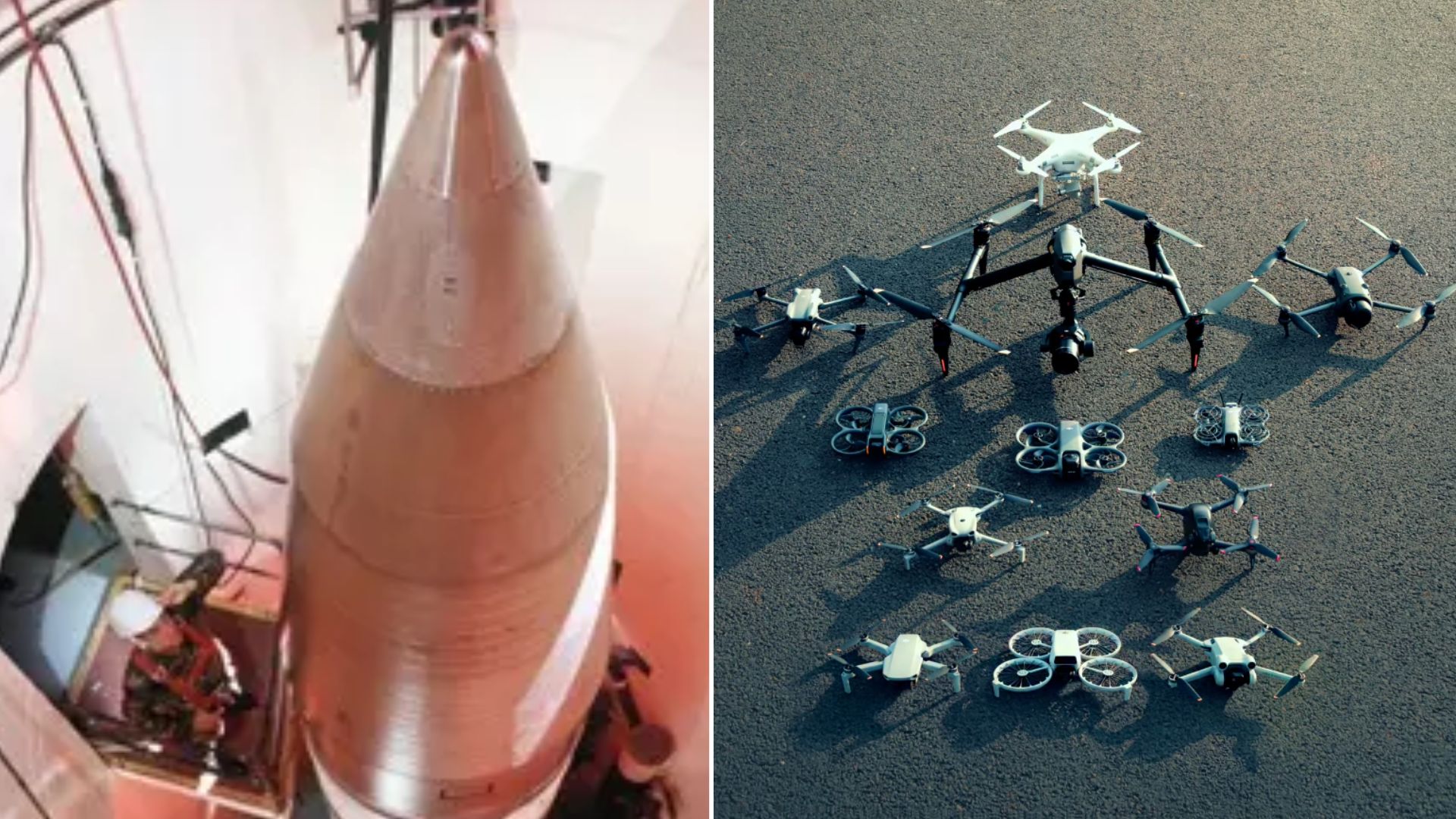
The U.S. Air Force is seeking to buy Chinese-made DJI drones for counter-drone training at F.E. Warren Air Force Base in Wyoming, home to part of America’s Minuteman III intercontinental ballistic missile force. The unusual procurement is being pursued by the 90th Missile Security Operations Squadron, which is responsible for security across the missile field and supports counter-small-unmanned-aircraft operations. The Air Force wants to use commercially available DJI aircraft as realistic targets so personnel can practice detecting and defeating the kinds of drones they could encounter around the base. According to procurement documents reported by Stars and Stripes, the service is seeking two refurbished DJI Mavic 2 Pro drones, two Mini 3 Pro drones and two Avata 2 systems, along with six payload-release devices and associated equipment. The selection of DJI is deliberate. The Air Force’s justification says DJI accounts for an estimated 80% to 85% of the global commercial drone market and that its aircraft have proprietary radio-frequency signatures, communications protocols and flight characteristics that cannot simply be reproduced by another manufacturer’s drone or a computer simulation. That makes the procurement less about acquiring Chinese technology for operational use and more about training against a specific and widely available threat. Why DJI? Small commercial drones have become an increasingly important security concern for military installations. A 2025 Air Force research program noted 350 reported drone incursions over more than 100 U.S. military installations during 2024, highlighting the scale of the counter-UAS challenge. F.E. Warren is a particularly sensitive location. The base hosts Minuteman III ICBMs, while the 90th Missile Security Operations Squadron supports security of the missile field and counter-small-UAS operations. The Air Force has also been expanding dedicated counter-drone training at the installation and elsewhere across its nuclear missile enterprise. The planned DJI aircraft would therefore serve as realistic training targets for systems and personnel tasked with protecting the missile infrastructure. The procurement comes despite Washington’s restrictions on Chinese-made drones. A July 2025 Pentagon memorandum, “Unleashing U.S. Military Drone Dominance,” emphasized a preference for domestically manufactured drones while also directing the military to train against modern drone threats. The Air Force’s procurement documents cited by Stars and Stripes say the unit can acquire limited quantities of foreign-made drone equipment for electronic-warfare testing, training and counter-drone development. Keeping the Chinese drones isolated The Air Force also plans to modify the aircraft before they are used. According to the procurement justification, the drones will be loaded with RIZER software, creating an air-gapped configuration intended to prevent data from being transferred to foreign entities or sensitive U.S. military networks. That allows personnel to train against the physical aircraft, radio-frequency characteristics and flight behavior of DJI systems while attempting to isolate the drones from external data connections. The procurement also comes as DJI continues to challenge its designation by the U.S. Department of Defense as a “Chinese military company.” In August, a U.S. appeals court ordered a lower court to reconsider part of the case concerning the basis for DJI’s designation. The Pentagon nevertheless continues to list DJI as a designated Chinese military company; a June 2026 Federal Register notice again included Shenzhen DJI Technology Co. Ltd. on the list. The planned purchase at F.E. Warren illustrates the unusual balance facing military counter-drone units. The most useful training target may be a commercial aircraft that the U.S. military would not normally want to procure for operational use. For the personnel protecting America’s ICBM infrastructure, however, accurately reproducing the drones they may have to defeat could be considered more valuable than simply training against a substitute. Get the latest in engineering, tech, space & science - delivered daily to your inbox.Kaif Shaikh is a journalist and writer passionate about turning complex information into clear, impactful stories. His writing covers technology, sustainability, geopolitics, and occasionally fiction. A graduate in Journalism and Mass Communication, his work has appeared in the Times of India and beyond. After a near-fatal experience, Kaif began seeing both stories and silences differently. Outside work, he juggles far too many projects and passions, but always makes time to read, reflect, and hold onto the thread of wonder.
U.S. Air Force to use DJI drones as targets at Minuteman III ballistic missile base
Full Article
Original Source
Read the full article at Interestingengineering →KhanList aggregates and links to publicly available news content. We do not host full articles from third-party sources. Always verify important information with original sources.