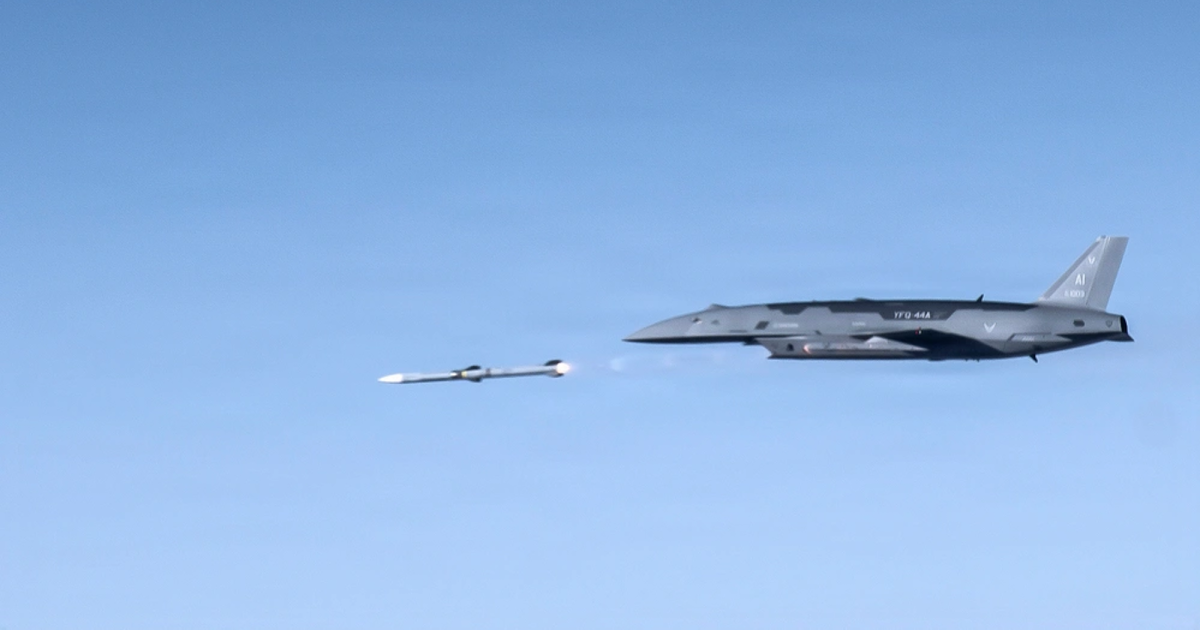
The YFQ-44A launching missileUS Air Force 1/2 The YFQ-44A in the airUS Air Force 2/2 The YFQ-44A launching missileUS Air Force In a US first, the US Air Force has successfully fired a missile from a Collaborative Combat Aircraft (CCA) Loyal Wingman. Conducted in collaboration with Anduril Industries, the YFQ-44A drone launched an AIM-120 missile at a digital target.If you're going to build robotic combat aircraft that will fly alongside conventional piloted fighter planes, you're going to reach the point where the drone has to let loose an actual weapon. Until now, aircraft like the YFQ-44A have flown with missiles aboard, but these have been little more than payload.That changed in the closed airspace over the Mojave Desert in California when the Anduril-built drone fired a live AIM-120 medium-range air-to-air missile at a target. No, that's not quite right. The YFQ-44A did most of the work of locating, acquiring, and closing with the target, but it was a human supervisor on the ground who gave the actual "fire" command based on standard US combat protocol, which forbids autonomous weapon release. New test footage: first missile shot from YFQ-44A. YFQ-44A executed an end-to-end, beyond-line-of-sight strike against a simulated target. The test, executed out of @EdwardsAFB, represents an important step in turning CCA into an operational capability. pic.twitter.com/70cRIs6uXJ— Anduril Industries (@anduriltech) July 15, 2026 Missiles have been fired from drones before, but those were remote-piloted aircraft with a human operating the flight controls from the ground. This test, performed in coordination with the 412th Test Wing’s Air Dominance Combined Test Force, was far more than a pre-programmed weapon drop.Instead, it was a complete, dynamic air-to-air engagement sequence driven by software. The onboard computer utilized Anduril's Lattice software to seek out the target, lock on, and compute an intercept course. The only human intervention was the fire order, after which the computer resumed control for the actual release."Moving from inert carriage earlier in the year to this weapon release demonstrates program maturity, allowing us to validate our digital integration models with actual data," said General. Dale White, portfolio manager for Critical Major Weapon Systems. “These tests provide operational validation that Collaborative Combat Aircraft can execute the weapon employment sequence autonomously within pilot-defined parameters, accelerating capability delivery to the warfighter."Source: US Air Force Tags David Szondy is a playwright, author and journalist based in Seattle, Washington. A retired field archaeologist and university lecturer, he has a background in the history of science, technology, and medicine with a particular emphasis on aerospace, military, and cybernetic subjects. In addition, he is the author of four award-winning plays, a novel, reviews, and a plethora of scholarly works ranging from industrial archaeology to law. David has worked as a feature writer for many international magazines and has been a feature writer for New Atlas since 2011.
US Air Force makes its first wingman drone missile launch
Full Article
Original Source
Read the full article at Newatlas →KhanList aggregates and links to publicly available news content. We do not host full articles from third-party sources. Always verify important information with original sources.