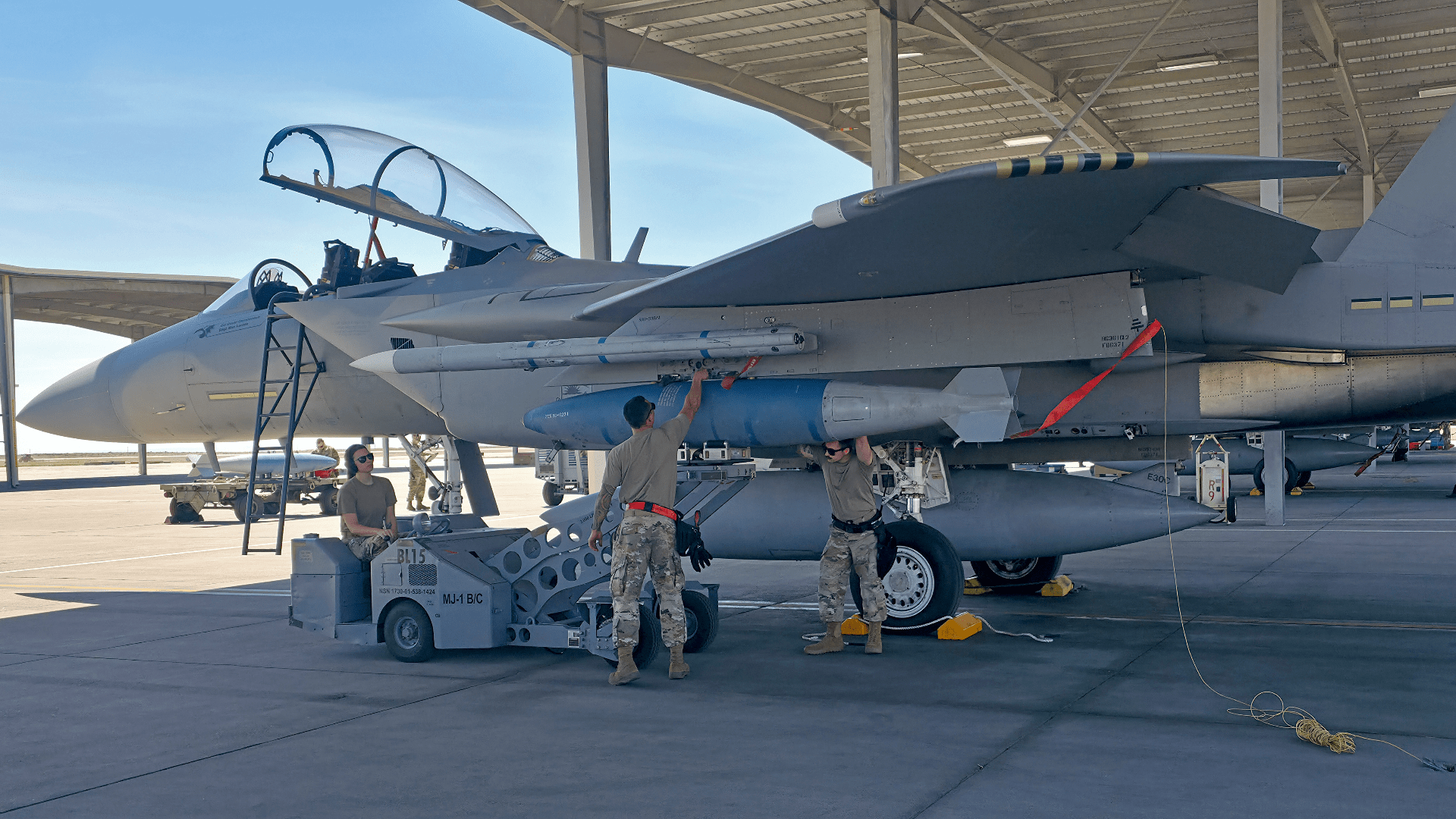
The US Air Force’s 142nd Wing has completed its first live bomb-dropping exercise with the F-15EX Eagle II, marking a key milestone in expanding the aircraft’s operational capabilities. In early May, pilots, maintainers, and munitions specialists traveled to Mountain Home Air Force Base in Idaho to carry out the training mission. During the exercise, crews loaded 500-pound BDU-50 and 2,000-pound BDU-56 practice bombs onto the aircraft before releasing them over the Mountain Home bombing range. Although these training munitions closely resemble live bombs, they are filled with concrete instead of explosives, allowing crews to safely practice real-world weapons employment. While the F-15EX has previously undergone weapons testing with the 85th Test and Evaluation Squadron at Eglin Air Force Base in Florida, this marks the first time an operational F-15EX unit has successfully loaded and dropped bombs as part of its mission readiness training. F-15EX’s new combat role required months of pilot training The F-15EX Eagle II is designed to do far more than its predecessor. Although it closely resembles the aging F-15C, the newer aircraft is built as a multirole fighter, capable of carrying out both air-to-air and air-to-ground missions. Unlocking that expanded capability, however, required months of preparation and specialized training across the 142nd Wing. A key part of that effort was led by Maj. Jesse Loya, one of only three pilots in the wing with prior experience in air-to-ground operations. Together, the three completed a nine-month training program focused on the tactics and technical aspects of delivering precision-guided munitions. They then developed a training curriculum to teach the rest of the wing’s pilots the fundamentals of air-to-ground operations, laying the foundation for the unit’s first operational bomb-dropping mission. According to Loya, the training at Mountain Home Air Force Base served as a stepping stone toward preparing pilots to safely employ air-to-ground weapons. The program focused on building the skills needed to handle ordnance while following a much shorter timeline than the traditional nine-month qualification course. He said the ability to complete the training so quickly reflected the experience and capabilities the pilots had developed throughout their careers, allowing the wing to accelerate the F-15EX’s transition into a multirole combat aircraft. Weapons loaders play key role in prepping F-15EX Preparing the F-15EX Eagle II for its first bomb-dropping mission required extensive training from weapons crews as well as pilots. Tech. Sgt. Tyler Phelps, one of the 142nd Wing’s experienced weapons loaders, traveled to Nellis Air Force Base in Nevada earlier this year to train with F-15E aircraft and earn certification to load bombs. After returning to Oregon, Phelps and other certified Airmen trained the rest of the weapons team ahead of the Mountain Home mission. Seeing the bombs loaded onto the F-15EX marked the culmination of months of preparation and a major milestone for the 142nd Wing. The training mission involved 10 sorties, during which crews dropped a total of 24 BDU-50 and 12 BDU-56 practice bombs. The operation was completed without any safety incidents, and all missions received satisfactory evaluations, marking a major step forward in the wing’s transition to the multirole capabilities of the F-15EX. The next phase in the F-15EX’s air-to-ground certification process will involve loading and dropping live munitions. The crew is scheduled to conduct that mission at Nellis Air Force Base at the end of August, bringing the wing one step closer to full air-to-ground operational capability.Recommended ArticlesGet the latest in engineering, tech, space & science - delivered daily to your inbox.Bojan Stojkovski is a freelance journalist based in Skopje, North Macedonia, covering foreign policy and technology for more than a decade. His work has appeared in Foreign Policy, ZDNet, and Nature.
US Air Force crews drop 36 practice bombs to validate F-15EX strike capability
Full Article
Original Source
Read the full article at Interestingengineering →KhanList aggregates and links to publicly available news content. We do not host full articles from third-party sources. Always verify important information with original sources.