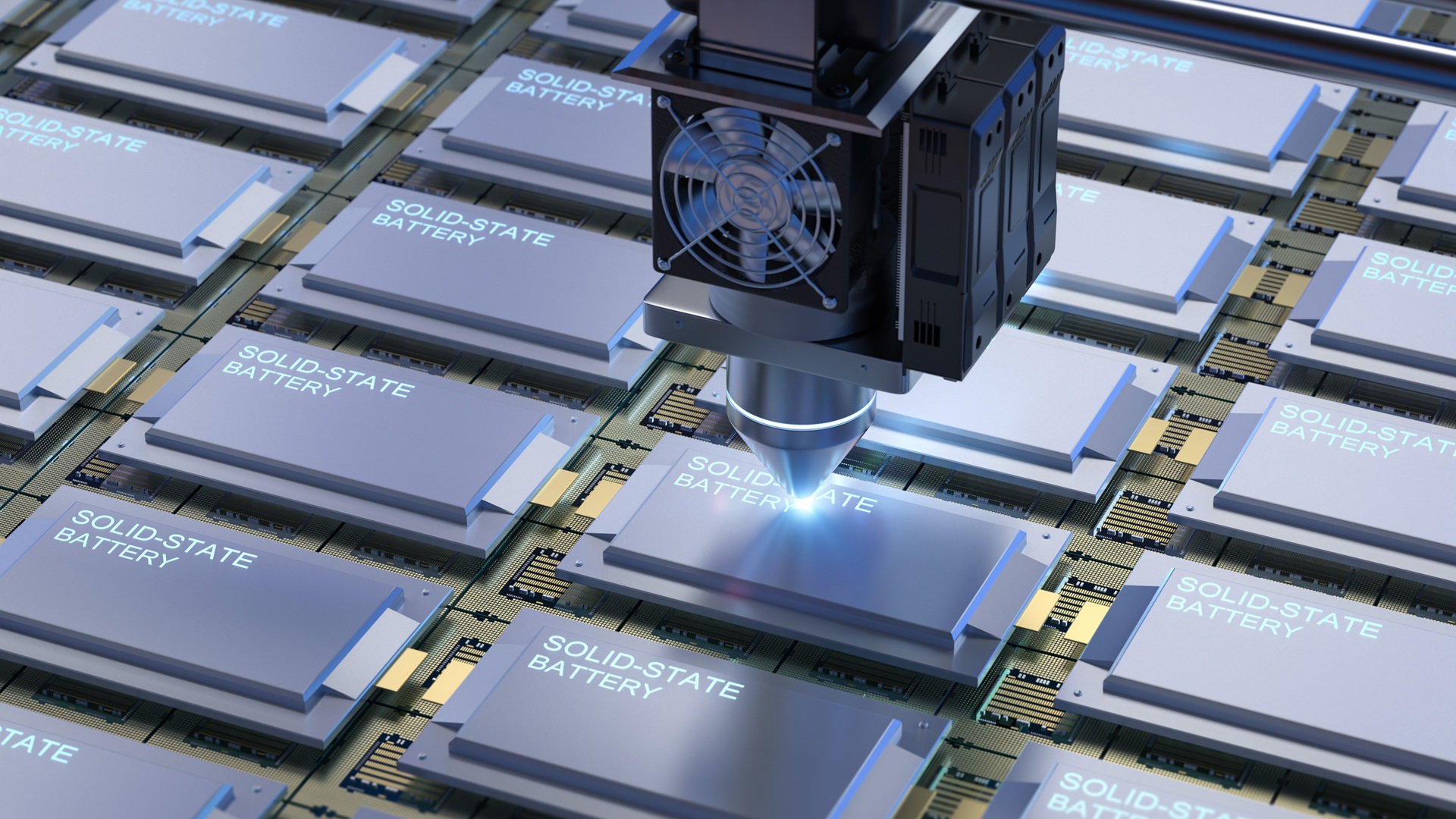
Scientists in the US have identified nearly 63,000 promising materials that could advance solid-state battery technology and speed up the development of safer and higher-performing energy storage. The researchers at Cornell University used an artificial intelligence (AI) framework called IonNet to search millions of possible materials for fast-ion conductors that are critical components of solid-state batteries. They replace the flammable liquid electrolytes found in conventional lithium-ion batteries with solid materials. However, finding solids that allow lithium ions to move rapidly enough remains a major challenge. According to the researchers, IonNet can predict how effectively lithium ions can move through a solid material using its chemical composition. “Most AI models for materials require reliable crystal structures, which are often unavailable for new or experimentally reported compounds,” Fengqi You, PhD, a professor at Cornell University and study co-author, stated. “IonNet predicts ion mobility from chemical composition, even without precise crystal structures.” Looking for new materials The researchers first applied the IonNet to roughly 4,500 stable compounds. They identified 87 potential fast-ion conductors. But after expanding the search to five million substituted chemical compositions, the system spotted 63,000 candidates with properties that could make them suitable fast-ion conductors. To determine whether the AI predictions held up under more rigorous testing, the team selected about 20 candidates for physics-based simulations. They managed to confirm a total of 13 as fast-ion conductors. According to You, the new approach could save significant computing resources by filtering out less promising materials before expensive simulations or even lab experiments start. He emphasized that evaluating just one material with physics-based simulations can require tens of thousands of CPU hours. “While IonNet does not replace experiments or high-level simulations, it is a fast front-end that prioritizes candidates before committing major experimental or computational resources,” You stressed. “Evaluating a single material by physics-based simulation can take tens-of-thousands of CPU hours.” IonNet can also identify chemical design rules associated with faster lithium-ion movement. This could give the researchers a better idea of why certain materials perform better. Unlocking higher voltages In a separate research involving You’s lab and collaborators from the University of Puerto Rico–Río Piedras, the scientists demonstrated that changing the chemical environment around ions could increase the voltage of concentration batteries. These unconventional batteries generate electricity from differences in electrolyte composition rather than using different electrode materials. They were previously assumed to produce less than 0.06 volts (V). However, the team engineered how ions interact with surrounding molecules and pushed zinc- and copper-based concentration batteries to as much as 0.7 volts, or more than 10 times the previously assumed limit. Once the electrolyte strategy was paired with conventional electrodes, the team produced water-based batteries operating between 2.2 and 2.5 volts. By contrast, a typical alkaline AA battery produces around 1.5 volts. “These electrolyte studies share the same larger goal to move battery design from trial and error toward rational design guided by AI, chemistry and physical insight,” You concluded in a press release. The studies have been published in the journals Science Advances and Nature Communications, respectively. Recommended ArticlesGet the latest in engineering, tech, space & science - delivered daily to your inbox.Based in Skopje, North Macedonia. Her work has appeared in Daily Mail, Mirror, Daily Star, Yahoo, NationalWorld, Newsweek, Press Gazette and others. She covers stories on batteries, wind energy, sustainable shipping and new discoveries. When she's not chasing the next big science story, she's traveling, exploring new cultures, or enjoying good food with even better wine.
US: 63,000 solid-state battery materials could unlock safer, better energy storage
Full Article
Original Source
Read the full article at Interestingengineering →KhanList aggregates and links to publicly available news content. We do not host full articles from third-party sources. Always verify important information with original sources.