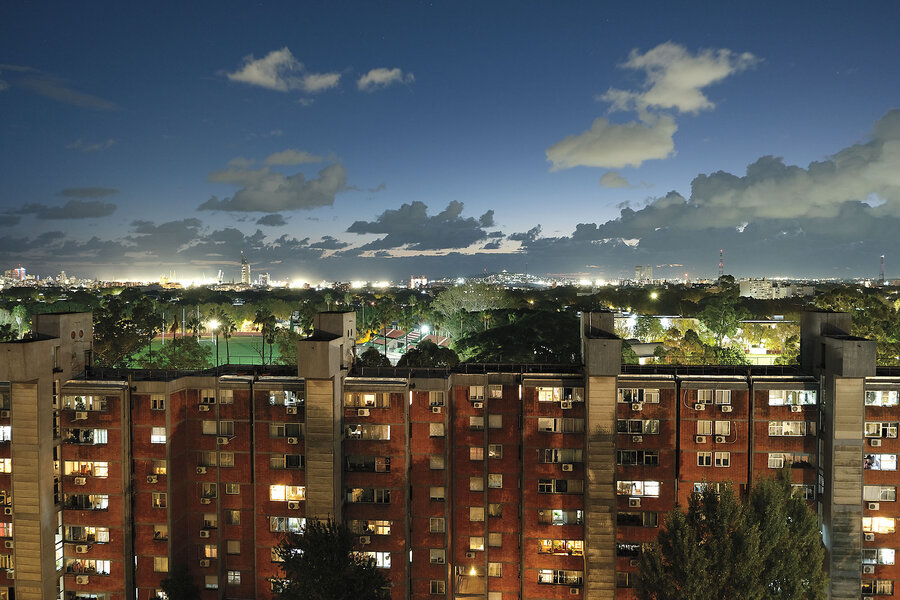
As a young couple with three children in the 1970s, Teresita Palomeque and her husband thought buying a house was an unattainable dream. So, when they were invited to join a housing cooperative – an emerging model at the time – they scrimped to pay the entry fee alongside colleagues from the bank where they worked. Construction lasted four years, and in 1975, the family of five moved into a compact three-bedroom apartment in a development of redbrick tower blocks on one of Montevideo’s main avenues. Ms. Palomeque still lives there to this day with a thousand other co-op residents. Why We Wrote This As affordability and housing crises grow worldwide, Uruguay's decades-old cooperative housing model is gaining new attention as part of a "tool kit of solutions." Collective housing is a model gaining attention across the globe as affordability and housing crises grow. Although collective home ownership exists from Sweden to Chile and Denmark to Canada, Uruguay’s cooperative housing policy has been enshrined into law since 1968 and is recognized as a way of giving lower- and middle-class Uruguayans access to dignified, affordable housing. “The Uruguayan case is iconic. It has been and continues to be an inspiration,” says Elkin Velásquez, regional director for Latin America and the Caribbean at UN-Habitat, the United Nations agency for urbanization.Cooperatives, and community-centered housing more generally, are part of a “tool kit of solutions” to the global housing shortage, estimated at 288 million homes, Mr. Velásquez says. It’s top of mind for people around the world, as concerns around affordability grow. The United States Congress passed a housing bill to boost supply, signed into law in early July. The 21st Century Road to Housing Act was one of the rare pieces of legislation to win bipartisan support in recent years.It was under similar conditions that the Uruguayan model was thought up in the 1960s, when the country was gripped by an economic crisis and a group of architects saw in co-op-owned residences a solution to the housing deficit. The idea drew on Uruguay’s strong culture of organizing through cooperatives and a working-class tradition of self-building homes, says Alina del Castillo, a professor at the University of the Republic’s Faculty of Architecture, Design, and Urbanism. There are now over 70,000 co-op-owned homes in Uruguay – 5.1% of the country’s total housing stock, according to the 2023 census. Some were built from scratch, sometimes by the residents themselves, while others repurposed existing buildings, all with state loans and technical support from a government-vetted group of experts.Uruguay’s law, which viewed an individual’s ability to work as a form of capital, was “ very pioneering,” says Dr. Del Castillo. Sandra Cáceres sits on her balcony in Montevideo, Uruguay, April 28, 2026. She helped found the Covicivi I cooperative, which renovated an abandoned bakery in Montevideo’s Old Town. It now houses 34 apartments. “Was it worth it?”Sandra Cáceres has a before-and-after photo of an abandoned bakery in Montevideo’s Old Town hanging by her front door. She put in 30 hours a week for eight years to restore the once crumbling structure in the 1990s. Today it’s a residential building with 34 apartments, one of which is hers.“The ovens were made of very long, large stones. The stones had to be removed; it was a huge amount of work,” she says. “It was tiring, but was it worth it? Of course it was.”The building’s transformation helped revitalize the rundown neighborhood and ward off real estate speculation. It also created a new sense of community. The societal “norm is for you to not know anything about who lives next door, above, below,” says Matías Paparamborda, who grew up in the same housing complex as Ms. Palomeque, Complejo Bulevar, and returned in 2021 after starting his own family. “Here, everyone knows who you are.”Residents’ children get priority to join the cooperative at Complejo Bulevar whenever a spot opens up – usually after someone dies.“We were convinced that this was the best place in the world to raise a kid,” says Mr. Paparamborda, as his son plays in the leafy central courtyard with other children. The complex isn’t closed off, which means communal spaces like a playground and a library have always been open to the wider neighborhood.Mr. Paparamborda is a writer and filmmaker and puts his social mobility – his father was an electrician and his mother a schoolteacher – down to the diversity of people he knew growing up in the co-op.But he says collective living has its challenges, too. “In general, the decisions that are taken during the assemblies are not what I would do,” he says. “But I’ve learned to embrace this, because one of the most important things that you learn with community living is that life is not about doing what you want.”Ms. Cáceres compares it to a marriage, where a couple must learn to compromise and cohabit. Filmmaker Matías Paparamborda grew up in the Complejo Bulevar cooperative housing complex and returned to live there in 2021 with his wife and young child. Changing timesThe number of co-op-owned homes more than doubled in Uruguay between 2011 and 2023. But the housing deficit has remained steady, at 400,000 homes.More than 60 years on from the national housing law, Dr. Del Castillo believes the system’s current rigidity may be holding it back. Rules around government funding for housing means that new cooperatives can no longer build commercial areas, or leisure spaces such as a soccer pitch, as part of a residential complex.“Regulations have become very restrictive. Projects are evaluated according to a checklist ... there’s no case-by-case study,” she says. “The law contains incredible values and for its time it was very innovative,” she says. But to meet the needs of a modern, growing society it may be time for the system “to be revised.” There’s no need to “copy-paste” the Uruguayan experience, Mr. Velásquez says. But if adapted to the specific conditions of each country, it can serve as an inspiration for other nations trying to navigate affordable, quality housing.
Uruguay offers a cooperative answer to the global housing shortage
Full Article
Original Source
Read the full article at Csmonitor →KhanList aggregates and links to publicly available news content. We do not host full articles from third-party sources. Always verify important information with original sources.