
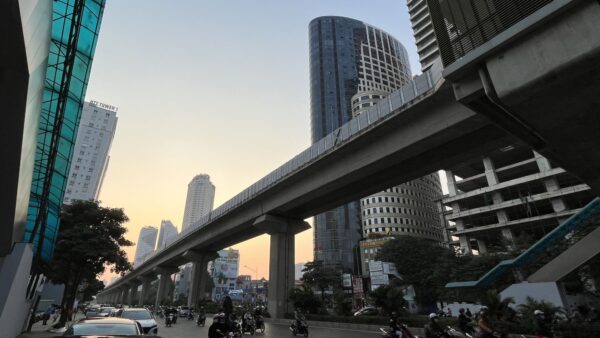
The last few years have seen a rapid expansion of urban rail systems throughout Southeast Asia, with major new lines going into operation in Malaysia, Thailand, Indonesia, Vietnam, and the Philippines, and more on the way. From 2015 to 2026, well over 400 kilometers of new track and extensions were completed across Bangkok, Kuala Lumpur, Jakarta, Manila, Hanoi, and Ho Chi Minh City. Between now and 2032, at least 200 kilometers are in an advanced stage of planning or already well into construction. In addition to that, Chinese-backed high-speed rail lines are already operating in Indonesia and Laos, with construction on additional lines in Thailand and Malaysia well underway. For rail enthusiasts and fans of public transit generally, the region is going through something of a golden era. And that’s not even counting Singapore, which has an extremely comprehensive transit system spanning the entire island. In 2015, Bangkok was operating its famous Skytrain, a single subway line and a rail link. The Philippines had an MRT that was over a decade old and two light rail lines, one of which was built in the 1980s. Kuala Lumpur had an airport link and commuter system, along with three rapid rail lines. In the decade since, tens of billions of dollars have poured into new and expanded lines all across the region, boosting capacity by hundreds of millions of passengers. Between 2016 and 2023, Bangkok opened the Purple, Yellow, and Pink lines at a combined cost of around $5 billion. The Orange line, with a price tag in excess of $4 billion, is expected to become operational in phases between 2028 and 2030. The Skytrain was extended, a commuter line was added, and extensions to the Purple line are underway. Ridership across the system increased from 359 million in 2017 to 520 million last year. Malaysia inaugurated its Shah Alam Line earlier this year, a project that cost approximately $5 billion, including five new stations still under construction. The Putrajaya line, which fully opened in 2023, cost around $7 billion and added over 50 kilometers of track. Kuala Lumpur and the surrounding area now have six rapid rail lines, not including commuter rail or bus, with total ridership of 330 million in 2025. Malaysia is also one of the few countries in the region that is starting to build urban rail in cities outside of the capital. Manila has been operating at least one light rail service since 1984. The MRT was fully opened in 2000 and a second LRT in 2003. Then very little progress was made, despite the fact that the system carried over 411 million passengers in 2014. That will change soon, as a new MRT line is nearing completion and should open next year. A $7 billion subway project is also underway, which is expected to be operational in the next few years, along with the 147-kilometer North-South Commuter Rail valued at around $14 billion. Indonesia and Vietnam are the newest entrants to the region’s modern urban rail club. Until recently, commuters in Jakarta had to make do with an aging commuter rail system that traces its roots to the colonial era. In 2019, the Jakarta MRT was opened, followed by a pair of light rail systems. The total cost was around $4 billion, and the system carried over 81 million passengers in 2025. Expansion plans, particularly for the MRT, are in various stages of development and construction. Vietnam opened its first metro line in Hanoi in 2021, and in Ho Chi Minh City in 2024. A second Hanoi metro line is partially operational, with full operations expected in 2027. More lines are planned. Progress on Vietnam’s metro lines has been very slow, however, in large part because of cumbersome land acquisition. If that bottleneck can be solved, we should expect the pace and scale of urban transit in Vietnam’s major cities to pick up in the years ahead. It’s clear that urban rail in the region is experiencing a huge resurgence. But what is driving this trend? One obvious factor is economic growth. Manila, Bangkok, and Kuala Lumpur invested in their metro systems in the late 1990s, but momentum slowed with the onset of the Asian Financial Crisis. It took over a decade to reach a point where they were comfortable investing in urban rail again and as their economic resources increase, more of those resources are being directed to building out urban infrastructure. We should also consider the role of China. It would be wrong to say that China is driving all of this. We see a range of financing and development arrangements across these projects, including a major role for Japanese development finance, multilateral lenders like the Asian Development Bank, European firms and even some domestic players. But Chinese capital and technology are certainly an important part of the story. It gives rapidly growing economies in the region more options as they look to upgrade and expand their urban transit systems, and it may encourage competitors to more aggressively pursue projects for fear of losing market share. We can debate the mechanism, but the result is clear: urban transit in Southeast Asia is absolutely booming, and looks set to keep growing in the years ahead.
Urban Rail in Southeast Asia Is Booming
Full Article
Original Source
Read the full article at Thediplomat →KhanList aggregates and links to publicly available news content. We do not host full articles from third-party sources. Always verify important information with original sources.