
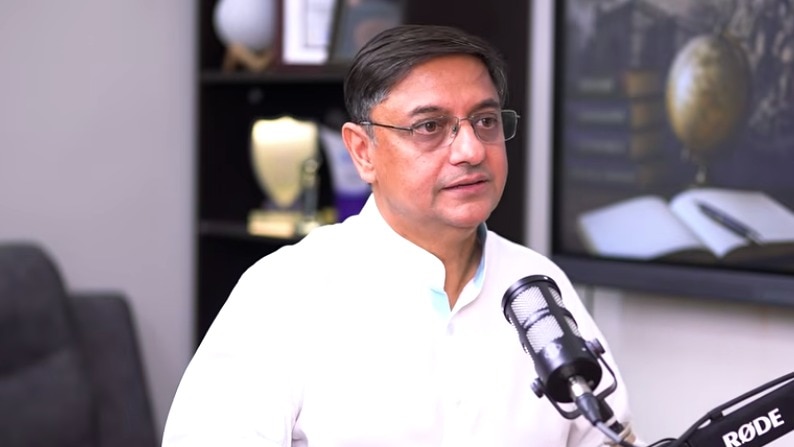
Sanjeev Sanyal has challenged the idea that some careers are inherently safe, using UPSC as a striking example. He explained why students should distinguish risk from uncertainty, avoid blindly following popular career paths and focus instead on skills, adaptability and whether they can sustain a chosen path.Sanjeev Sanyal has challenged the idea that some careers are inherently safe, using UPSC as a striking example. (Photo: YouTube/ProfMaheshPanchagnula)New Delhi,Sep 25, 2026 16:22 ISTFor Indian students and parents, a “safe career” often means UPSC, government jobs, banking, medicine, engineering or software. But economist, author and Prime Minister's Economic Advisory Council member Sanjeev Sanyal has challenged the very idea that any career comes with a guarantee of security.Speaking to IIT Madras professor Mahesh Panchgula on the Professor Mahesh podcast, Sanyal said students often spend too much time trying to identify the one perfect career decision.“There isn't one,” he said when asked about the safest possible career.He then used UPSC as an example. “First of all, you are taking a ridiculous risk in trying to get into this,” Sanyal said, pointing to the highly competitive nature of the examination and the years candidates can spend preparing. The Union Public Service Commission’s own data shows how competitive the civil services route is. Over 10 lakh people had applied for the UPSC Civil Services exams in 2023 and 5.95 lakh actually appeared for the UPSC Prelims 2023. Of them, only 1,016 candidates were recommended against 1,143 vacancies, while 1,410 candidates who reached the interview stage were not recommended.Sanyal’s argument, however, was not that students should not pursue UPSC. His point was that a socially respected career should not automatically be treated as a low-risk career.RISK IS NOT THE SAME AS UNCERTAINTY Sanyal said risk and uncertainty are different. Risk is when you can roughly estimate the chances of different outcomes. Uncertainty is when you cannot predict which way the future will go.“We are always living in this world,” he said, adding that society creates anxiety by making young people believe that one correct decision can put them on a fixed path to success.His advice is particularly relevant as AI and technology reshape jobs. A supposedly “future-proof” degree or job cannot guarantee that an industry will look the same 10 or 20 years later.SO WHAT SHOULD STUDENTS LOOK FOR?Sanyal suggested thinking less about finding a perfect path and more about whether you can sustain the one you choose.“Since persistence down those pathways matters because it's about path dependence, then one very important thing then comes up which is your ability to simply last the course.”His own career followed an unexpected route, from economics to financial markets and eventually economic policymaking.The practical question for students, therefore, may not be “Which career is safest?” but “If this path changes, what skills and options will I still have?”WHAY SANJEEV SANYAL SAID ON UPSC BEFORESanyal’s latest comments on career safety are part of a broader argument he has made about education and career choices.In December 2025, he questioned the idea of spending years chasing the UPSC exam simply for job security, arguing that young Indians should consider whether civil services is something they genuinely want rather than treating it as the default definition of a successful career.He had made a similar point in March 2024, saying too many young people were “wasting their time trying to crack the UPSC” and arguing that the exam should be pursued by those who actually want to become administrators.His views extend beyond competitive exams. In July 2026, responding to Elon Musk’s argument that college degrees are becoming less important, Sanyal said he had “come around to a similar view”. With knowledge widely available online, he argued, “college is not needed for lecture-based learning”.Taken together, his comments point to a consistent message: a degree, a competitive exam or a supposedly secure job should not automatically be treated as the safest route to a successful career. The bigger question is whether the path gives young people the skills, flexibility and options to adapt when the world around them changes.- Ends
UPSC is not a safe career: Sanjeev Sanyal's career warning on risky bets
Full Article
Original Source
Read the full article at Indiatoday →KhanList aggregates and links to publicly available news content. We do not host full articles from third-party sources. Always verify important information with original sources.