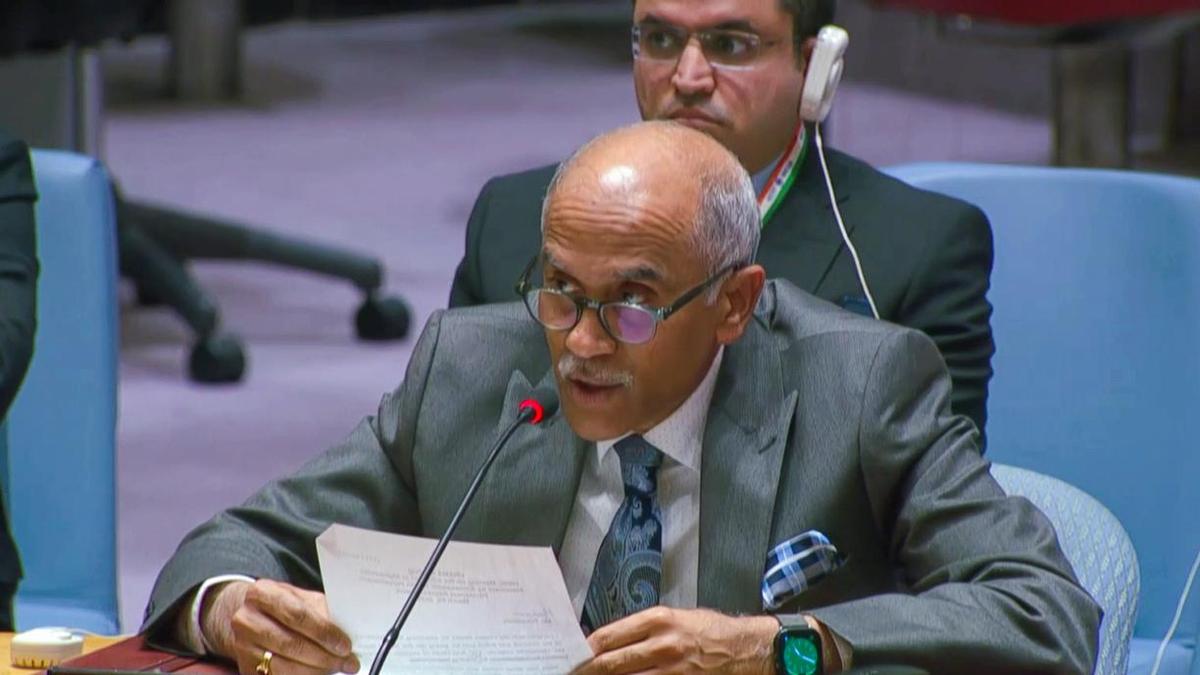
Permanent Representative of India to the United Nations, Parvathaneni Harish. File | Photo Credit: ANI India’s envoy to the UN said negotiations on Security Council reform have been through 17 rounds with no concrete result in sight, underscoring that the process cannot be held hostage by the “divisive interests” of a few.The UN General Assembly on Tuesday (July 28, 2026) decided to “roll over” to its next session the Inter-Governmental Negotiations (IGN) on Security Council reforms, an annual practice by the 193-member body that now enters its 18th year with no concrete results or end-date so far.Negotiations to reform the powerful 15-nation Security Council will now continue in the 81st session of the UN General Assembly that will commence in September.India joined the consensus to adopt the draft oral decision for the rollover of IGN on the ‘Question of the equitable representation on and increase in the membership of the Security Council’ to the 81st session, but voiced strong criticism over the lack of progress in achieving tangible outcomes and efforts by some Member States to stall the process.“The 80th IGN session, like the previous sessions, has not been successful in forging any outcomes or initiatives that could pave the way for implementing real reforms. The cluster debates have largely been a reiteration of known positions of member states and groups,” India’s Permanent Representative to the UN Ambassador Parvathaneni Harish said here Tuesday (July 28).In a statement at the adoption of the oral decision to roll over the Intergovernmental Negotiations to the 81st UNGA session, Mr. Harish invoked the Indian philosophy that a soul has to go through cycles of births and deaths, making incremental progress each time, before attaining liberation. “The IGN has been through seventeen cycles already. Sadly, however, there is no liberation in sight. How much longer should the world wait?” he said.Voicing strong criticism over the slow-moving reform process, India said that every session in which UN Member States spent “regurgitating” their positions from the "comfort of New York" dashed the hope for a fit-for-purpose UN in the real world. “There is a palpable sense of disappointment among Member States and global citizenry regarding the inability of the Security Council to meaningfully intervene in conflicts across the globe. The need for comprehensive UN Security Council reforms cannot be more pronounced, and more urgent. It cannot be held hostage by the narrow, divisive interests of a select few Member States,” Mr. Harish said.He emphasised that the path to securing such reforms is clear — text-based negotiations with clearly defined timelines and milestones.India said the outcome of such a genuine effort must lead to an expansion in both the permanent and non-permanent categories of UNSC membership, with greater representation of the Global South. “India stands fully ready to contribute to this endeavour. It is our sincere hope that the 81st IGN session would mark a new beginning on this count,” he said.Earlier this month, External Affairs Minister S. Jaishankar launched India’s official campaign for a non-permanent seat at the Security Council for the 2028-29 term. Elections for the 2028-29 term will be conducted in June next year, when India and Tajikistan will compete for the sole seat in the Asia-Pacific Group category.India had last sat in the UNSC in 2021-22, its eighth time at the horseshoe high table after tenures in 1950-1951, 1967-1968, 1972-1973, 1977-1978, 1984-1985, 1991-1992 and 2011-2012.India has called for expansion in permanent and non-permanent categories of UNSC membership, cautioning that reform of the UN Security Council will border on “failure” if only its non-permanent category of membership is expanded, as this will “fundamentally” not change the decision-making power structure of the five permanent members.The Uniting for Consensus (UfC) Group, which comprises Canada, Pakistan, Türkiye and Italy, has called for increasing Security Council seats exclusively in the non-permanent category. UfC proposes a 27-member Security Council, without any increase in the number of permanent members, which currently stands at five. Published - July 29, 2026 07:47 am IST
UNSC reform process cannot be held hostage by divisive interests of select few: India
Full Article
Original Source
Read the full article at Thehindu →KhanList aggregates and links to publicly available news content. We do not host full articles from third-party sources. Always verify important information with original sources.