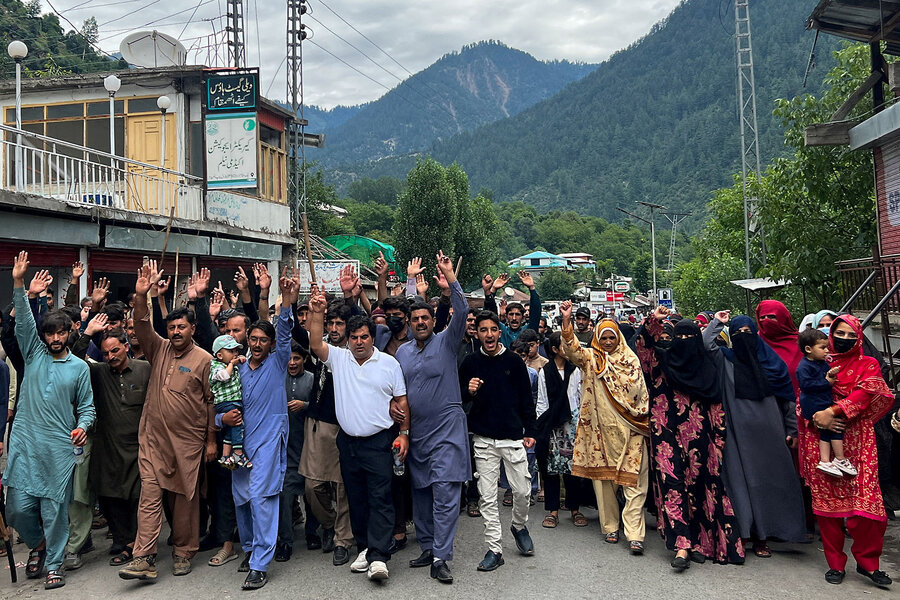
In an open-air field outside the city of Rawalakot – a picturesque hill station in Pakistan-administered Kashmir – thousands of protesters are camped under the stars. They have been there for more than a month, objecting to what they describe as state brutality and a lack of political representation.In the city proper, a curfew has been in place since early June after a wave of deadly protests and a subsequent security crackdown. Commerce has come to a virtual standstill, with shops shuttered and the internet restricted. ATMs aren’t working, either.Danish Irshad, author of the Kashmir history book “Azadi ke Baad” (“After Freedom”), hails from Rawalakot and works in Islamabad – meaning he can move freely between the two, something many people, including journalists, have been barred from doing in recent weeks. He says friends and relatives keep asking him to bring them cash. “People are in dire straits,” he says. Why We Wrote This When the world hears about turmoil in Kashmir, it’s usually from the Indian side of the disputed region. But ongoing protests in Pakistan-administered Kashmir reveal how both sides are grappling with thorny issues of political freedom, representation, and autonomy. Pakistan and India have fought several wars over Kashmir, a disputed, majority-Muslim region strategically located in the Himalayas. But in recent years, international attention has been fixed firmly on India’s side of the Line of Control. Separatist insurgencies, abuses by Indian security forces, New Delhi’s sudden revocation of Kashmiri statehood in 2019, and its ongoing crackdown on free speech have all reinforced Islamabad’s narrative that Kashmiris crave freedom from India, and that the region would be better off in Pakistan’s hands.The recent unrest – which is casting doubt over local elections that begin Monday – complicates that story.“There has always been this narrative in Pakistan that India suppresses and tyrannizes” the people of Indian-administered Kashmir, says Farhan Khan, a Kashmiri journalist. “Now, India can say that the things you accuse us of doing, you yourself are doing on a much bigger scale.”What are Kashmiris protesting?As a semiautonomous region, Pakistan-administered Kashmir has its own courts, prime minister, and legislature. The cause of the current protests is the reservation of 12 seats in that legislature for refugees from Indian-administered Kashmir who settled in Pakistan proper.This practice, which began in the 1960s, was meant to reinforce the idea that the entire Kashmir valley was one political unit. Kashmiri refugees fleeing across the border and settling in Punjab or other Pakistani provinces could still be recognized and represented as displaced people of Kashmir. But protesters now feel that only residents of Pakistan-administered Kashmir should decide how the territory is governed. They say recent occupants of these 12 seats have close ties to Pakistan’s civil-military establishment and little connection to Kashmir, and ultimately wield outsize power in the 53-member assembly.These concerns first surfaced in 2023 when nationalists, traders, and local activists banded together under the banner of the Jammu Kashmir Joint Awami Action Committee, commonly known as JAAC, to pressure Islamabad for fairer treatment.The JAAC demanded subsidized wheat and cheaper electricity as well as investment in infrastructure. Through negotiations with the federal government in Islamabad, an agreement was reached on most of these points. But both sides dug their heels in on the matter of the refugee seats, and tensions grew.On June 5, ahead of a planned demonstration by the JAAC, the government of Pakistan-administered Kashmir banned the group because it “engaged in terrorism,” and police arrested hundreds of JAAC activists. On the same day, according to the JAAC, a convoy led by one of its leaders, Umar Nazir, was attacked by law enforcement. Though Mr. Nazir escaped, one of his associates was killed, sparking demonstrations throughout the territory.Doubt over the region’s futureExperts argue that the roots of this crisis go back further, to the 1949 U.N. ceasefire that divided Kashmir between rival neighbors.Kashmiri analyst Safdar Gardezi says Pakistan-administered Kashmir has since been focused on a single issue: the liberation of the parts of Kashmir under Indian control.“From the syllabus in schools to the debates in the assembly, this idea became so dominant in public life that the matter of citizens’ rights was more or less forgotten,” says Mr. Gardezi, who writes regularly about the region’s political history. “The political class never needed to focus on reforms or governance.”In 2019, when India decided to revoke the special status of Indian-administered Kashmir, Pakistan downgraded diplomatic ties, campaigned in the United Nations, and suspended trade with India. But those actions ultimately had little effect, and some wish their government did more. In Pakistan-administered Kashmir, Islamabad’s failure to take consequential action was seen as not just a betrayal of the Kashmiri people but also a warning sign.“The initial reaction among the people was one of dismay that Pakistan had given India a walkover,” says Mr. Gardezi. “But after that, fears began to grow that Islamabad could also revoke the special status of Pakistan-administered Kashmir.”Last month, an unofficial delegation led by former Pakistani Prime Minister Shahid Khaqan Abbasi tried to visit the region, but was stopped en route by security forces. Mr. Abbasi says it is the responsibility of the Pakistani government to listen to the grievances of the people of Pakistan-administered Kashmir. “The issue can only be resolved through dialogue,” he says. “Using force is not a solution.”The political crisis has meant that legislative elections, originally scheduled for July 27, have now been staggered into three separate days over a period of two weeks. But the legitimacy of these elections is already being questioned, with the JAAC calling them a sham.In response, Pakistan-administered Kashmir’s chief election commissioner, Ghulam Mustafa Mughal, extended an invitation to election observers who want to keep an eye on the polls: “Our doors remain open to all observers, including those coming from Pakistan.”
Unrest in Pakistan-administered Kashmir casts doubt over polls – and region’s future
Full Article
Original Source
Read the full article at Csmonitor →KhanList aggregates and links to publicly available news content. We do not host full articles from third-party sources. Always verify important information with original sources.