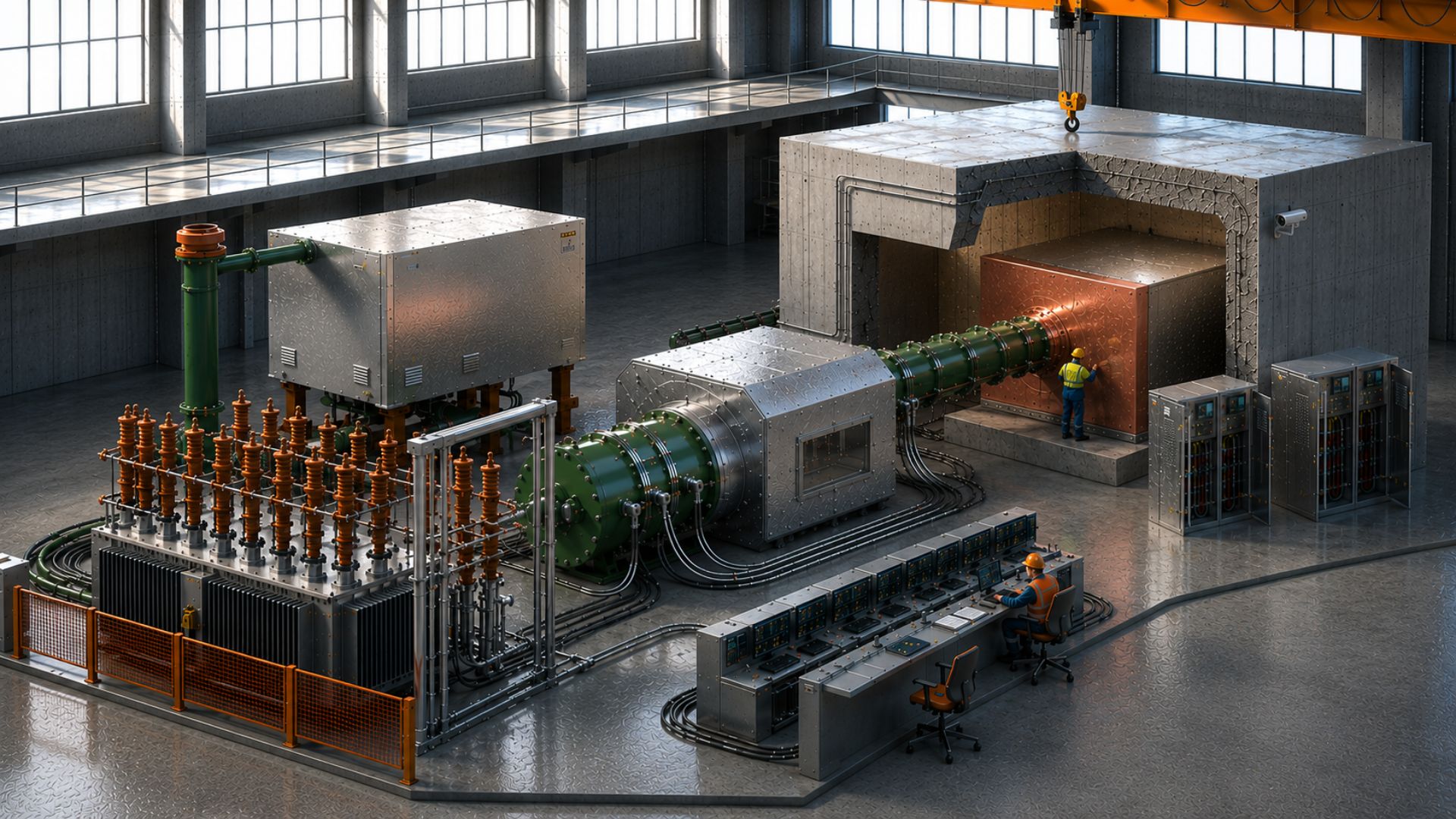
Japanese company Kyoto Fusioneering is relocating its primary US office to East Tennessee. Working with Oak Ridge National Laboratory, the firm plans to build a specialized testing facility called UNITY-3. The project receives funding from the US Department of Energy along with support from Tennessee’s Nuclear Energy Supply Chain Investment Fund. The initial agreement behind this project began in January 2026. The main technical goal of UNITY-3 is to solve a major fuel problem in fusion energy. “A fusion power plant runs on tritium, a hydrogen isotope that barely exists in nature, so the plant must breed its own fuel inside a lithium-bearing shell wrapped around the fusion reaction,” explained the company in a press release. UNITY-3 does this by placing a shell containing lithium around the fusion reaction. This shell, known as a breeding blanket, absorbs neutrons from the reaction to create fresh tritium. However, tritium breeding technology remains one of the least developed areas in nuclear engineering. Without working blanket systems, commercial fusion cannot function. UNITY-3 aims to test and de-risk these systems before full-scale power plants are built. Fits into broader US energy plans The new facility is equipped with a particle accelerator that generates high-energy fusion neutrons across a broad volume. Researchers will place prototype blankets inside this neutron environment to measure how much tritium is produced. They will also track how neutrons move through the materials. These physical measurements will help engineers correct and improve the computer codes used to design future fusion plants. Currently, no other facility combines this exact source shape, component scale, and deep measurement capability. This testing approach fits directly into broader US energy plans. The Department of Energy recently released its Fusion Science and Technology Roadmap, which identifies blanket testing as an urgent technical gap. Beyond hardware testing, UNITY-3 will also produce high-fidelity scientific data. This data will be fed into the Department of Energy’s Genesis Mission, specifically helping to train AI models for the AI-Fusion Digital Convergence Platform. These digital tools are designed to simulate reactor performance and speed up engineering timelines. Third stage of overall testing strategy The project forms the third stage of Kyoto Fusioneering’s overall testing strategy, known as the UNITY program. Rather than testing every component at once, the company isolates different physical processes across separate sites. The first facility, UNITY-1 in Kyoto, Japan, tests non-nuclear liquid-metal systems, focusing on heat transfer, liquid flow in magnetic fields, and power generation alongside Idaho National Laboratory. The second facility, UNITY-2 in Ontario, Canada, demonstrates a continuous tritium fuel processing loop in partnership with Canadian Nuclear Laboratories and Savannah River National Laboratory. “UNITY-3 adds the critical fusion-nuclear dimension — the neutronics, tritium production validation, and transmutation effects that can only be measured in a real fusion-neutron environment,” concluded the press release. UNITY-3 operates as an open facility that works regardless of a reactor’s specific plasma design. Several fusion companies, including General Atomics, Realta Fusion, OpenStar Technologies, Thea Energy, Xcimer Energy, and Type One Energy, have supported the project as a shared tool to test their designs. By settling in East Tennessee, Kyoto Fusioneering gains access to the regional nuclear workforce, local suppliers, and research staff at Oak Ridge National Laboratory. In return, the firm brings Japanese fusion hardware and manufacturing capabilities directly into the local industrial network. Get the latest in engineering, tech, space & science - delivered daily to your inbox.An active and versatile journalist and news editor. He has covered regular and breaking news for several leading publications and news media, including The Hindu, Economic Times, Tomorrow Makers, and many more. Aman holds expertise in politics, travel, and tech news, especially in AI, advanced algorithms, and blockchain, with a strong curiosity about all things that fall under science and tech.
Unprecedented US nuclear fusion facility to solve critical tritium crisis for reactors
Full Article
Original Source
Read the full article at Interestingengineering →KhanList aggregates and links to publicly available news content. We do not host full articles from third-party sources. Always verify important information with original sources.