
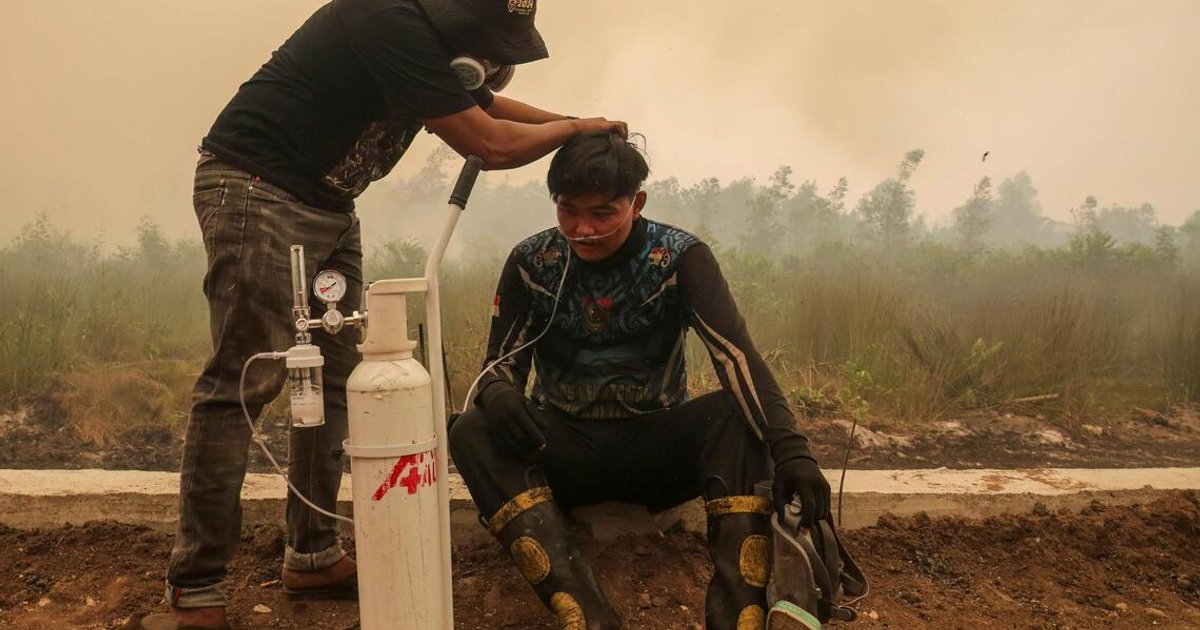
Smoke haze from Indonesia has blanketed the region since August, causing weeks of misery, from respiratory illnesses to curtailed outdoor activity and flight disruptions.The vast cloud of haze is much more than just particulate matter from forest and land fires. It also includes a toxic mix of polluting gases, including carbon monoxide (CO) and carbon dioxide (CO2), which together fuel climate change.Deputy foreign editor David Fogarty and infographics journalist Lim Yong take a deeper look.1. Carbon monoxide.When viewed from space, it is easy to see the vast plumes of CO that stretch across all of Indonesia, Singapore, Malaysia, northern Australia and towards India.It was a completely different picture a year ago, when there was no plume because there were no major fires.Carbon monoxide replaces oxygen in the bloodstream, starving the brain, heart and tissues of the air they need to function, according to Harvard Health. In the atmosphere, the compound can exacerbate global warming.CO does this by slowing the destruction of methane and other short-lived greenhouse gases in the atmosphere, increasing their lifetimes in the air. Methane is an even more powerful greenhouse gas than CO2 and forest fires also produce large amounts of this gas, creating a vicious cycle that accelerates global warming.2. Carbon dioxideAs plants grow, elemental carbon, or C-12, is stored in a plant’s trunk, leaves and roots. When plant matter is burned, the carbon oxidises into CO2. Indonesia’s fires have released large amounts of CO2 into the atmosphere, which is the planet’s main greenhouse gas.Especially concerning is dense peat, which is plant matter that has accumulated over hundreds to thousands of years in deep layers often several metres thick. Peatlands can burn for months, releasing a dense, toxic smoke.Monitoring agencies, such as the European Union’s Copernicus Atmosphere Monitoring Service, track the daily carbon emissions from Indonesia’s fires.To date, Indonesia’s fires have released about 200 million tonnes of elemental carbon (or roughly the equivalent of 733 million tonnes of CO2). That is approaching Indonesia’s total fossil fuel CO2 emissions of 813 million tonnes in 2024, according to the Global Carbon Atlas, which measures national greenhouse gas emissions.3. AerosolsCarried aloft over large distances are tiny particles that include soot from burning plant matter, dust and particles with a diameter of 10 micrometres or less.Haze also contains large amounts of fine particulate matter (PM2.5) with a diameter of 2.5 micrometres or less. These particles can lodge deep inside the lungs and enter the bloodstream, exacerbating existing respiratory and heart conditions.Other components include sulfate and sulfur compounds, dust from soil particles and volatile organic compounds, a key source of smog.In addition to aerosols, forest fires release nitrogen dioxide (another powerful greenhouse) that can inflame the respiratory tract and can be a risk for people with asthma or heart disease. Forest fire smoke can also increase ozone in the air, a key component of smog and a respiratory irritant.4. By the numbersThis year’s fires have burned nearly 2 million hectares (nearly 28 times the area of Singapore) as of September, according to satellite analysis by the deforestation monitor Nusantara Atlas. More than 1.2 million hotspots were recorded by September in a fire season fuelled by drought triggered by El Niño and illegal land clearing.The area burned has likely grown because severe fires continued to rage in Kalimantan, Sumatra, Sulawesi and South Papua during October.During the 2019 and 2015-16 haze episodes, more than 2.6 million ha burned. While heavy rains have started to fall in parts of Sumatra and Kalimantan, deep peat fires are likely to continue to smolder until persistent monsoon rains finally put them out.But there are concerns the current El Nino, which is still strengthening, will delay the onset of the north-east monsoon.David Fogarty is deputy foreign editor at The Straits Times and senior climate writer. He also covers the environment, in areas ranging from biodiversity to plastic pollution.
Unmasking the haze’s toxic cocktail
Full Article
Original Source
Read the full article at Straitstimes →KhanList aggregates and links to publicly available news content. We do not host full articles from third-party sources. Always verify important information with original sources.