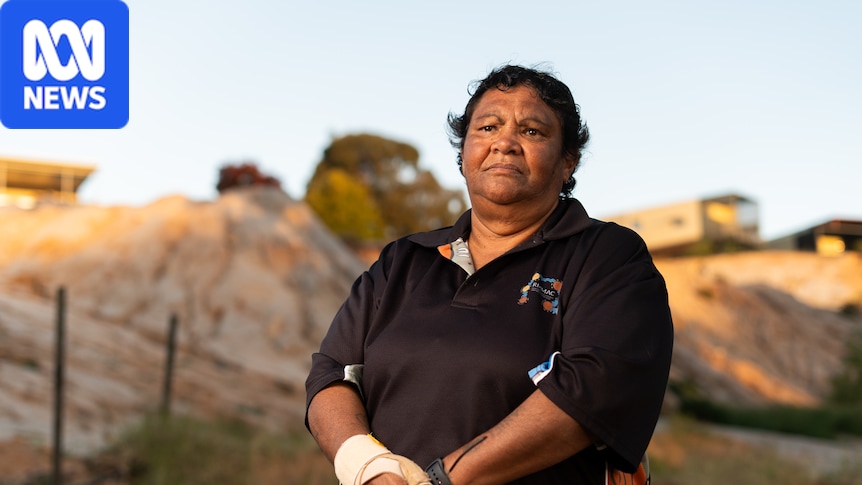
Standing along the banks of the River Murray on Erawirung Country, Aunty Sheryl Giles watches the sun set over a cliff face. It is something the Ngintait Nganguruku woman has done many times. But this cliff is special; it is the burial place of ancestors and home to artefacts that tell a story of Aboriginal occupation from thousands of years gone by. Ms Giles said both had been irreversibly changed by an unlawful excavation carried out four years ago. Warning: Indigenous readers are advised this story contains details some may find distressing.Aunty Sheryl Giles says there are two dreaming stories directly related to the River Murray cliffs. (ABC News: Lincoln Rothall)"This is now country that can't be shared for generations because it's gone. It's not Country, it's man-made now ... the story is gone," she said."Just because we didn't fence our cemeteries doesn't mean they're not there."Renmark Paringa Council documents show landowner Arisvi Holdings Pty Ltd instructed earthworks at the site without any development approvals in March 2022. The company received a retrospective approval three years after the initial excavation. It was also found in breach of planning and environmental acts in relation to the excavation.The company issued a statement through its lawyer that said that since the earthworks, the company had been investigated by or had to engage with various regulatory authorities."Arisvi has fully cooperated with the relevant authorities ... all the matters have been resolved," the statement said."There are no outstanding investigations against Arisvi to its knowledge." A big dig without consent The private land is in South Australia's Riverland, about 260 kilometres north-east of Adelaide. It is a picturesque riverfront site surrounded by several houses and tourist accommodation businesses. Council documents show Arisvi Holdings's director Stavros Georgantas and Anastasios Babaniotis, who had an informal interest in the land, instructed a bulldozer operator to excavate the site. The site in 2014 before the development. (Supplied: Kerry Twyford)The current state of the site. (ABC News: Lincoln Rothall)Six weeks later, the Renmark Paringa Council became aware of the earthworks and issued a stop work order.This prompted a retrospective application proposing a staged development of the site: the first for earthworks and a land division, and the second for houses to be built. The River Murray Act 2003 Referral Policies state that modification of landform within 50 metres of the River Murray should not occur. (ABC News: Lincoln Rothall )The State Commission Assessment Panel rejected the application in full. "The proposal does not minimise modifications to the natural landform and, as a result, will have detrimental impacts on the natural features and stability of the waterfront," it said.The Department for Environment and Water "strongly encouraged" Arisvi to consult with the local Aboriginal corporation about protecting cultural heritage. (ABC News: Lincoln Rothall)Arisvi Holdings fought to have the decision overturned in the Environmental Resources and Development Court.This time, it was successful, and stage one was approved. The statement from Arisvi's lawyer said it had not benefited from the earthworks, which occurred in 2022."In accordance with settled legal principles, Arisvi obtained no advantage in the assessment of its development application by virtue of works having been commenced on site prior to receiving development approval," it said. A devastating discoveryAn anonymous call in July 2025 alerted the River Murray and Mallee Aboriginal Corporation (RMMAC) to the excavation, more than three years after the dig had occurred. Uncle Willow says ancestral remains were scattered across the site, and artefacts were exposed in the soil. (ABC News: Lincoln Rothall)It led to Ngintait elder and RMMAC board director Philip Johnson, better known as Uncle Willow, to assess the site. "I saw a bit of a skull part with an eye socket in a big pile of dirt and it wasn't very good to see," he said.Uncle Willow said ancestral artefacts, including human-generated shell deposits, known as middens, were also disturbed. The bones were confirmed to be Aboriginal ancestral remains in August 2025. (Supplied: RMMAC)"I nearly cried; it was very bad. I was thinking of my children," he said. "Our ancestors got disturbed on that land and it's just not right [in] my eyes."Freshwater shell middens reflect the collection, cooking, eating and gathering of Aboriginal ancestors. (ABC News: Lincoln Rothall)Professor of archaeology at Flinders University Amy Roberts has conducted archaeological exploration of clifftops in the Riverland. She said River Murray waterways and cliffs were areas that had preserved some of the oldest evidence of Aboriginal life and history. "We've found sites that are 30,000 years old upwards to maybe even 40,000 years old on those clifftop areas," she said.Remains confirmedSix months into becoming RMMAC's new chief executive, Les Harris learnt of the excavation and immediately contacted the Aboriginal Affairs and Reconciliation (AAR) Department, and all other relevant authorities.Les Harris says RMMAC should have been alerted to the site back in 2022 due to it bordering Crown land. (ABC News: Lincoln Rothall)Mr Harris said RMMAC provided Uncle Willow's assessment to the department to further investigate. He said the department's report showed the magnitude of the excavation and its impact.The site in July 2025. (Supplied: RMMAC)"I believe there were at least 40 points put in the report where there was a culturally significant location or area," he said. "There is at least two human remains located at that site and it's been scattered quite significantly ... about 20 to 25 metres of area."The site borders Native Title and Crown land. (ABC News: Lincoln Rothall)AAR said the remains were confirmed in August 2025. A spokesperson said there was no Aboriginal heritage documented on the property prior to the excavation. "Should the developer wish to progress with further ground-disturbing works that may impact Aboriginal heritage, authorisations under the Aboriginal Heritage Act 1988 would be required," they said. The site was closed for a period of time whilst the remains were being investigated. (ABC News: Lincoln Rothall)Arisvi's statement from its lawyer said the matter with RMMAC had been resolved."Aboriginal Affairs and Reconciliation [Department] has determined not to take any further action regarding alleged contraventions of the Aboriginal Heritage Act and has closed its investigation," it said.Mr Harris said RMMAC had provided Arisvi Holdings with recommendations to protect Aboriginal heritage at the site in the future, in line with the Aboriginal Heritage Act. He said he could only hope they would be followed. "[The recommendations] … include potential re-burial, relocation and even just fencing off or excluding areas of the block to protect the cultural heritage there," Mr Harris said. The Aboriginal Heritage Act 1988 says areas near rivers may have campsites, shell middens, burials, and other signs of Aboriginal occupation. (ABC News: Lincoln Rothall)The exhausted neighboursGary and Kerry Twyford have enjoyed a riverside life for years and their home was meant to be their dream retirement location.But the excavation, reaching within metres of their back deck, had disrupted those plans. Gary and Kerry Twyford say they contacted multiple state government departments in search of answers. (ABC News: Lincoln Rothall)"It has ended up more like an open-cut mine in a residential zone," Mr Twyford said."It's dragged on for four years … [we] can't go through it anymore."The couple said the surrounding neighbours had all dedicated extensive time, effort and money to seek answers and stop further work from going ahead. Gary and Kerry Twyford's daughter got married at the property. (ABC News: Lincoln Rothall)Mr Twyford said he had crunched the numbers, including travel, hiring a lawyer and even hiring a town planner to understand what had happened. "I would say we wouldn't get much change out of $100,000," Mr Twyford said.Gary and Kerry Twyford say they want reassurance that the foundation of their home is safe. (ABC News: Lincoln Rothall)Despite their best efforts, the couple said they felt no-one had been held accountable. "The whole system has so many loopholes. I don't even know why they have them in place," Mr Twyford said.Penalties and prosecution Renmark Paringa Council chief executive Tony Siviour said it initially pursued a criminal prosecution against Arisvi Holdings for the unlawful excavation but later made a financial settlement.The $150,000 was paid for breaching the Planning, Development and Infrastructure Act 2016. Of that, $100,000 was paid to cover council's legal fees. "Council intends to use the [remaining $50,000] towards parks, open space, environmental and landscaping works," Mr Siviour said.Six river red gum trees were removed from the site without prior approval, according to DEW's public register. (ABC News: Michael Coggan)Meanwhile, the Environmental Protection Agency SA found breaches of the Environment Protection Act following reports of run-off into the River Murray. In an August 2022 document, it said the sediment run-off was caused by "development-related activity". The sediment bank that had washed into the River Murray measured approximately 3 metres wide by 7 metres long by 300 millimetres deep, according to EPA documents. (Supplied: Renmark Paringa Council)The EPA issued a clean-up order in response. "Arisvi Holdings was found to have polluted the environment by discharging, or failing to prevent the discharge of sand, clay, gravel and soil from the site into the River Murray," an EPA statement said. "Thereby caused material environmental harm, namely increased turbidity or sediment levels in the River Murray. "The company complied with the order and it was lifted in 2024. In the past 12 months no further reports have been made in relation to the site." An AAR spokesperson says it "intends to ensure" the state's Planning Commission is aware of the ancestral remains and artefacts to "assist with the assessment process". (ABC News: Lincoln Rothall)While stage one of the application was retrospectively approved in April 2025, an amendment was submitted in May 2026. This included some minor changes to the location of the two proposed residential pads. That change is now under review. The Arisvi response said its current application with the State Planning Commission was "for a variation to its development approval to reduce the level of earthworks.""Construction works on site have stopped while Arisvi awaits the outcome of the variation application," it said.Aunty Sheryl Giles says she has been left devastated. She feels let down by the systems that are meant to protect her ancestors and culture. Aunty Sheryl Giles says a lot more education is needed to protect Aboriginal heritage and culture for generations to come. (ABC News: Lincoln Rothall)"I don't think non-Aboriginal people see the importance of a burial site and the significance to us; they're still our great, great, great grannies," she said.
Unlawful excavation of river cliff disturbs Aboriginal ancestral remains
Full Article
Original Source
Read the full article at Abc →KhanList aggregates and links to publicly available news content. We do not host full articles from third-party sources. Always verify important information with original sources.