
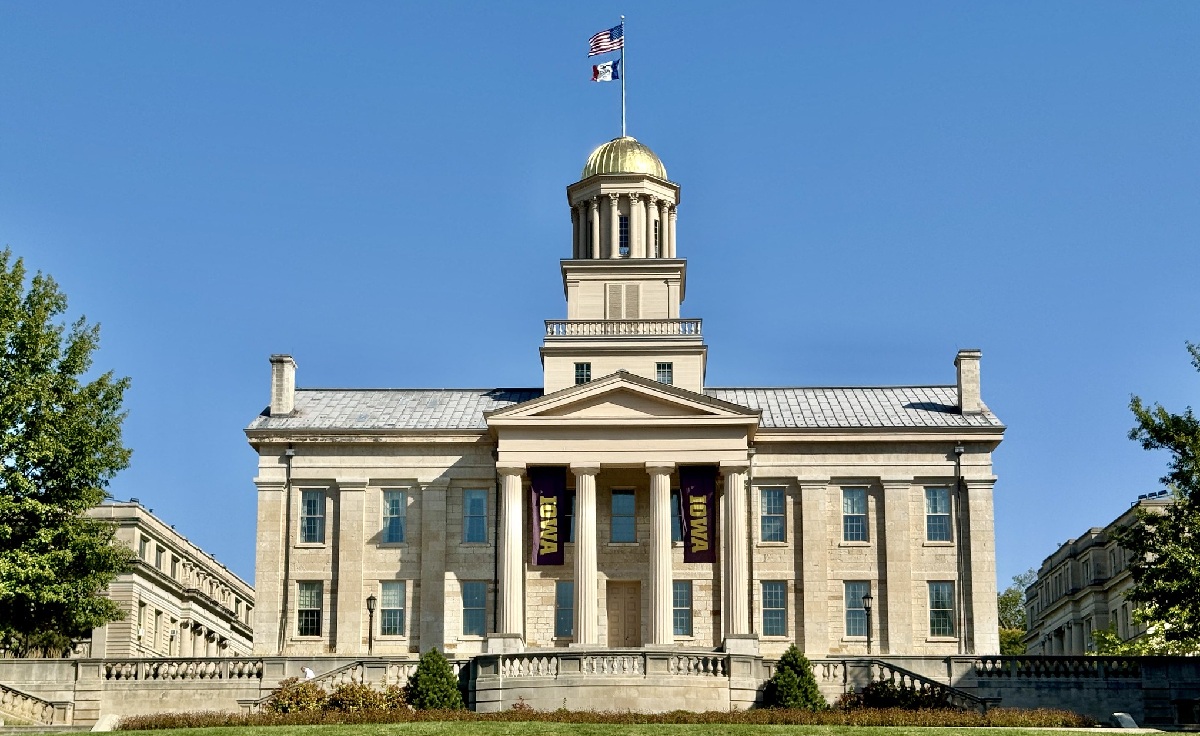
Since 2022 nearly two dozen “civics centers” have been created at American universities. Their primary purpose is to teach college students about the American Founding and the instruments of self-government in our republic. They are a rebellious innovation, authorized and funded by state governments that do not trust their public universities to carry out this basic mission of higher education. In principle, the new civics centers are also supposed to give academics who are on the outs with the progressive establishment the opportunity to teach without the hamstringing that comes from woke colleagues and administrators. The civics centers might be counted as true innovations in the grim landscape of contemporary higher education. But getting them off the ground has not been easy. A case in point is the University of Iowa. It offers a case study of what can and has gone wrong in the attempt to establish an island of intellectual sanity in the ocean of complacent leftism. The evolution of the Center for Intellectual Freedom at the University of Iowa has been an up and down process. Earlier this year, the center tried to hire a headhunter firm to help with the search for a permanent director, but negotiations with the first firm broke down and no other one was hired. In September, most of the scholars on the advisory committee resigned in protest at the regents’ assumption of authority over the operations and budgeting of the center. A few weeks later, after the executive committee did not select him as a finalist for the permanent position, the interim director filed a grievance with the state accusing the regents of violating the center’s bylaws. Soon after, the first choice for permanent director declined the regents’ offer. Now, the regents have chosen another candidate as permanent director, and the offer has been accepted. It’s a terrible selection. His name is Brian Lai, and he’s a professor of political science at the University of Iowa. His academic profile falls well short of the broad understanding of U.S. history and civics that the center requires. Worse, his recent work reinforces the very identity politics to which the center was meant to provide an alternative. In July, a research study by Lai and coauthor Lindsey Goldberg was published in the journal International Interactions. The title of the study is “Leading Ladies: Gendered Perceptions of Chief Executives and International Threats.” The purpose of the study is to gauge how women leaders of states around the world are perceived and how this perception affects international policymaking. The prose is littered with phrases such as “stereotypically masculine responses” and “gender stereotypes,” “gender equality in politics” and “gendered doubts of [women’s] abilities.” Lai and Goldberg hope their work will produce “language and narrative framings that avoid reinforcing the problematic gender stereotypes.” Goldberg completed her dissertation at Iowa in 2022 under Lai’s direction. The title of the thesis was, “’More Than Child Bearers or Sex Machines’: How Gendered Ideologies Affect Reproductive Violence Against Rebel Women.” She described herself at that time as a specialist in “feminist International Relations.” Today, she includes pronouns on her LinkedIn page. She credits Professor Lai more than anyone else with this formation. Needless to say, a professor who endorses this kind of identity fixation should not be in charge of a center devoted to traditional, survey-based approaches to U.S. history and civics. The feminist lens that Lai and Goldberg adopt in their article delivers the evidence in a neat package. Other possibilities are foreclosed. It is likely that, under Lai’s direction, faculty at the center will do exactly what faculty in the history and political science departments do. In 2020-21, Lai was a member of the diversity, equity, and inclusion theme year committee at the College of Liberal Arts and Sciences. The identity element isn’t the only problem. Lai’s academic record shows not a whisper of interest in periods of U.S. history preceding the last few decades, nor in the Constitution and the Founding, nor in civic thought overall. Given that the director of the center will oversee all general education courses in U.S. history and in government, which state law has empowered the center to do, this is a disqualifying trait. The legislature wants the center to return to traditional general education requirements, teaching the basics of the American Founding, our history, and the principles of constitutional government. In contrast, Lai is likely to allow the cross-listing of specialized gender- and race-focused courses, leaving general education in lowa entirely unreformed. The civic center movement has been a success on many campuses. Great progress has been made in Gainesville, Columbus, Chapel Hill, Austin, Knoxville, and elsewhere. In Iowa City, a failure is developing. Is it too late to be stopped? Peter Wood is president of the National Association of Scholars. A former professor of anthropology and college provost, he is the author of several books about American culture, including Diversity: The Invention of a Concept (2003) and Wrath: America Enraged (2021). He is the editor in chief of the journal Academic Questions and a widely published essayist. In 2019 he received the Jeane Kirkpatrick Prize for contributions to academic freedom. AcademiaAmerican FoundingBrian Laicivics centerscivics educationcultural MarxismDEIfeminismgender studieshigher edhigher educationhistory instructionidentity politicsIowaRed Statesstate universitiesU.S. HistoryuniversitiesUniversity of Iowawokewoke education
University Of Iowa Picks DEI Pusher To Lead Non-Woke Reform Program
Full Article
Original Source
Read the full article at Thefederalist →KhanList aggregates and links to publicly available news content. We do not host full articles from third-party sources. Always verify important information with original sources.