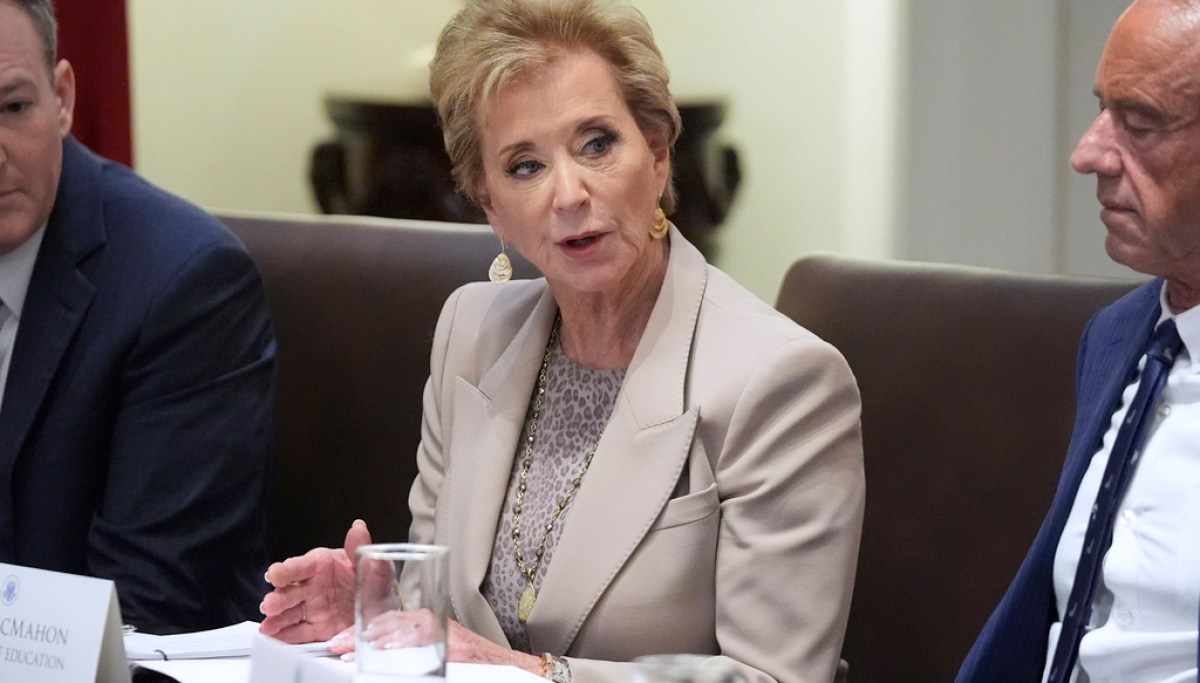
Education Secretary Linda McMahon has asked every U.S. college and university to publish, before the end of 2026, a statement explaining how it will restore public trust through stronger commitments to academic rigor, free speech, intellectual pluralism, affordability, research integrity, and national service.Universities should take her up on the challenge. They should also make clear that their answers will arise from their own educational missions rather than from a political program written in Washington.Conservatives who care about higher education should resist the false choice between defending institutional failures and placing universities under partisan supervision. Reform and independence can coexist. In fact, each depends on the other. CONVICTED FOR MURDER, PRAISED TERRORISTS — NOW TEACHING AT PENN?The easiest response from higher education would be reflexive opposition. That would be a mistake. McMahon’s letter identifies failures that many students, parents, faculty members, and taxpayers already recognize. Too many campuses have allowed ideological conformity to narrow legitimate debate. Grade inflation and generative artificial intelligence have made it harder to determine what students have actually learned. Tuition and administrative costs have risen while families struggle to understand the value of particular degrees. Many graduates leave college with little knowledge of the institutions they will inherit as citizens.The letter specifically points to a recent report commissioned by Vanderbilt University and Washington University in St. Louis that examines scholarship in the humanities and humanistic social sciences. Its authors rejected the most sweeping indictment of those fields, while finding genuine instances in which political criteria have displaced scholarly standards. That distinction matters: Higher education faces real problems, but serious reform requires evidence rather than caricature.Universities should answer these criticisms directly. Yet federal officials should neither dictate acceptable academic conclusions nor make public support contingent on ideological compliance. A university cannot defend free inquiry by surrendering its intellectual independence to whichever party controls the executive branch.The better response is a civic covenant: a public, institutionally written statement explaining what a university owes its students, its scholars, and the country that sustains it.Vanderbilt has already offered a useful starting point. Its recent “Declaration of First Principles” grounds the university in academic freedom, institutional neutrality, open debate, scholarly excellence, and the production of educated citizens. It describes academic freedom as a covenant in which the public protects scholarly independence and scholars, in return, exercise that freedom with rigor and intellectual honesty. That balance of liberty and responsibility should guide the broader sector.A meaningful civic covenant should begin with intellectual pluralism. Universities should judge scholarship by evidence and argument, create space for serious disagreement, and ensure that students encounter competing schools of thought rather than a prescribed political outlook.It should establish rigorous and transparent assessment in the age of AI. Every institution should explain how it verifies student learning, preserves meaningful writing and reasoning, and resists awarding credentials detached from demonstrated competence.It should also guarantee civic knowledge across undergraduate programs. Chemists, engineers, teachers, journalists, and business leaders will all exercise citizenship. Every graduate should understand the constitutional system, the responsibilities of different levels of government, the rights of free expression and association, and the habits required for democratic disagreement.Universities should then publish evidence of public service. “Engagement” must mean more than slogans. Institutions should report how their research, teaching, clinical work, partnerships, and graduates materially serve their communities and the nation.HOW UNIVERSITIES TAUGHT AN ENTIRE GENERATION TO HATE THE WESTFinally, every covenant must defend institutional independence. Universities should welcome scrutiny, disclose outcomes, and reform themselves where they have failed. They should also reject partisan control over teaching, hiring, research, and inquiry.McMahon is right that a forthright conversation between universities and the public is overdue. Higher education can answer Washington without becoming an instrument of Washington. By writing civic covenants of their own, universities can show that self-government remains both their privilege and their responsibility.Alejandro J. Ramos is the executive director of the Ramos Research Institute, a doctoral student at Vanderbilt University, and an instructor at Sacred Heart University. His work focuses on civic education, democratic citizenship, and public leadership.
Universities should answer Washington with civic covenants of their own
Full Article
Original Source
Read the full article at Washingtonexaminer →KhanList aggregates and links to publicly available news content. We do not host full articles from third-party sources. Always verify important information with original sources.