
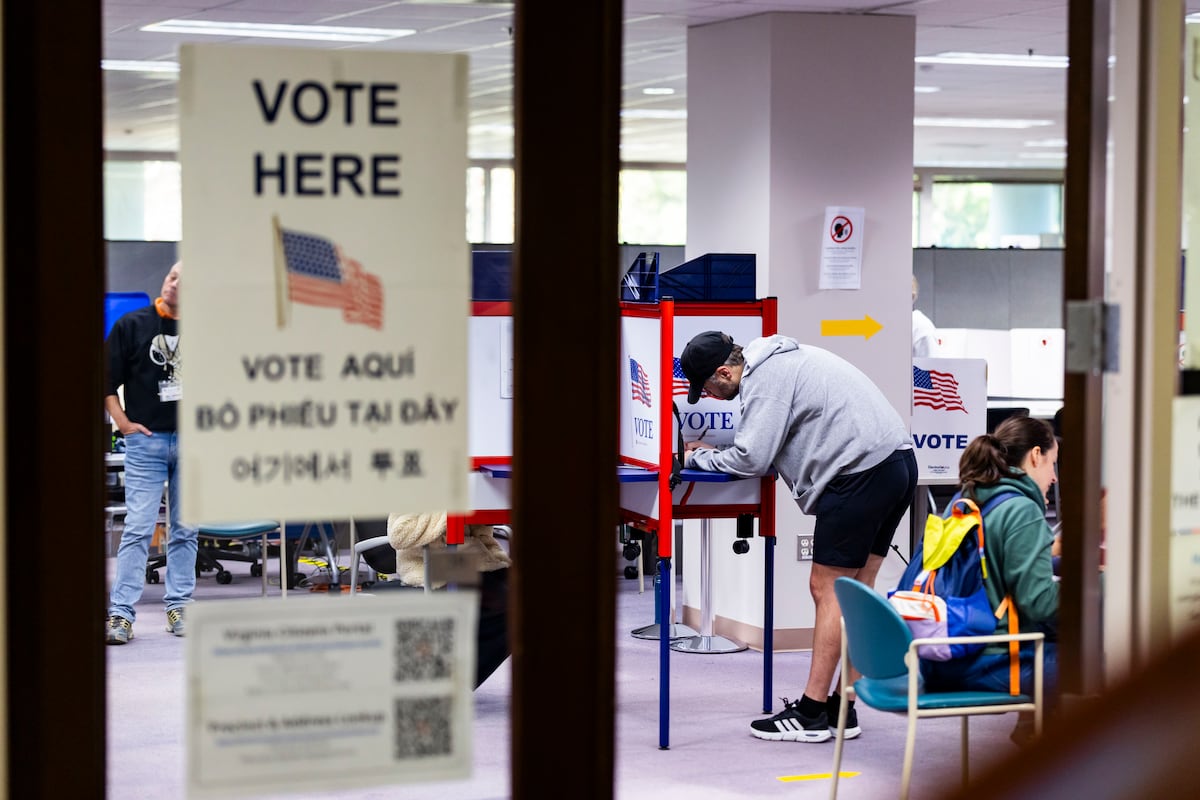
After months of primaries and dirty tricks, insults and off-the-cuff comments, an unrelenting downpour of millions in dirty money, threats to the system, and surprises, the big day has arrived: the midterm legislative elections that will serve as a referendum on the second presidency of Donald Trump.Americans are called Tuesday to deliver their verdict in hundreds of contests and answer dozens of ballot questions posed across all 50 states. Early-voting figures have reached historic levels. All 435 seats in the House of Representatives and one-third of the Senate are up for election, along with 30 governors and countless local and state offices.Given the complexity of the event and the immensity of the United States’ landmass, by the end of the day it is likely we will be talking less about election night than about an election week or weeks. The next key date is January 3, the day set on the calendar to certify the composition of the Congress that emerges from the ballots.These contests will also yield a handful of answers about the future of the United States, in the same week that marks the 10th anniversary of Donald Trump’s first election as president. What follows is a review in six questions and one certainty.Will both chambers be Democratic?Before the summer, polls suggested a Democratic victory in the House of Representatives was likely; not so much in the Senate. The latest polls take the former for granted and do not consider the latter out of the question. And this is despite the fact that the one-third of the Senate up for election favors the conservative vote.The current makeup of the upper chamber (with a 53-seat republican majority) means Democrats would need to flip just four of the 100 seats to regain the Senate. A poll by The New York Times and Siena published Monday landed like a bombshell in Washington by showing Democrats would pick up seven new senators.In some cases, like Michigan (11 points) and Texas (7), the survey shows advantages not previously seen during the campaign. If the first prediction holds, Abdul El‑Sayed would become the first Muslim U.S. Senator in history. The second case would write a different kind of history: Republicans have not lost in the country’s largest state in over 30 years.There will be other closely contested races to keep an eye on: In Alaska, a ploy to throw rival voters off track by fielding a candidate with the same name as the Republican nominee could derail a Democratic victory. Iowa is a barometer of rural voters’ frustration with the economy. While Kansas is the scene of a race between a pastor and an obstetrician, Republican Susan Collins is seeking a fifth term in Maine; and Ohio, home of Vice President J. D. Vance, threatens to turn Democratic blue.Is this the beginning of the end of Trumpism?The midterms usually bring bad news for the party in power. If Republicans lose both chambers, it would be disastrous for Trump. There are only six precedents for that occurrence. The first was in 1894, with Grover Cleveland in the White House — the only prior president to serve two nonconsecutive terms. The others came in 1918 at the end of World War I; in 1946 after World War II; in 1954 after the Korean War; in 1994 after the end of the Cold War; and in 2006, when Americans’ patience with the war in Iraq reached its limit.If Democrats take control of the Capitol, they would have the ability to launch investigations into Trump and members of his administration. The president said Monday that, in that eventuality, he is willing to grant a preemptive pardon to Elon Musk, one of his most controversial allies.The Constitution bars Trump from running in 2028, so whatever happens this Tuesday, the “lame duck” season begins in Washington — the jargon for White House occupants whose days are numbered and, if the case arises, whose hands are tied either on one or both sides. The current president has promised to govern by vetoing Congress’s decisions, and in his first two years he has demonstrated an authoritarian zeal for expanding executive power at the expense of the legislative branch, with the invaluable help of the conservative supermajority on the Supreme Court.What will happen to Trumpism if the political death of its leader is confirmed remains to be seen. Its followers amount to roughly 30% of the electorate, and over a decade they have forged a movement, MAGA, which is hard to imagine without Trump as its figurehead.His loyalists have shown some signs of fatigue for the same reasons that other voters seem ready to turn their backs on Trump: the war with Iran, government corruption, a president perceived as dismissive of family concerns, the brutal immigration campaign, and a battered economy.What lessons will Democrats draw?These midterms are also a referendum on the party that could emerge victorious. If they do, it will be more because of rejection of Trump (and Democratic unity in response to the excesses of his second term) than because they have crafted an inspiring message for voters.The Democrats are also in the middle of a battle for the soul and future of the party. On one side is the formation that dared to embrace progressivism in the mold of Bernie Sanders, led by Zohran Mamdani and Alexandria Ocasio-Cortez. On the other are candidates who favor a centrist populism to woo undecided voters and attract disaffected Republicans. Abdul El‑Sayed sits in the first group. In the second are pastor Adam Hamilton (Kansas), Josh Turek (Iowa) and seminarian James Talarico in Texas.And the Republicans?The big question is whether Republicans will finally be willing to break with Trump if defeat turns into a rout. They could have done so in 2021 after the Capitol riot, and in 2022 after the last midterms, when the red wave that polls had predicted turned into a ripple, in large part because of the role of the then‑ex‑president. On both occasions they decided not to deliver a final blow to Trump.Throughout the campaign the president has insisted voters pretend he is the one running and not the candidates whose fortunes his unpopularity is affecting by delegation. He has also pushed for nominees who have complicated otherwise safe Senate bets in places like Texas (Ken Paxton) and South Carolina (Darlene Graham, whose main qualification is being the sister of the late Lindsey Graham).Life after Trump will not be easy for American conservatism. They find themselves in what is commonly referred to — thanks to Joseph Heller’s novel — as a “Catch-22,” an unsolvable dilemma. Not only will it be difficult to find a replacement, but finding one could condemn the party to an even longer-lasting MAGA hijacking — and one that will be even harder to shake off.Will the president accept the results?Trump and his allies have spent a year orchestrating a campaign that lays the groundwork to refuse to accept the results in the event of an electoral defeat. They have filed lawsuits — dismissed by judges — sown doubts about the integrity of election workers, threatened them with fines and jail terms, and warned voters about the presence of federal agents at polling stations.Officials, lawyers, and voting rights activists are prepared to take action if any of these threats materialize on Election Day, which promises to last well beyond election night. They also warn that the damage may already be done, because Trump and his supporters have spent months casting doubt on a secure system in order to sow mistrust among voters and lead them to believe that it isn’t worth participating.Will Latinos turn their backs on Trump?Some of the earlier questions are partly answered by the role of Hispanics in these midterms. They swung in 2024 to support Trump because their household finances were suffering, and after two years of a harsh immigration policy, high inflation, and sky-high gasoline prices they now seem willing to change their minds. Early voting is setting records, and Hispanics, long characterized by high abstention rates, are turning out like never before.That voting bloc represents at least 20% of the registered electorate in roughly two dozen highly competitive House races in Arizona, California, Colorado, Florida, Pennsylvania, and Texas, among others.What they decide will be crucial for the future of the United States. And that trend can only intensify. It is estimated that every 30 seconds in the country a person of Hispanic heritage turns 18 and thus becomes eligible to vote.The 2028 campaign starts nowIn a country that lives in perpetual campaign mode, when the midterms fall midway through the term of a president who cannot run again, they mark the countdown to the next election. Both parties will have to pick their candidates between now and 2028. The betting lists, open for months, are entering a decisive phase.Several Democratic politicians are expected to announce decisions after the legislative elections. Will Alexandria Ocasio-Cortez step forward? Will Jon Ossoff, the Senate candidate from Georgia, be catapulted toward the White House if polls correctly give him a win? Will Kamala Harris dare to try again? Or will it be California Governor Gavin Newsom, who said he would not run if Harris decides to do so?The opposing field looks clearer. There is the option of Vice President J. D. Vance, who has again made off-color remarks during this campaign but appears to enjoy MAGA’s favor, even if he lacks its leader’s charisma.There is also Secretary of State Marco Rubio, who ran for the White House in 2016. If the toxic drift of the current presidency continues, the best idea for Republicans may be to present a candidate unconnected to the management of an enormously controversial administration.And who could it be? We still have two years to go before we find out, an eternity in the world of American politics.Sign up for our weekly newsletter to get more English-language news coverage from EL PAÍS USA Edition
United States votes in decisive midterms for Trump’s mandate: Seven keys to the elections
Full Article
Original Source
Read the full article at English →KhanList aggregates and links to publicly available news content. We do not host full articles from third-party sources. Always verify important information with original sources.