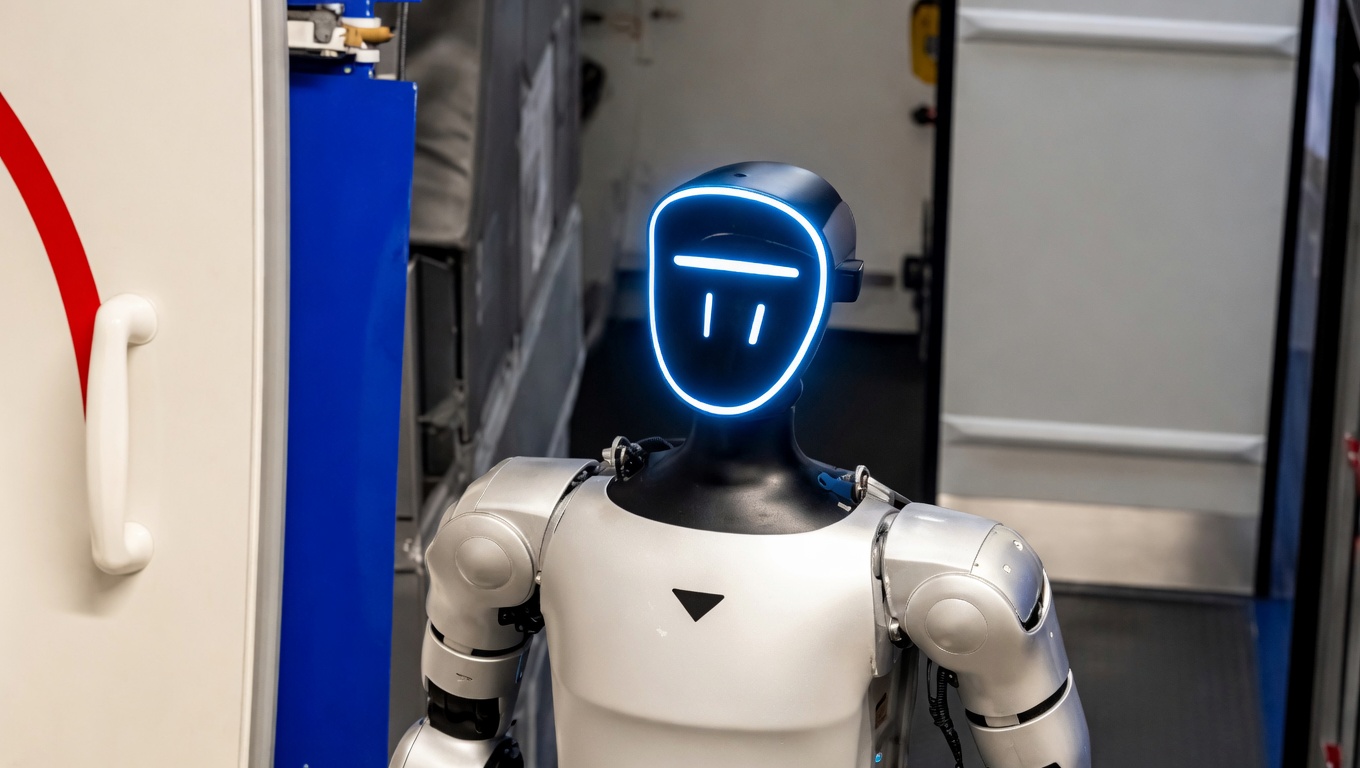
United and Delta Air Lines have followed Southwest in banning humanoid and animal-like robots both from flying as passengers and also as checked baggage. Live and Let’s Fly reported an internal United bulletin that flagged the carrier’s policy took effect July 23. “Starting July 23, humanoid and animal-like robots are not permitted in the cabin… [We will] continue to evaluate if and how we can transport them safely.” United defines a humanoid as an AI-driven or remotely controlled machine that mimics how a person looks, moves, thinks or speaks. An animal-like robot is one that looks or behaves like an animal. Small robot toys and gadgets may still travel if they meet ordinary carry-on and battery rules. Employees have reportedly been told to stop these robots at check-in and boarding. If one reaches the aircraft, flight attendants are supposed to contact the gate and arrange to have it removed. This is also now reflected on United’s public dangerous-items page. Delta Has Quietly Done The Same Thing Delta’s published baggage policy says it has temporarily banned any robot designed to resemble or imitate a human or animal in appearance, size, movement or behavior, whether in the cabin or checked. Human- and animal-like toys are exempt if they fit normal carry-on limits, can be stowed properly and comply with battery restrictions. Delta also says these robots are not assistive devices and are not trained service animals. That distinction works for today’s event-rental robots, though it’s going to become much harder to maintain as robots become personal aides for older people and travelers with disabilities. That leaves American as the only one of the four largest U.S. carriers without a published humanoid prohibition. Of course, ordinary battery, size, weight, cabin-baggage and cargo rules still apply. Southwest Adopted A Rule After Robots Actually Showed Up I first wrote about this in May, before the later wave of coverage. A passenger bought an extra seat on Southwest flight 1568 from Oakland to San Diego for Bebop, a four-foot, roughly 75-pound robot. Crew first objected to its aisle seat and then to its battery. Bebop was moved to the window, the battery was removed, and the flight eventually left about an hour late. Then a 3.5-foot robot named Stewie flew from Las Vegas to Dallas. Its owner bought the extra seat used for fragile cabin-seat baggage and fitted the robot with a smaller battery comparable to one in a laptop. Stewie walked through the terminal, boarded and sat at the window. Two days later, Southwest issued a companywide safety alert barring human- and animal-like robots regardless of size or purpose. A humanoid robot just boarded a @SouthwestAir flight with its own ticket. Crews reportedly weren’t sure if it counted as a passenger or luggage. That sounds funny. But it also shows how unprepared public systems are for robots entering everyday life. pic.twitter.com/QUcBzAcBDQ — Chris Madden (@chrismadden_) May 9, 2026 We just got robots banned from Southwest Airlines. You’re welcome 🫡 Yesterday we flew our humanoid robot Stewie from Las Vegas to Dallas on Southwest — something we (and others) have tried and failed multiple times because batteries are always the issue.This time we cracked… pic.twitter.com/FqJjk1vSfQ — Aaron Mehdizadeh (@rentbotsTX) May 12, 2026 Batteries And Projectiles Are Real Problems FAA rules generally allow lithium-ion batteries up to 100 watt-hours. Batteries from 101 through 160 Wh require airline approval, with limits on the number carried. Above 160 Wh they are not permitted on a passenger aircraft under the ordinary personal-electronics exception. Spare batteries must remain in the cabin, where crew can detect and respond to a fire. Lithium cells can enter thermal runaway after damage, overheating, overcharging, improper packing or a manufacturing defect. It can happen without warning. The 46.8-volt, 9 amp-hour pack documented for the Unitree G1 is about 421 Wh, more than twice the passenger limit. Figure’s current humanoid battery is 2.3 kWh—more than fourteen times the limit and is integrated into the torso as a structural part of the robot. Southwest banned Stewie even after it was fitted with a compliant smaller battery, though. United’s rule applies regardless of size or purpose. A human-shaped shell with no battery is prohibited while a box-shaped machine with a permissible lithium battery may be allowed. There are non-battery issues, too. A 75-pound machine can become a projectile. Motors could activate accidentally. And cabin baggage has to be secured without exceeding seat or floor limits or blocking an aisle or exit. An interim ban can make sense while airlines develop a process. A robot traveling in the cabin should be secured as approved cabin-seat baggage at a window in a non-exit row, and it should not walk around during the flight. Batteries over the passenger limit shouldn’t travel as a standard carry-on. Our Travel Reality Is About To Change Delta’s policy declares that these robots are not assistive devices. But the federal definition is functional, not based on shape: an assistive device is equipment that helps a passenger with a disability hear, see, communicate, maneuver or perform another function of daily life. A future robot that guides a blind traveler, lifts bags for someone with limited mobility, monitors an older passenger’s health or helps someone communicate will fit that definition. It would not be a service animal (under current rules that means a trained dog) but it could be assistive equipment. Airlines have obligations to carry assistive devices when they can be stowed and transported safely, though hazardous-material rules still apply. The idea that “a humanoid robot can never be an assistive device” is simply not going to be reality soon. Airlines Are Already Putting Humanoid Robots To Work The irony is that airlines are not merely waiting for this future. Japan Airlines began a multi-year trial at Tokyo Haneda this spring using humanoid robots for ground handling. It is starting with cargo-container movement and studying baggage and cargo loading, cabin cleaning and eventually the operation of ground-support equipment. JAL explains exactly why the robots are humanoid: airports and aircraft were built around human movement. A human-shaped machine may be able to use the existing facilities and equipment without an airport first rebuilding everything for specialized automation. Airbus is also in an early test phase with a humanoid robot for aircraft manufacturing. And Aeroflot low-cost carrier Pobeda already put “Volodya,” a Unitree G1, on a regular Boeing 737 flight from Ulyanovsk to Moscow. It greeted customers, made limited safety-demo gestures, walked the aisle and sat down for takeoff and landing. Human flight attendants still performed all required service and safety duties. The Faster Disruption Is Already Inside United Physical robots are a little farther off than the disruption from large language models. But United has already said AI is helping it shrink management staffing. Its CFO said management headcount was 4% lower than the year before and that the airline planned another 4% reduction in 2026 as process changes and AI made headquarters work more efficient. The first airline jobs to change are not likely to be flight attendants and pilots. They are contact-center work, back-office processing, marketing and loyalty servicing, revenue management, network planning, crew pairing and disruption recovery, and maintenance planning. Much of this is well-paid white-collar work. Airlines are heavily regulated, so cockpit and cabin-crew mandates will probably make those jobs among the last to change even when the technology is capable. Eventually, though, United may be banning a robot in the passenger cabin while relying on machine intelligence up front. A robot pilot! And a ban on machines will be strange when robots are building aircraft, moving bags, and cleaning cabins. We are too status quo-biased in how we think about this. We see today’s awkward robot and assume tomorrow will look like today with a slightly less awkward robot. We look at 2023’s unreliable chatbot and miss how quickly it is improving or how much repetitive professional work it can already take over. United is right to say it may revisit the rule. Topics on this page
United And Delta Have Officially Banned Humanoid Robots From Flying As Passengers
Full Article
Original Source
Read the full article at Viewfromthewing →KhanList aggregates and links to publicly available news content. We do not host full articles from third-party sources. Always verify important information with original sources.