
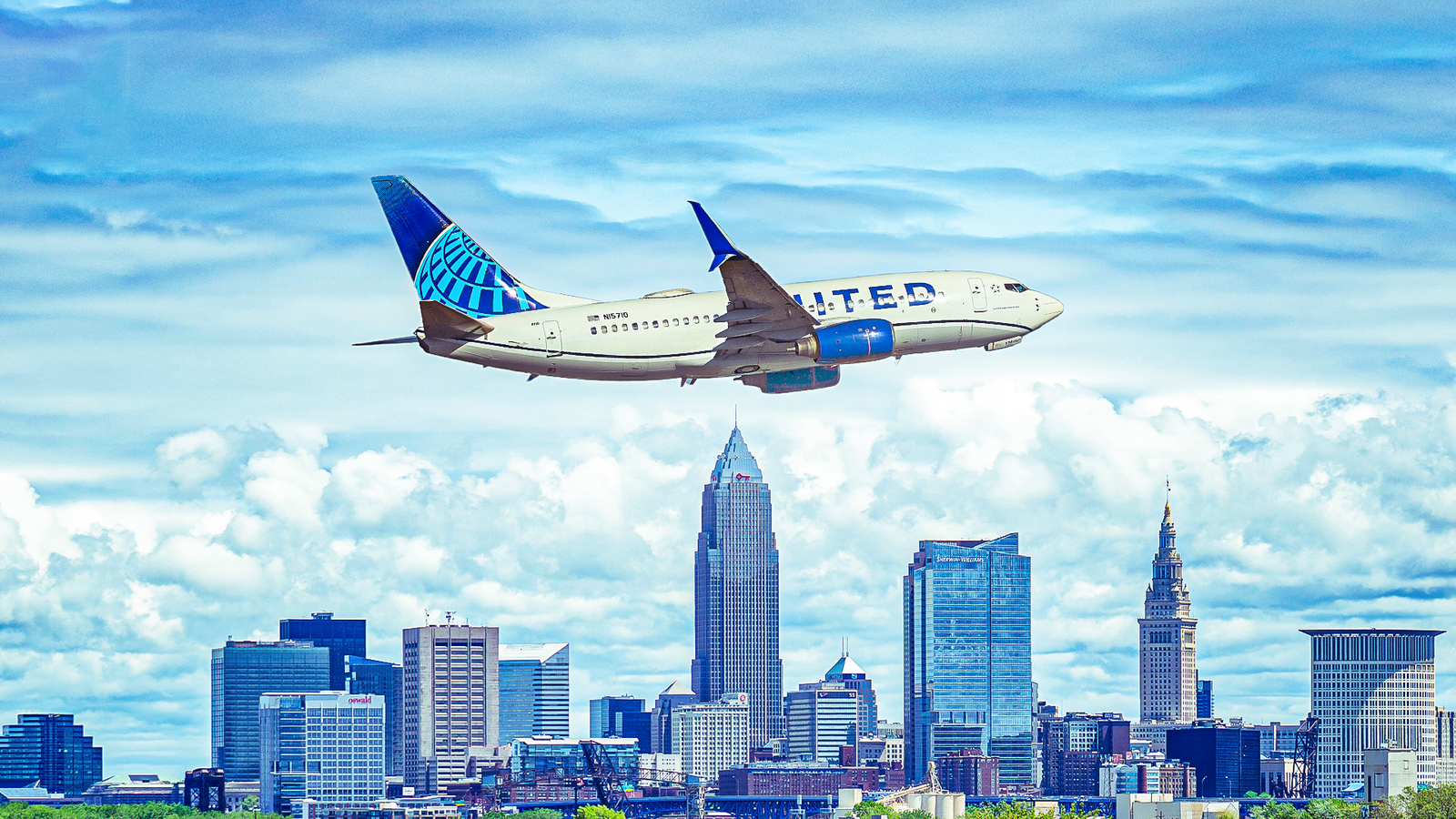
Published Nov 19, 2026, 4:00 AM EST Based in the UK, Josh is a keen writer with a degree in Military History. Having worked previously as a financial journalist, he has covered the aviation industry extensively, reporting on airlines' results and monthly passenger statistics in the aftermath of the pandemic, alongside the likes of regulation around sustainable fuels, and the prospects for hydrogen-powered commercial flight. He joins Simple Flying with a lifelong love of all things aviation. United Airlines has buoyed its presence at Cleveland Hopkins International Airport (CLE) recently. Several route additions this year have helped expand the US-based legacy carrier’s footprint in Northern Ohio to its largest in over a decade. They have also left locals with ample choice of United hubs and leisure destinations, making Cleveland an ever more important part of the airline’s network. But there is a sense of irony in the move. United largely turned its back on the airport, unceremoniously winding down operations 12 years ago. This cut what was a major hub in itself from United’s network. So with the carrier now appearing to bet on the site once again in what looks to be a full-circle moment, the question is: What has changed? United’s Abrupt Departure From Cleveland United’s move back to Cleveland is particularly noteworthy because of its historical relationship with the airport. After a merger with Continental Airlines in 2010, Cleveland became one of nine hubs for the expanded carrier, which retained United’s name. Unfortunately for the airport, this would turn out to be just one of a host of factors that would see it fall out of favor with the new, combined entity. Not only was Cleveland the smallest of the nine hubs, but it was also relatively close to United’s existing gateways at Chicago O'Hare International Airport (ORD) and Washington Dulles International Airport (IAD), as well as another former Continental base: Newark Liberty International Airport (EWR). While these fit nicely into the larger network and remain in use as hubs by United to this day, Cleveland failed to fill a significant role in the wider operation. Not least was Chicago—a huge airport in comparison, serving a far greater market—being only 315 miles (275 km) down the road. Behind all of this was the fallout from the 2008 financial crisis, which had hammered profitability across the industry. After United and Continental joined forces to cut costs, the unviable, loss-making Cleveland base became an easy target in the now-unified United and Continental brand’s drive towards efficiency. This came in 2014, with its de-hubbing (which was actually the second time in its history that United moved away). New Routes Leave United With Biggest Presence At Cleveland In A Decade The de-hubbing did not mean United left Cleveland altogether, though. Rather, the carrier drastically scaled back on departures and rerouted connecting services elsewhere. Under plans laid out at the time, United said average daily departures would be cut by around 60%. Some 72 peak-day flights serving 20 destinations nonstop were to be retained, it added, down from 200 and 61 beforehand, respectively. These fell further with time, too. By 2025, just 30 or so United flights were departing Cleveland daily. That is, until the carrier opted to expand its offerings from the base once again this year. Las Vegas’ Harry Reid International Airport (LAS), which United last flew to from Cleveland in 2024, would be served year-round with five flights a week starting in September, an announcement said in May. A winter service, running between December and April next year, would then see Miami International Airport (MIA) reappear on United’s list of destinations from the airport for the first time since 2014. American Airlines Delta Air Lines Frontier Airlines United Airlines Southwest Airlines JetBlue Airways Avelo Airlines Aer Lingus Alaska Airlines Air Canada Charlotte Atlanta Atlanta Cancún Baltimore Boston Concord Dublin Seattle Toronto Chicago O'Hare Boston Cancún Chicago O'Hare Chicago Midway Fort Lauderdale New Haven Dallas/Fort Worth Detroit Denver Denver Dallas Love Field New York-JFK Los Angeles Minneapolis Fort Lauderdale Fort Lauderdale Denver Miami New York-JFK Fort Myers Fort Myers Fort Myers New York-JFK New York LaGuardia Las Vegas Houston Las Vegas New York LaGuardia Salt Lake City Miami Las Vegas Nashville Philadelphia Myrtle Beach* Los Angeles Orlando Phoenix Orlando Miami Phoenix Washington Reagan Phoenix Newark Sarasota*** Punta Cana Orlando St. Louis Raleigh-Durham San Francisco Tampa San Juan** Tampa Tampa Washington Dulles * Myrtle Beach: 11 flights from June 4, 2027. ** San Juan: 26 flights from December 17, 2026, to January 11, 2027. *** Sarasota: 4 flights from March 13 to April 3, 2027. Owing to the additions, United’s winter schedule for this year going into next is set to cover 14 nonstop routes from Cleveland. This will be the most among any of the 10 passenger airlines that regularly operate out of the airport during the period. It will also leave United flying out of Cleveland almost 40 times a day in the meantime, taking capacity of the airport to its highest in over a decade. No doubt, this is in response to strong local demand. Sustained Passenger Growth At Cleveland As Scott C. Carr, a City of Cleveland Department of Port Control assistant director, commented on the news of United’s route additions in May. “Strong demand for leisure travel continues to create opportunities to grow service and connect Northeast Ohio travelers to destinations they want most.” This is by no means new, however, with the airport having enjoyed progressively stronger footfall for some time now. In fact, the airport’s own data shows a clear trend of improving traffic in almost every year since United’s large-scale departure in 2014, aside from an obvious slump during the pandemic. Though passenger numbers naturally dipped as United slashed services, it only took a few years for other airlines to move in, pick up the slack, and push the figures higher once more. Year Footfall Change vs. prior year 2013 9,072,126 - 2014 7,609,404 -16.1% 2015 8,100,073 +6.4% 2016 8,422,676 +4.0% 2017 9,140,445 +8.5% 2018 9,642,729 +5.5% 2019 10,040,817 +4.1% 2020 4,122,517 -58.9% 2021 7,282,475 +76.7% 2022 8,693,866 +19.4% 2023 9,868,868 +13.5% 2024 10,173,861 +3.1% 2025 10,003,833 -1.7% Among the flurry of airlines to begin or expand operations in response were low-cost carriers Frontier Airlines and Spirit Airlines, as well as close United rivals Delta Air Lines and American Airlines, to name a few. Simply put, demand was always there, but capturing it without losing money required a different approach than the one United had committed to thus far. Same Airport, Different Strategy Prior to 2014, Continental — and later United following their merger — primarily used Cleveland as any other airline would: to funnel passengers originating elsewhere onto flights headed elsewhere. But such an operation is complex and can come with caveats. A major consideration is whether what are known as banked connections can be sustained. Here, airlines effectively sort their arrivals and departures into waves so that passengers have time to disembark one flight and board another. The downside is that all aircraft involved have to remain grounded for a period to give travelers time to get through the airport, which can be costly for a carrier. Alongside this, airport infrastructure and ground crews must be in place to support sudden spikes in activity as planes come and go in waves. Clearly, the practice was ultimately deemed unsustainable at Cleveland by United post-consolidation with Continental. Instead, a scaled-back, arguably simpler operation targeting those originating in or traveling to the area has taken its place. The bonus for United is that the fewer moving parts in a point-to-point system, compared to a hub-and-spoke model, make reacting to demand simpler — especially when the personnel and infrastructure to accommodatechanges are already in place. Indeed, United drastically cut back on services from Cleveland, but it did not fully scrap them. In fact, the airline remained its largest by passenger traffic, which gives some context into the weight of the de-hubbing decision on the airport. Either way, that meant United retained everything it needed to fly from the site — including a pilot base, cabin crew domicile, and maintenance facility. But despite having the means in place to easily expand its schedule from Cleveland, United has found itself in a far less dominant position there today. Yes, it is still the airport’s primary carrier, but that is by no means as clear-cut as before the de-hubbing. United accounted for a 28.84% share of Cleveland’s passengers over the year to August 2013, according to the US Bureau of Transportation Statistics. ExpressJet was the airport’s next-largest operator at the time, with a 14.60% share. Come the 12 months to August this year, United’s share was a more moderate 23.77%, while the gap to the second-largest - now Frontier with 21.47% - had narrowed drastically. Spirit Airlines’ Exit From Cleveland In other words, competition has heated up, and a string of nonstop routes passengers can choose from in Cleveland are serviced by more than one carrier — hence the risk United has had to accept in moving back in. But another factor may have contributed to the decision. Spirit took the axe to its network prior to its collapse this year. This involved closing its base in Cleveland, where it had historically held a near 10% market share and from which it had even flown to the likes of Miami and Las Vegas. How much that has influenced United’s decision-making is debatable. Regardless, it has no doubt left a gap to be filled.
United Airlines Coming Back To A Hub It De-Hubbed Over A Decade Ago Could Be Its Biggest Domestic Bet In Years
Full Article
Original Source
Read the full article at Simpleflying →KhanList aggregates and links to publicly available news content. We do not host full articles from third-party sources. Always verify important information with original sources.