
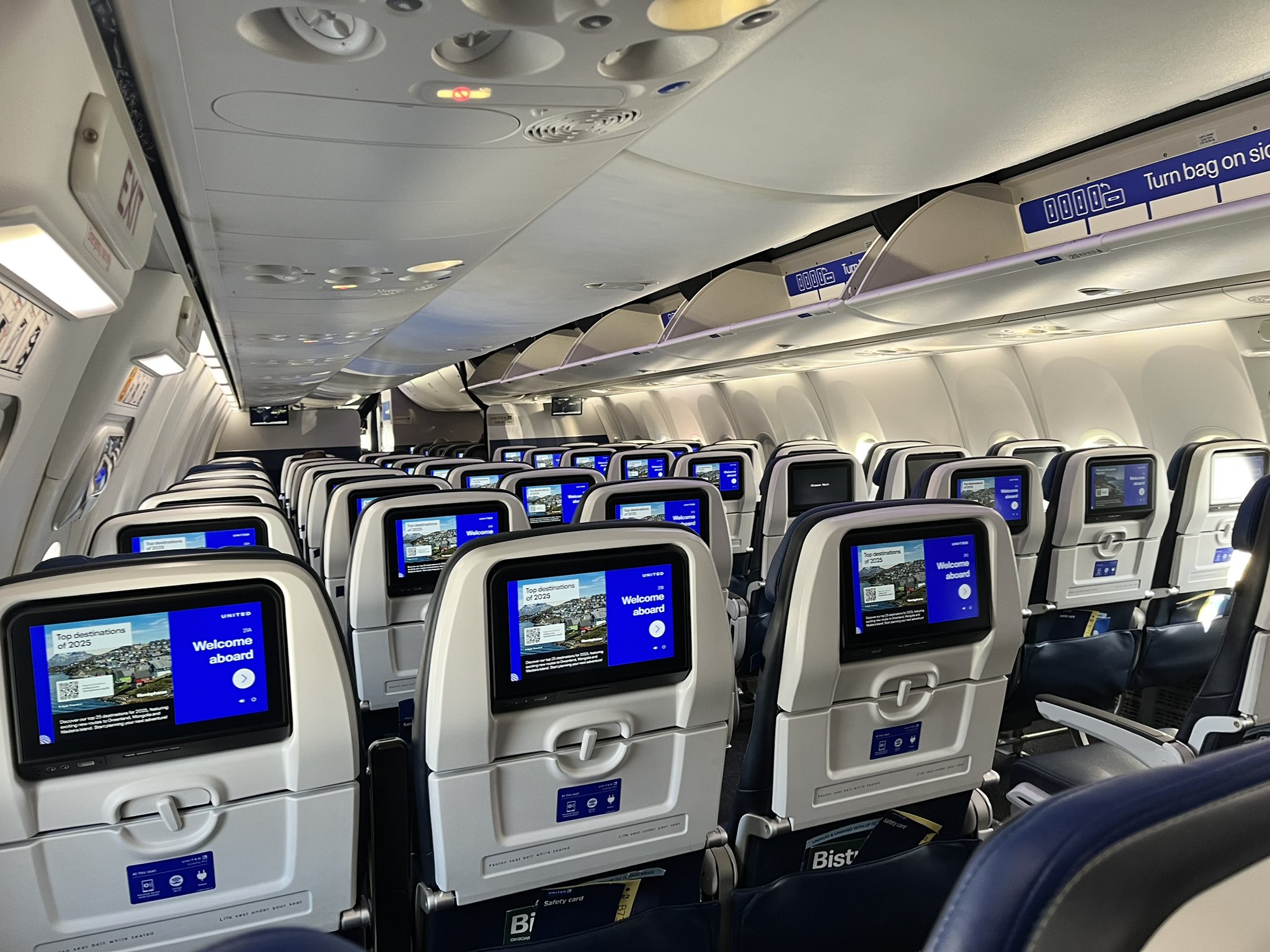
United Airlines now expects to have Starlink internet on more than 1,000 mainline aircraft by May 2027, according to a leak shared by aviation watchdog JonNYC. The plan calls for completing more than 20 aircraft a week across 17 maintenance stations. That would put United’s rollout well ahead of its earlier announcements – and leave the other airline it primarily competes with for premium business – Delta – in the dust. Delta says it won’t even begin installing Amazon’s low earth orbit satellite internet until 2028, and that schedule may not hold – and only applies to about half 500 planes or half its mainline fleet. United is already using this difference to go after Delta’s frequent flyers. There’s a real opportunity here. I’ve avoided United and Southwest whenever possible because I couldn’t count on functional internet. Getting enough aircraft equipped with Starlink changes the calculation completely. I’ll pay a premium for functional internet, because lack of onboard productivity is far more costly than airfare savings. UA accelerating the Starlink rollout. — JonNYC (@xJonNYC) October 6, 2026 What Changed In United’s Starlink Timeline United’s original announcement was a multiyear project, with the airline repeatedly moving its targets forward. Usually projects like these slip, but Starlink is an advantage, United is pressing it, and installations are quick. September 2024: United announced free Starlink across its mainline and regional fleets. Testing would begin in early 2025, with passenger service later that year and installations continuing over several years. January 2025: United moved up the first passenger flights to spring. It targeted its entire two-cabin regional fleet by the end of 2025 and its first mainline aircraft before that year ended. February 2026: United reported more than 300 regional aircraft equipped, and targeted more than 500 mainline installations during 2026. That would bring the combined total above 800. June 2026: United raised its year-end target to nearly 1,000 aircraft, counting mainline and regional jets together. Its first Starlink-equipped Boeing 777-200 entered transatlantic service. The airline expected roughly 60 widebodies equipped during the year and its entire widebody fleet completed by summer 2027. Now: The graphics shared by JonNYC call for more than 1,000 mainline aircraft alone by May 2027, supported by more than 20 installations a week. June’s roughly 1,000-aircraft target included the regional jets that were already far along. The new 1,000-plus target is for mainline aircraft alone. Earlier this year, I wrote about United’s plan to have its dual-class fleet equipped by the end of 2027. While not every single aircraft will be done by May, this timeline is even more aggressive. The United deck shows 17 activated stations, with work spread across the United States, Latin America and Asia. Those include Xiamen, Hong Kong and Singapore, along with locations such as Houston, San Antonio, Orlando, San Salvador and Rio de Janeiro. This is a major installation program running in parallel across the network. The speed of an individual installation matters, but so does having enough places to perform the work while keeping aircraft available to fly. United Is Already Using Starlink To Recruit Delta Customers The rollout comes as the argument over Delta’s decision to choose Amazon over Starlink has become personal. I covered employee accounts of Delta CEO Ed Bastian criticizing Elon Musk while discussing the decision. Musk responded to my coverage by declaring that Bastian “will lose his job over this.” Musk later began promoting American and United offers to match competitors’ elite status. United’s “Switch To Better Wi-Fi” offer makes clear what this is all about – eligible U.S. residents with Delta or American status can apply through October 15 for 90 days of status, including matches as high as Premier 1K, with a spending challenge to keep the status through January 31, 2028. (American will be installing Starlink beginning next year.) Delta’s 2028 Date Is A Starting Point For Half Its Fleet Delta is betting on an airline product that doesn’t exist today. Amazon has conducted a limited enterprise preview, but even its initial fixed broadband rollout remains a future promise, limited to certain latitude bands. And Delta’s 2028 date is when deployment is supposed to begin, assuming Amazon delivers. The initial commitment covers 500 aircraft, roughly half Delta’s mainline fleet. United is targeting more than 1,000 mainline aircraft with Starlink by May 2027. Delta risks spending years asking customers to pay a premium while competitors are the ones offering a more premium experience. Delta is also committed to a second provider, Hughes Fusion, combining low Earth orbit and geostationary satellite connectivity, for parts of its fleet. Its new Airbus A350-1000s are also slated for Hughes connectivity through Airbus’s connectivity platform. But Delta’s Amazon deal leaves a large gap between what competitors are installing and what Delta hopes to begin offering in 2028. And United is hardly alone: American has announced Starlink for more than 500 Airbus aircraft, with installations beginning in the first quarter of 2027. I’ve reported murmurings that they could expand it to the rest of their mainline fleet as well. Alaska plans Starlink across its fleets by 2027, building on Hawaiian’s existing service. Southwest announced a rollout beginning this summer, with more than 300 aircraft targeted by the end of 2026 and the entire fleet ultimately planned (and CEO Bob Jordan boasting that they could even finish before United, though that may not have assumed this acceleration – indeed, the acceleration could partially be to beat Southwest, currently the only carrier with 100% Starlink across its fleet is JSX). Even Frontier has announced Starlink beginning in early 2027. Internet Quality Changes What Passengers Book I’ve written about avoiding United and largely avoiding Southwest because of their internet. For my purposes, their older systems have been at the bottom of the industry. When I need to work, an inexpensive fare can be a bad deal if it means losing several productive hours. The relevant question when booking is whether I can count on getting work done. Knowing that an airline has some aircraft with great internet doesn’t solve that problem. I need enough of the fleet equipped that booking the airline becomes a reasonable bet. And the performance difference is substantial. In Ookla’s first-quarter 2025 inflight measurements, Starlink delivered median download speeds of about 152 megabits per second, compared with about 50 for Viasat. Starlink’s median latency was 44 milliseconds, versus hundreds of milliseconds for the other providers measured. Latency is crucial – it’s the delay before the connection responds. It affects how quickly websites and cloud applications react, even when download speed are adequate. There’s also evidence that customers change airlines over internet quality: Passengers report having already switched. A 2016 Honeywell survey found that 21% of respondents had abandoned their preferred airline for one with better inflight internet, up from 17% in 2014. More recent research finds a strong stated preference. A 2024 Viasat survey of 11,213 people across 11 countries found that 75% were more likely to select or rebook a long-haul airline offering quality Wi-Fi, and 60% said the same about shorter flights. United reports a large improvement once passengers use Starlink. The airline says Wi-Fi satisfaction scores on equipped aircraft have nearly doubled. When United CEO Scott Kirby was President of US Airways he was reluctant to install wifi, knowing they’d never earn a return on the investment by selling access. Then he started to see customers switching to other airlines for the wifi. Losing sales was showing up in the data and US Airways had to sign on back then with Gogo’s air-to-ground system. Not everyone will be swayed by wifi but that doesn’t matter. It’s enough to drive some premium passengers, and avoid loss of passengers too. And that’s premium flying that drives credit card cobrand acquisition and spend too. Topics on this page
United Accelerates Starlink Rollout With 1,000+ Jets By May 2027—Goes After Delta’s Frequent Flyers
Full Article
Original Source
Read the full article at Viewfromthewing →KhanList aggregates and links to publicly available news content. We do not host full articles from third-party sources. Always verify important information with original sources.