
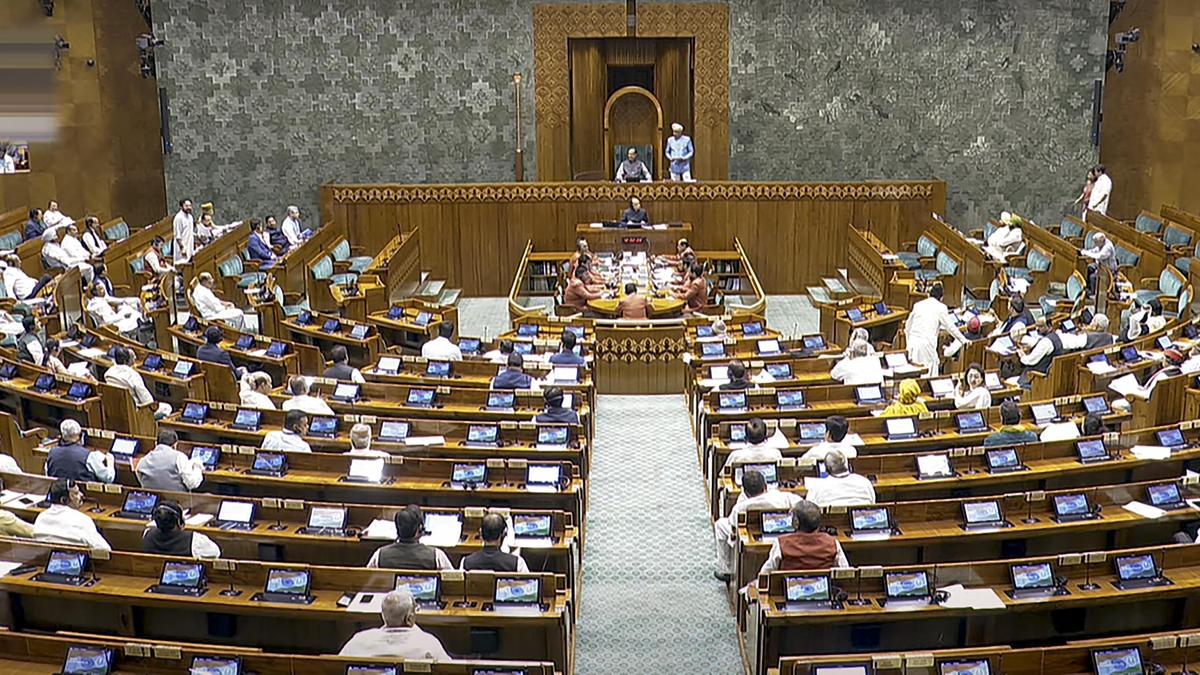
‘If the Bills are passed in the special session, political parties should endeavour to secure crucial changes to the amendment’ | Photo Credit: Sansad TV/SPECIAL ARRANGEMENT After realising that both extremes of self-indulgence and self-mortification failed to end suffering, Gautama Buddha chose the Majjhima Patipada (Middle Path), which was to tread the middle path in a noble way. The current delimitation proposal is an exercise to find such a middle path, though political expediency, rather than nobility, is the driving force behind it.The Constituent Assembly had decided that the allocation of seats in the Lok Sabha to various States should be in proportion to their population, with the actual allocation being determined by Parliament after every Census. This exercise is performed by the ‘Delimitation Commission’ that is set up by an act of Parliament. The number of seats in the Lok Sabha based on the 1971 census was fixed at 543, when the population of India was 54.8 crore — translating to an average population of 10.1 lakh people per constituency. However, it has been frozen ever since in order to encourage population control measures. The boundaries of territorial constituencies were redrawn based on the 2001 Census. Now, the number of seats and territorial boundaries are to be readjusted based on the first Census after 2026 under existing provisions. In 2023, through the 106th constitutional amendment, Parliament had provided for one-third reservation of seats for women in the Lok Sabha and Legislative Assemblies. Under existing provisions, this would be implemented through delimitation, based on the next Census in 2027.The Union government has proposed the Constitution (132nd Amendment) Bill to increase the maximum number of Lok Sabha seats from the existing 550 to 850 (comprising 815 State seats and 35 Union Territory seats). The amendment provides for a 50% pro-rata increase in the number of seats for every State/Union Territory. Constituency boundaries would be drawn based on the latest published Census figures available on the date of commencement of this amendment act, namely the 2011 Census. The number of seats and territorial boundaries established after this exercise would remain frozen for 25 years, until 2051.The Delimitation Commission would comprise a chairperson who is a sitting or a retired judge of the Supreme Court of India, the Chief Election Commissioner (CEC) or an Election Commissioner nominated by the CEC, and the State Election Commissioner of the State concerned as its members. It would also have up to 10 associate members in each State, comprising Members of Parliament (MP) and Members of the Legislative Assemblies from all political parties. However, they would neither have voting rights nor the right to sign the commission’s decisions. The commission would hold public sittings to consider objections and suggestions to its proposals before publishing its orders. Article 329 bars the courts from questioning the validity of such orders.There are two main arguments in support of the proposal. First, without the proposed amendment, delimitation would take place, through a simple majority law of Parliament, based on the 2027 Census population. This could potentially prove even more detrimental to the southern States and the smaller northern States. Instead, the proposed 50% increase for all States would preserve their existing relative representation in the Lok Sabha. Second, and paramount, it would facilitate seamless implementation of one-third reservation for women, with the additional 272 seats reserved for women in the enlarged House. Published - November 30, 2026 12:16 am IST
‘Uneasy’ middle path between democracy, federalism
Full Article
Original Source
Read the full article at Thehindu →KhanList aggregates and links to publicly available news content. We do not host full articles from third-party sources. Always verify important information with original sources.