
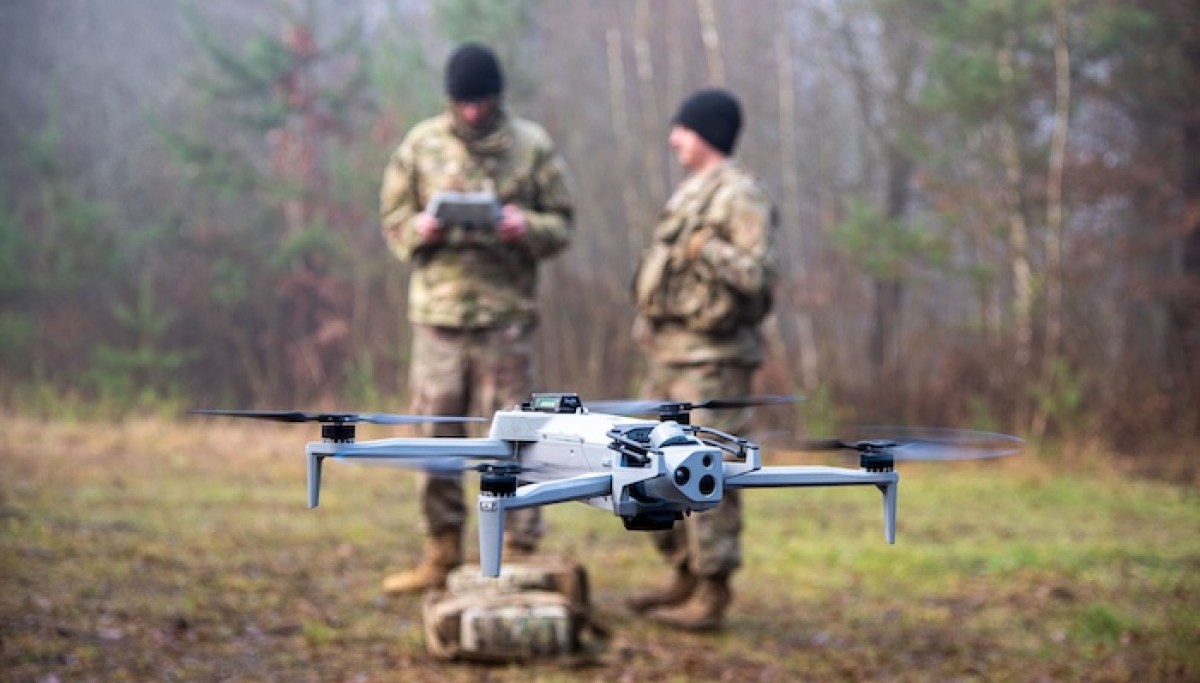
The Army is making progress on its mass acquisition of drones and its effort to get every soldier across the force trained up on them before relying on them in life-or-death situations in combat.The director of the Drone Dominance program, Col. Gregory Merkl, told reporters this week that the Army views unmanned and autonomous systems “as being necessary at every echelon of command, across every warfighting function.”He and other Army officials have disputed earlier reports that leaders shut down a drone battalion, saying it was never intended to be a long-term plan, in part because they want the entire force, not just one unit, intimately familiar with how to use them. The Europe-based battalion, known as the 3rd Battalion of the 504th Parachute Infantry Regiment, is part of the 173rd Airborne Brigade, and it had been tasked to learn lessons from Ukraine about the use of drones. Last month, it was reported that the Army decided to shutter the unit, though Alex Miller, the Army’s chief technology officer, recently disputed that characterization, saying that the unit “was never flagged to be a permanent centralized drone unit.”“In fact, we’ve pushed back on having something like a drone corps since its inception because our theory of the case is if you centralize that in one place, what you lose is the ability to actually scale that learning and send that out to the rest of the Army,” Miller said.War Secretary Pete Hegseth announced the Drone Dominance program in July 2025, and one of the goals of the program was to have every Army squad be outfitted with small one-way attack drones by the end of fiscal 2026, at the end of September.The program has arranged various competitions, called Gauntlets, allowing hopeful drone companies to demonstrate their capabilities for the military in the hopes that the department will order their products in particular. The military ordered between 1,500 and 2,560 drones from 11 companies following Gauntlet I, and more than 12,000 have been delivered in total.Merkl said the Army is “in the process of receiving another 30,000 drones,” while Emil Michael, the undersecretary of war for research and engineering, told the Washington Examiner last month that he has “high confidence” the program will hit its goal of purchasing more than 200,000 by 2027.Merkl said the Army has the “volume” to meet the goal of getting small drone to every unit by the end of the month, but he acknowledged, “Where we still have some work to do, candidly, is getting everybody trained at the appropriate level,” and he added, “I think if you look across the force, you have that capability in every platoon. We still have a little bit of work to do in terms of getting the qualified pilots down to the squad level.”Acquiring the drones is half of the equation, and the other half entails getting U.S. service members familiar and experienced in operating the different systems in any conditions they may find on the battlefield.U.S. Army Europe and Africa recently completed an annual international exercise called Exercise Saber Junction 26, which occurred at the Joint Multinational Readiness Center in Hohenfels, Germany. It began in mid-August and concluded about a week ago. The ultimate goal of the exercise is to work with allied European militaries to increase their collective readiness and interoperability in support of NATO’s collective defense and deterrence.During the monthlong exercise, the troops utilized nearly 2,000 autonomous systems, said Maj. Gen. Christopher R. Norrie, the acting commanding general of U.S. Army Europe and Africa.“We’re also in a unique position here with the proximity to the large-scale ground combat operations in Ukraine, co-located and supporting U.S. and NATO assistance to the armed forces of Ukraine, that we can observe and capture lessons from that and other conflicts as we scan the world, and then provide those to the Army and joint force,” he said.“That means we can replicate the conditions you would find in those types of fights, and then we throw that at these units,” Norrie continued, adding that they had “a small contingent” of Ukrainian military personnel at the exercise, “augmenting our observer-coach-trainer teams to provide advice on” drones and counter-drone technology.The relative cost of mass-producing drones is much lower than that of the exquisite equipment commonly associated with the most advanced militaries, giving much smaller militaries or nonstate actors the opportunity to build up their own arsenals.“I think what you can see from the Houthis is just the lowering bar to entry for this capability,” Merkl said in reference to the Yemen-based, Iranian-aligned group that has recently captured additional territory along its coast, near U.S. forces in Djibouti.“As we look at the modern battlefield, we should assume that our adversaries will have this in general, regardless of who they are,” he added.There is no specific defense system that the military intends to rely on for drone defense.BREAKING DOWN THE MILITARY’S NEARLY $40 BILLION IRAN WARInstead, the military is pursuing a layered defense made up of sensors to detect incoming projectiles, using the data collected from them to inform which type of defensive measure should be used, and that could range from launching an interceptor drone to destroy it in the air, using high-energy lasers, and electronic warfare, such as jamming signals.“There is no one system to rule them all,” Merkl said. “We need kinetic defeat, we need nonkinetic defeat, we need to be able to operate in the electromagnetic spectrum. We’re looking at things like high-energy lasers. But I think one of the things that is very, very apparent to the Army institutionally is that all of these tools are just equipment unless we can truly train it.”
Understanding the Army’s drone strategy: Necessary ‘across every warfighting function’
Full Article
Original Source
Read the full article at Washingtonexaminer →KhanList aggregates and links to publicly available news content. We do not host full articles from third-party sources. Always verify important information with original sources.