
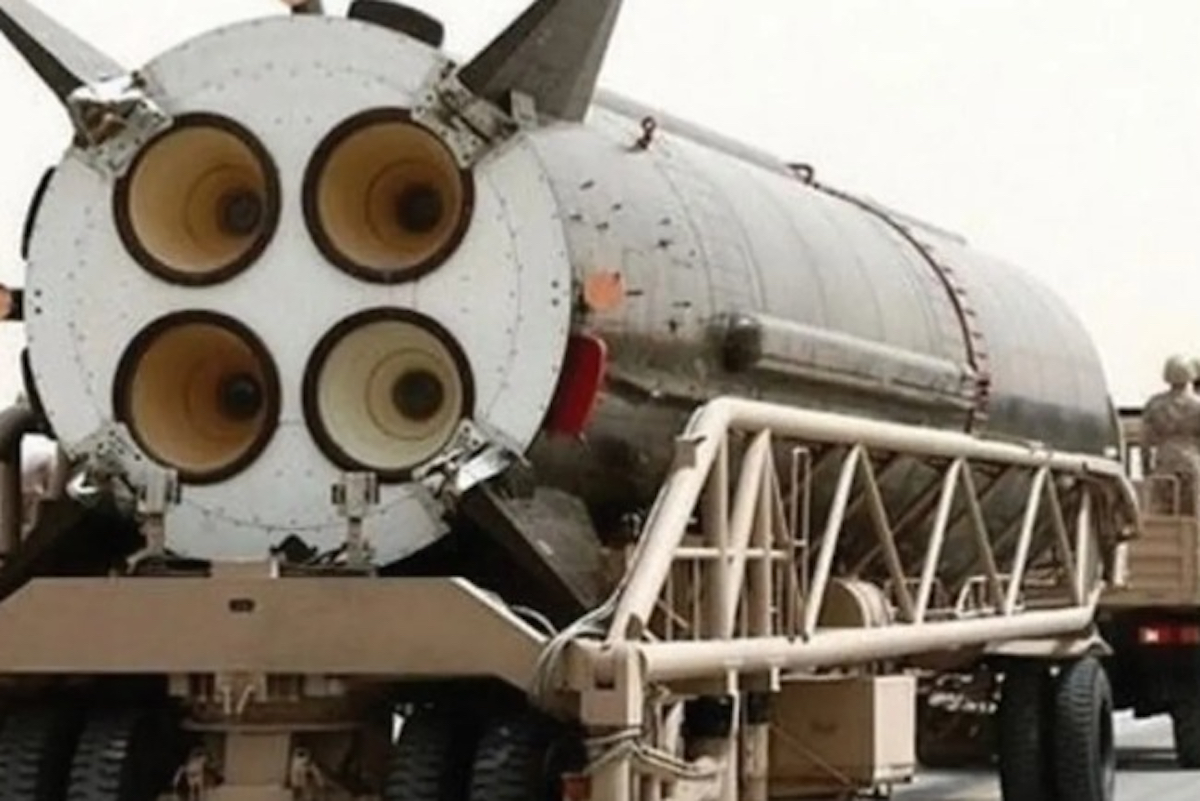
Saudi Arabia’s rapid expansion of a ballistic missile factory signals a transformative shift in its pursuit of strategic deterrence. Saudi Arabia is expanding its solid-propellant missile production complex near al-Duwadimi, approximately 200 kilometers west of Riyadh, to develop longer-range ballistic weapons capable of carrying heavier payloads, multiple media outlets reported this month based on satellite imagery analysis. Work began in April 2025 on two primary structures: an expanded motor-casting facility equipped with 5-to-6-meter casting pits flanked by blast-deflection walls, and an adjacent site likely intended for raw propellant precursors or component storage. The upgrades, which experts assess could be operational by late 2026, rely heavily on Chinese technical designs following decades of missile acquisitions, including DF-3 and DF-15 systems. By shifting toward domestic solid-fuel manufacturing—which enables rapid launch preparation and extended storage—Saudi Arabia aims to counter regional security threats, deter Iran without risking its air fleet, and counter Yemen’s Houthi fighters amid restricted US ballistic weapons transfers. However, the expansion accelerates a regional arms buildup across the Persian Gulf while potentially hardening bipartisan opposition in the US Congress against a proposed civilian nuclear cooperation agreement. Saudi Arabia’s expansion of domestic solid-propellant ballistic missile manufacturing — underwritten by Chinese technical assistance — reflects an operational strike doctrine shaped by combat aircraft losses over Yemen, vulnerable military airfields, and dwindling US munition stockpiles, even as geopolitical constraints prevent China from replacing the US as Saudi Arabia’s primary security partner. This operational doctrine is already being tested in combat. Amidst the ongoing Iran war, The Wall Street Journal (WSJ) reported in September 2026 that Saudi Arabia appears to have fired a Chinese-made DF-15 ballistic missile in combat for the first time, after missile debris bearing “DF-15A” markings was discovered in the Yemeni desert. According to Missile Threat, China’s road-mobile DF-15 short-range ballistic missile (SRBM) can deliver 500-to-750-kilogram conventional or nuclear warheads at ranges spanning 600 to 900 kilometers. Missile Threat says the single-stage, solid-fuel system is 9.1 to 10 meters long, weighs 6,200 kilograms, and can be deployed from mobile launchers in 30 minutes. According to the report, variants feature advanced guidance that achieves a 30-meter circular error probable (CEP), while specialized bunker-busting models can penetrate 25 meters of reinforced concrete. WSJ says that Saudi Arabia deployed the weapon amid escalating clashes with Houthi militants, who recently seized territory along the Bab al-Mandeb Strait. The report notes that it remains unclear if the detached warhead hit an intended target; the launch may have been a deliberate strategic signal to deter both the Houthis and Iran following repeated drone strikes on critical Saudi Arabian energy infrastructure. Saudi Arabia has a decades-long history of buying ballistic missiles from China. According to Fabian Hinz, in a February 2025 article for the Center for Strategic and International Studies (CSIS), Saudi Arabia established its strategic missile force in 1988 by acquiring liquid-fueled DF-3 intermediate-range ballistic missiles (IRBMs) from China and constructing four underground bases to house the systems, despite significant operational and accuracy limitations. Seeking more accurate missiles, Hinz says that Saudi Arabia subsequently procured solid-propellant DF-21 missiles from China in 2007; by 2022, intelligence reports revealed Saudi plans to import additional Chinese ballistic missiles under a program codenamed “Crocodile,” while further assessments indicate the kingdom is now manufacturing solid-propellant ballistic missiles domestically with Chinese assistance at its al-Watah base. Saudi Arabia’s use of Chinese ballistic missiles against the Houthis in Yemen may signal a shift in its airpower doctrine for asymmetric warfare. While top-end fighter jets such as the F-15 and Eurofighter Typhoon remain Saudi Arabia’s premier precision-strike assets, it may be combining manned combat aviation with ballistic missile strikes in response to rising threats to its aircraft and airbases, and to conserve dwindling Western munitions. A September 2026 article by The War Zone (TWZ) outlines Saudi Arabian aircraft losses over Yemen. TWZ reports that since 2015, Saudi Arabia has lost a dozen helicopters, five fighter jets, and 30 drones for all causes. The report also says that other incidents include an F-15 crash in the Red Sea in 2015 and several jets damaged by surface-to-air missiles in 2018, demonstrating how the group’s mobile, passive infrared air-defense network can continually threaten advanced Western-supplied combat aircraft over contested Yemeni airspace. Furthermore, Houthi attacks on Saudi Arabian airbases, such as King Khalid Airbase, could destroy aircraft on the ground, inflicting damage comparable to the US’s loss of an E-3G Sentry airborne warning aircraft at Prince Sultan Air Base. In view of those attacks and losses, road-mobile ballistic missiles provide a far more survivable strike option than vulnerable combat aircraft stationed on exposed runways. Looming US munition shortages may also incentivize Saudi Arabia to seek long-range strike weapons from alternative suppliers, including China. Responsible Statecraft reported in September 2026 that the Trump Administration is advancing a US$5 billion arms sale to Saudi Arabia that includes 5,000 units of 900-kilogram bombs, despite government watchdog warnings of dwindling US stockpiles across major weapons systems. The report notes that the transfer further pressures strained US weapons production lines as the US seeks to bolster Saudi Arabia amid rapid battlefield advances by Yemen’s Houthis. For China, sustained missile cooperation with Saudi Arabia provides access to a lucrative arms market and influence over an energy superpower that remains aligned with the US. Still, ongoing bilateral defense ties do not indicate that China will displace the US as Saudi Arabia’s primary security partner. China lacks the extensive regional military footprint and bases the US maintains across the Middle East, appears reluctant to enter formal defense alliances, is risk-averse to direct entanglement in foreign conflicts, and remains unwilling to bear the strategic costs of acting as an external security guarantor. Also, most of Saudi Arabia’s military equipment still comes from the US and Western providers. Chinese arms sales seem opportunistic rather than sustained, largely limited to items the US or other suppliers are unwilling or unable to supply. China’s close relationship with Iran may put its relations with Saudi Arabia in an awkward position, leaving Saudi Arabia’s longstanding security concern about Iran and its proxies largely unaddressed. As the al-Duwadimi complex approaches operational status, Saudi Arabia’s expanding indigenous missile capability will test the kingdom’s ability to assert operational independence while managing a fragile triangular dynamic: leveraging Chinese technical cooperation without compromising the vital defense guarantees and diplomatic bargains only the US can still provide.
Under Houthi fire, Saudi Arabia looks to China for missile support
Full Article
Original Source
Read the full article at Asiatimes →KhanList aggregates and links to publicly available news content. We do not host full articles from third-party sources. Always verify important information with original sources.