
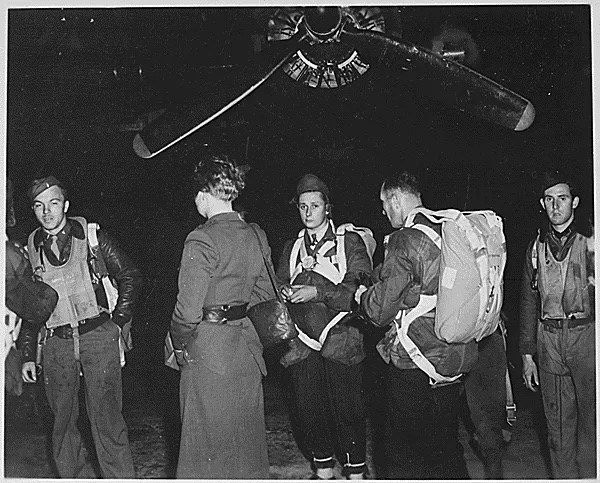
The Office of Strategic Services rides again — at least in name. Defense Secretary Pete Hegseth resurrected the OSS, the intelligence and commando wing of the U.S. military that was created during the Second World War. In a memo issued Nov. 2, Hegseth moved to rename the assistant secretary of defense for special operations and low-intensity conflict to the assistant secretary of war for the Office of Strategic Services. Significantly, the memo also outlines a move up for the assistant secretary of defense for special operations and low-intensity conflict position to “Code 2,” which is designated exclusively for top-tier senior civilian and military leadership positions, according to the Defense Department. The directive, should it be approved by Congress, would put civilian oversight of special operations forces on par with the service secretaries. The directive also seeks to expand personnel and funding for SOF at a time when the Pentagon is increasingly utilizing its special operations forces — the January raid to capture Venezuelan President Nicolas Maduro, for example. Lawmakers and those inside the SOF themselves are pressing Congress for a greater slice of the defense budget. “Although the Pentagon is eyeing a 44% overall budget increase to $1.5 trillion in fiscal year 2027, the top-line budget for U.S. Special Operations Command operations and maintenance would rise much more modestly, from $9.7 billion in discretionary spending this fiscal year to $10.9 billion in 2027,” according to a Washington Times article. “Special operations forces conduct direct action against high-value targets. … They train and advise partner forces, building capacity and strengthening alliances across Latin America, Europe and the First Island Chain,” Sen. Roger F. Wicker, Mississippi Republican and chairman of the Senate Armed Services Committee, said at an April hearing. “They gather intelligence against our adversaries in hostile environments. They respond to crises worldwide at a moment’s notice. And they operate in the gray zone between peace and war, the context in which much of today’s strategic competition unfolds. “However, the funding provided to Special Operations Command has not kept pace with the seemingly insatiable demand for its capabilities. The command faces a troubling gap between its mission requirements and available resources,” Wicker concluded. Hegseth’s memo seeks to close that gap by raising the funding by $45 million and expanding the assistant secretary’s staff by 75 civilians and 25 service members. “Special operations forces (SOF) remain the Joint Force’s pathfinder and our Nation’s vanguard in an era of global uncertainty and strategic competition,” the memo reads. “Despite this contribution to the Joint Force and our Nation, resourcing for SOF remains behind current operational and force posture. It is time for a bold, foundational change.” History of the OSS While America employed spies from the earliest days of the Revolutionary War, by the onset of World War II, President Franklin D. Roosevelt deemed the coordination for gathering intelligence to be codified under one unified service. Roosevelt turned to Gen. William “Wild Bill” Donovan, a trusted advisor and veteran of the First World War, to draft what Donovan called the “Establishment of Service of Strategic Information.” In it, Donovan detailed a framework for a centralized intelligence organization and for gathering essential data for strategic planning. The result was the creation of the Coordinator of Information, or COI, on July 11, 1941. Less than a year later, however, Donovan presented FDR with his new vision: A hybrid organization, inspired by the British Special Operations Executive, that utilized sabotage, espionage, guerrilla warfare and psychological operations. Thus, the Office of Strategic Services, or OSS, was born. OSS Secret Intelligence personnel in France, 1944. (DVIDS) Operating under the Joint Chiefs of Staff and helmed by Wild Bill himself, the OSS “bridged the realms of diplomacy, intelligence and the military. [Donovan] recruited technology, economics, psychology, and finance experts to provide specialized knowledge to military operations. Donovan firmly believed in a two-pronged strategy: physically attacking the enemy’s military forces and targeting their morale and spirit,” writes Maj. Nicolas Dockery. From that wide net, the OSS attracted the likes of specialists from around the nation, including intelligence analysts, linguists and field operatives. Its operatives underwent rigorous training to support guerrilla and partisan forces, particularly in the Western Theater of operations. However, Gen. Douglas MacArthur banned OSS from operating in areas under his command in the Pacific. The Army’s G-2 and the Navy’s Office of Naval Intelligence (ONI) also opposed OSS operations in some theaters, according to the National WWII Museum. At the core of the OSS were the Strategic Services Operations (SSO), writes Dockery, “consisting of six units, each with its specialized areas of expertise and responsibilities. Notably, units like the Special Operations (SO) and the Operational Group (OG) eventually led to the formation of the twelve-person Operational Detachment-Alpha, commonly known today as the Green Berets.” At its peak, according to the National WWII Museum, the OSS numbered roughly 13,000 people, 35% of whom were women. About 7,500, both men and women, served overseas, with OSS officers given military status and rank. By war’s end, however, the OSS disbanded, fractured by internal and external rivalries, particularly with J. Edgar Hoover’s FBI. The Army, Navy and State Department, too, sought to eliminate Donovan’s motley crew that included the likes of film director John Ford, chef/writer Julia Child, actor Sterling Hayden, baseball player Moe Berg, historian Arthur Schlesinger, Jr. and Henry and John Ringling North, of the Ringling Circus family fame. Four future directors of the CIA were also among its ranks. What was once the OSS was posthumously streamlined in 1947 to become the Central Intelligence Agency (CIA) and the Department of State’s Bureau of Intelligence and Research. Special operations would not come under the government’s aegis until 1987, when Congress stood up U.S. Special Operations Command (SOCOM) and the office of assistant secretary of defense for special operations and low-intensity conflict (SO/LIC). Now, with Hegseth breathing new life into the OSS, Donovan, who was ordered to disband the organization in just 10 days in September 1945, might just have the last laugh.
Under Hegseth, the OSS rides again — kind of
Full Article
Original Source
Read the full article at Militarytimes →KhanList aggregates and links to publicly available news content. We do not host full articles from third-party sources. Always verify important information with original sources.