
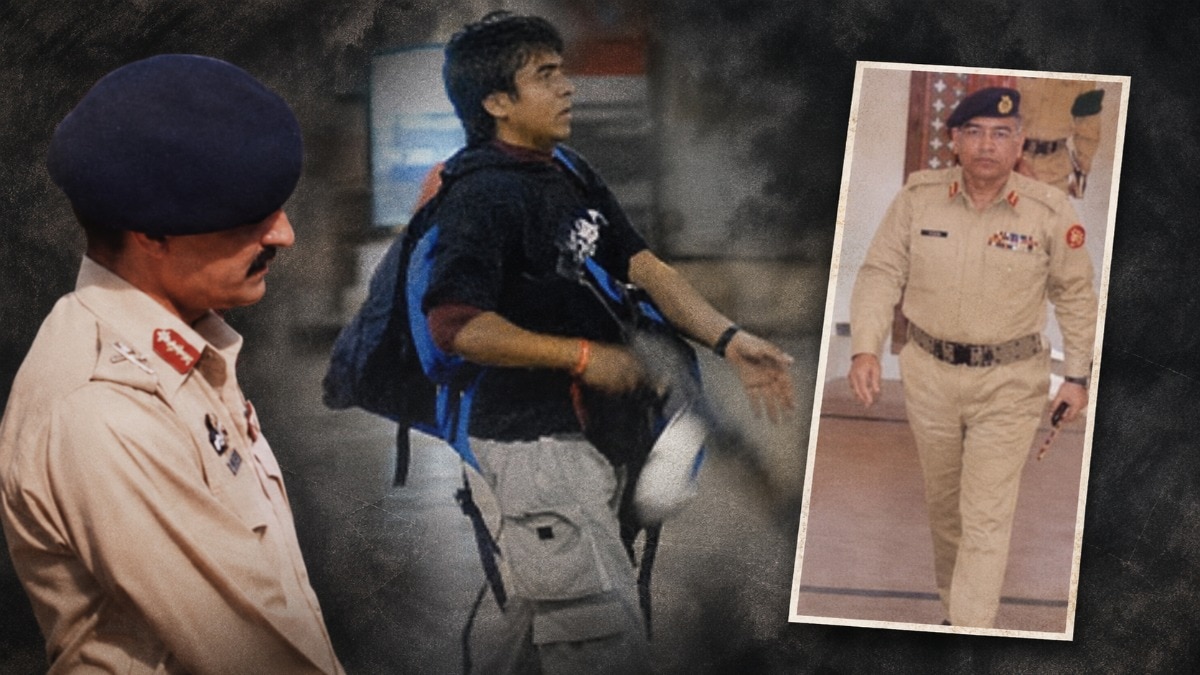
"Fire! Fire!" the Pakistani Major General shouted as the ten recruits stood with their AK-47s pointed at a row of cardboard targets on the firing range. That was the signal for the recruits to empty their magazines. Three hundred bullets echoed across the Lashkar- e-Taiba's Baitul Mujahideen camp nestled in the rugged Chelabandi Hills near Muzaffarabad in Pakistan-occupied Kashmir (PoK).The Major General walked to the targets and inspected them closely. His eyes stopped at target number 4. "Who fired at this target?" he asked.A short, stocky recruit, Ajmal Kasab, raised his hands. "This is how to shoot," the general said, before walking away. Kasab's bullets had completely destroyed the target.A few weeks later, Kasab and his nine 'fedayeen' or suicide commando comrades executed one of the Pakistani deep state's deadliest attacks against India -- an assault on its commercial capital Mumbai that killed 166 people and injured over 500. Kasab and his partner Ismail Khan killed over 60 persons in a murderous rampage that began at the CST station, through the Cama Hospital, the Rang Bhavan lane where they ambushed Maharashtra Anti Terrorism Squad (ATS) top brass, chief Hemant Karkare, Additional CP Ashok Kamte and Inspector Vijay Salaskar. Their killing spree ended at a police checkpoint near Marine Drive where an unarmed police officer, ASI Tukaram Ombale, heroically grappled with Kasab, capturing him alive but falling to his bullets. Kasab was to later recount to the Mumbai Police in graphic detail the levels of training by the LeT and the Pakistan Army that converted him into a pitiless killing machine all under the shadowy supervision of a 'Major General Sahab'.THE MYSTERIOUS MAJOR GENERALThat the 26/11 attacks were supervised and launched by the Pakistan Army is beyond doubt -- detailed statements made to the National Investigation Agency (NIA) by David Headley aka Daood Gilani, who recced the targets in Mumbai, point to serving Pakistan Army officers behind the attack. From Major General Muhammad Khalid Rao and Colonel Sadatullah of the Special Communications Organisation (SCO), who set up the secure networks with voice over internet or VOIP phones, to David Headley's handler, Major Iqbal, and Major Iqbal's boss, Lt Col Hamza. 'Every LeT official had a handler from the Pakistan ISI,' Headley told Indian interrogators from the NIA in Chicago two years after the attacks. During the team's training in PoK, Headley was introduced to a Pakistan Navy frogman, an officer in his mid-30s. The frogman, 'Abdul Qadir', who Indian officials believe was from the SSG-Navy (Pakistan's equivalent of India's Marine Commandos) spent several days in Muzaffarabad with nautical charts and a GPS set, plotting the 10-man attack team's 1000-km sea voyage to Mumbai and letting the LeT know where to land the boat.But an enduring mystery of the attack is the "Major General Sahab". This mysterious two-star officer, identified only by his rank, and who keeps cropping up phantom-like in all the 26/11 chargesheets and trial papers. Identified as 'Accused number 20: Major General Sahab - Name not known', the officer is the only one among 32 Pakistanis not named in the Mumbai police's 2009 chargesheet. A part of the Mumbai Police's 26/11 attacks chargesheet listing the accused. But who is he?No police artist sketch of the Major General was taken based on Kasab's description. In the absence of this, the only clues lie in Kasab's police interrogation report.That the officer was a serving officer is beyond doubt -- Kasab's statement mentions the general as the one who brought Pakistan Army trainers to the camp. The 'Major General sahab' was a regular visitor and keenly supervised the training of the 10-man team and commanded the respect of the LeT senior cadres, receiving sharp salutes from the trainers, most likely serving personnel from the Special Service Group, the Pakistan Army's special operations force.Like any other general in charge of a high-stakes operation, this officer was keen to know whether his highly-trained recruits could deliver -- by killing the maximum number of people in Mumbai, as efficiently as possible.When the attacks were underway, intercepted communications between the attackers and their handlers referenced the Major General saheb. The boss was clearly in the loop.It is clear the officer was from the ISI -- but not its chief -- the spy agency is headed by a serving Lt General. Under the ISI chief are around a dozen departments dealing with everything from intelligence analysis to counter-intelligence, policy and planning and special operations and political intelligence. Each of the ISI's 12 departments is headed by a Deputy Director General (DDG), a two-star officer who's either a Major General, Air Vice Marshal, or Rear Admiral.THE ISI'S SINISTER DIRECTORATE SOf all the ISI's 12 directorates, one stands out for being particularly secretive and sinister -- the S branch.Directorate S, as it is also called, functions as an agency within an agency. Its actions are known to few even within the ISI, and for good reason. This Directorate handles external covert actions, which includes training terrorist organisations and liaising with the agency's regional militant proxies targeting India, Afghanistan, Iran, and Central Asia. The S branch's actions have led countries like India to name Pakistan a state-sponsor of terrorism.This directorate, headed by a two-star officer, almost always a serving Army Major General, had its origins in the Afghan Bureau during the proxy war against the Soviet Union in Afghanistan between 1980 and 1988. The bureau armed, trained and equipped the Mujahideen -- a searing account of which was detailed by the then bureau chief Brigadier Mohammed Yusuf in his explosive 1992 book 'The Bear Trap'.Yusuf's successors carried the war into India from the late 1980s onwards, first with Khalistani groups and then Kashmiri militant groups, as the expanded bureau oversaw a covert war against India through militant proxies like the LeT and the Jaish-e-Mohammed.During the 20-year US presence in Afghanistan from 2001, Pakistan ran with the hares and hunted with the hounds. The Pakistan Army and the ISI pretended to help the Western coalition fight the Afghan Taliban, even as its Directorate S armed and trained the Taliban. The S branch practically runs groups like the LeT and Jaish, along with another directorate, DDG (North) also known as Joint Intelligence North, in charge of ISI actions within Jammu and Kashmir.THE MUSHARRAF CABALWhen the attacks in Mumbai broke out on the night of November 26, 2008, the ISI was headed by Lt General Ahmed Shuja Pasha. The S branch chief then was Major General Mumtaz Bajwa. But, interestingly, the duo were not in charge when the attacks were being planned and the ten terrorists were being trained between 2007 and 2008.Between 2006 and 2008, Indian security agencies began receiving a gush of intelligence alerts, 23 in all, warning of a major terror attack on five-star hotels and a Jewish centre in Mumbai. The last alert in 2008 gave out the exact coordinates of an LeT vessel off Karachi carrying ten terrorists.Many of these alerts came to Indian agencies from US intelligence agencies, but the full picture of a major attack was never given -- a fact later noted by India's then National Security Adviser MK Narayanan.In 2007, as the alerts kept pouring in, a close Musharraf aide was appointed as DG ISI -- Lt General Nadeem Taj. He was personally loyal to the dictator and was his wife Sehba's relative. Taj was Musharraf's Military Secretary and onboard the fateful Colombo-Karachi flight carrying Musharraf in 1999. When the aircraft was refused permission to land, the Army staged a coup and overthrew Nawaz Sharif's government. A rare photo fo Lt General Nadeem Taj (Picture sourced by author) In 2003, Taj was also in the convoy when a powerful bomb targeted Musharraf's cavalcade in 2003. "He was just a bag man for Musharraf, a guy nobody trusted," the author Steve Coll quotes a US intelligence officer in his 2018 book 'Directorate S'.Musharraf resigned as President on August 18, 2008, to avoid impeachment. He had ruled Pakistan for nine years. The commando general had launched the 1999 Kargil War against India and during his nine-year rule as dictator, terror attacks against India soared.Under Musharraf, the Pakistani deep state unleashed fedayeen attacks across the country. Pakistani terrorists struck India's parliament in 2001 and across Indian cities -- Bengaluru, Ahmedabad, Delhi, Hyderabad, and even the Ram Janambhoomi shrine in Ayodhya. Over 4,000 people died in a single year in Jammu and Kashmir in 2001, the state's most violent year.A month after Musharraf's exit, in September 2008, the ISI began cleaning house, reportedly under US pressure. Coll quotes the US as being furious at multiple terror attacks in Afghanistan and Pakistan with ISI fingerprints on them. The Indian embassy in Kabul was hit by a suicide bombing on 8 July 2008 -- the attack killed 58 people, including India's defence attache Brigadier RD Mehta and an IFS officer V Venkateswara Rao. On September 20, a Pakistani suicide bomber detonated a truck bomb at the Marriott in Islamabad, killing 54 people including two Americans.Shortly after these attacks, Taj was moved out and Pasha brought in. One other officer was shunted out of the ISI - the Deputy Director General of the notorious 'S branch', Major General Asif Duraiz Akhtar.'The head of operations (handling relations with Mujahideen groups in Kashmir and other similar groups), Major General Asif Akhtar, and the head of the internal wing dealing with counter-terrorism and political issues inside Pakistan, Major General Nusrat Naeem, are reported to have been superseded for promotion by junior officers and moved to other jobs in the army itself,' Pakistani author Shuja Nawaz wrote of the changes in 2008.Two months later, as the savage 26/11 attacks unfolded, the Pakistani state went from extending cooperation to outrightly denying it. In 2018, former PM Nawaz Sharif admitted Pakistani nationals were involved, but steered clear of naming the army.Musharraf, in particular, performed a volte-face in his statements. At the India Today conclave in March 2009, he called the 26/11 attacks 'most unfortunate', 'a terrorist act' and said that 'terrorists have no nationality.' In later years, he called for cooperating in punishing those responsible, denied the involvement of the ISI and, in later years, rejected the idea that Hafiz Saeed or the LeT were behind the attacks.Musharraf acolytes Taj and Akhtar have never been quizzed about the attacks. Major General Asif Akhtar seen standing on the left (Picture sourced by author) Few photographs exist of the duo on the internet, particularly of Akhtar, who evidently had a more storied career than Taj. Major General Akhtar was commissioned into the 13 Punjab regiment sometime in the late 1960s and saw action in the 1971 war with India on the western front. In 1993, Akhtar was the Deputy Force Commander of the Pakistani UN contingent in Somalia that rescued US special forces stranded after their helicopter was shot down in Mogadishu (popularised by the 2001 Hollywood movie 'Black Hawk Down').In 1999, he commanded the Peshawar-based 7th Infantry Division before going on to take over as the Director General Logistics for the Pakistan Army during the Musharraf years, between 2000 and 2003. After leaving the army, he served as Pakistan's High Commissioner to Nigeria between 2009 and 2011.The few photographs available show Akhtar as a short, slim officer with bushy eyebrows and a hooked nose. Akhtar's LinkedIn profile has no photograph and lists him as 'Retired General / Ambassador, dealing in Oil and Gas Equipment, trading, consultation, Insurance and expertise in logistics.'Eighteen years later, Taj and Akhtar could hold the answers to one of the last great mysteries of the 26/11 attacks: Who in Pakistan authorised the savage attacks and why? And, more importantly, who is the 'Accused number 20' in the Mumbai police chargesheet.- Ends
Uncovering the 'Major General Sahab' from 26/11
Full Article
Original Source
Read the full article at Indiatoday →KhanList aggregates and links to publicly available news content. We do not host full articles from third-party sources. Always verify important information with original sources.