
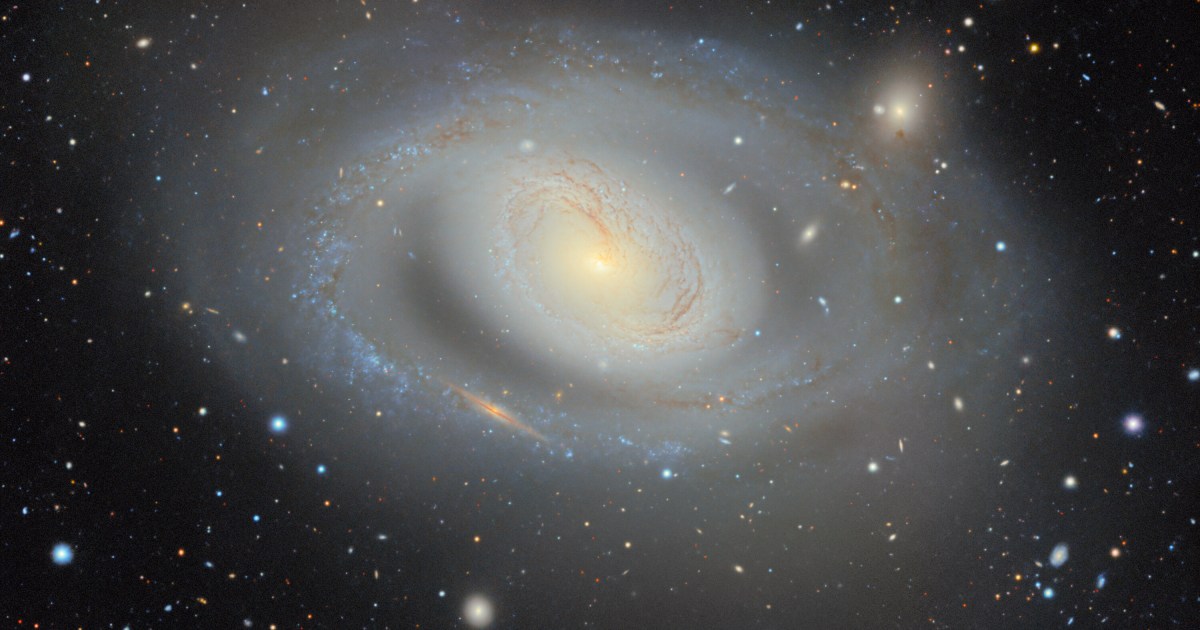
M96 is about the Milky Way's size and mass, but its past was rougher. A new view from the Dark Energy Camera shows the gravitational bruises its neighbors left behind. | Published: October 6, 2026 Credit: DESI Legacy Imaging Surveys/LBNL/DOE & KPNO/CTIO/NOIRLab/NSF/AURA. Image processing: M. Rodriguez (Gemini Observatory/NSF NOIRLab), J. Miller (Gemini Observatory/NSF NOIRLab), T.A. Rector (University of Alaska Anchorage/NSF NOIRLab) & M. Zamani (NSF NOIRLab) Credit: DESI Legacy Imaging Surveys/LBNL/DOE & KPNO/CTIO/NOIRLab/NSF/AURA. Image processing: M. Rodriguez (Gemini Observatory/NSF NOIRLab), J. Miller (Gemini Observatory/NSF NOIRLab), T.A. Rector (University of Alaska Anchorage/NSF NOIRLab) & M. Zamani (NSF NOIRLab) The DESI Legacy Imaging Surveys combine data from three separate, smaller surveys — the Dark Energy Camera Legacy Survey, the Beijing-Arizona Sky Survey, and the Mayall Z-band Legacy Survey — to create a catalog of some 4 billion objects in the night sky. This stunning image of spiral galaxy M96 was captured by the first of those surveys, which used the Dark Energy Camera mounted on the Víctor M. Blanco 4-meter Telescope at the Cerro Tololo Inter-American Observatory in Chile. Located 35 million light-years away in the constellation Leo, M96 is a galaxy similar to our own in mass and size. But look closely, and differences become clear: M96’s off-center bright nucleus and distorted dark dust lanes, which spiral outward through its arms, reveal a turbulent history. Astronomers believe these features are clues that hint at past gravitational interactions with other members of its group of galaxies, which have since moved away but nonetheless left their mark. Alison Klesman is senior editor of Astronomy magazine. She holds a Ph.D. in astronomy and has studied a variety of topics, from minor planets to supermassive black holes.
Uncovering M96’s violent past
Full Article
Original Source
Read the full article at Astronomy →KhanList aggregates and links to publicly available news content. We do not host full articles from third-party sources. Always verify important information with original sources.