
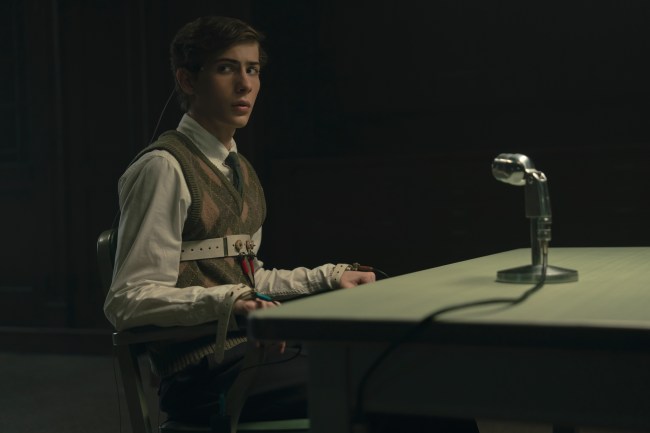
Was Ted Kaczynski crazy? It seems like you’d have to be to start mailing bombs across the United States, murdering three and injuring nearly two dozen more in a terror campaign that spanned decades. Of course, the Unabomber, as he’d come to be known, never accepted the characterization that he was mentally ill. That’s important background going into Netflix’s new biopic: a troubled true crime account that’s often insightful but also dangerously simplistic. Jacob Tremblay, now 19 years old and ages away from his breakout role as the son of a kidnapping victim in “Room,” is the real draw here. But casting Russell Crowe as Dr. Henry Murray, a controversial professor at Harvard when Kaczynski was an undergrad, recalls “A Beautiful Mind” with a purpose. Both Ron Howard’s Best Picture winner from 2001 and director Janus Metz Pedersen’s latest effort examine the inner lives of extraordinarily intelligent men. But “Unabomber” goes further, inventing a diagnosis for Kaczynski inside Murray’s experiment and turning a seriously disputed question into a tidy answer that doesn’t fit the known facts. Squeezing the wildly complicated life of a truly frightening man who wanted to dismantle industrial society into a Netflix-ready origin story is ironic enough. And fabricating his medical history is almost amusingly reckless. Crowe’s “A Beautiful Mind,” in which he portrayed mathematician John Nash, was heavily fictionalized and, at times, pretty ridiculous, too. Critically, however, it was based on a thoroughly documented schizophrenia diagnosis. Kaczynski, on the other hand, spoke to several clinicians after his 1996 arrest and rejected their conclusions that he had the same condition, maintaining his sanity even when mental health evidence might have helped him avoid the death penalty. Other experts disputed schizophrenia as the right diagnosis, suggesting his symptoms were better explained by a personality disorder. His ideas have continued to find an audience, a fact the movie seems unsure how to handle alongside his capacity for calculated violence. Kaczynski’s intellect brought him to Harvard, where Murray’s researchers recruited him for a study that commands most of “Unabomber’s” tortured narrative attention. Participants wrote statements of their beliefs and were subjected to a filmed confrontation in which those values came under personal attack. Kaczynski was selected in part for his score on a questionnaire measuring alienation, not because anyone had identified him as a budding radical thinker. Obviously, when you’re dealing with a politically motivated murderer, that’s a lot to dramatize. But Tremblay proves an extraordinary fit for the slippery material, delivering monologue after monologue about abstract concepts with the blood-boiling conviction of a prodigy who, even suffering manufactured duress, is convinced he is fundamentally right. Crowe, watching from behind one-way glass and turning up in encounters beyond the study itself, gives that intensity a perfectly legible antagonist. The betrayal Murray inflicts on Tremblay’s Kaczynski is reasonably compelling, even as the film presses it into service as an explanation for everything that follows. While “Unabomber” never quite decides whether Ted is crazy, it has much less trouble showing Murray do things that are plainly wrong. As a tender-hearted researcher, Annabelle Wallis, offers Tremblay a tender shoulder to cry on — but her sympathy is so enveloping that it becomes easier to see Kacyznski as a boy steered disastrously off course. Those scenes work emotionally; they also make the movie’s moral arithmetic suspicious. The more harm we watch the adults do to Ted, the less room the story leaves for what he chose to do to others. In real life, there is no verified record that Murray’s team diagnosed Kaczynski with schizophrenia, much less told him so at Harvard. The “Unabomber” script nevertheless keeps trying to connect the study to its FBI procedural, anchored by a strong showing from Shailene Woodley. Co-writers Sam Chalsen and Nelson Greaves use Kaczynski’s beliefs to bridge the timelines, drawing a clear line from a student defending his worldview to a terrorist demanding an audience for it. In life, it was Kaczynski’s writing that helped bring the manhunt to an end. His last bomb killed California forestry official Gilbert Murray (no relation to the Harvard psychologist) in April 1995. He then threatened to kill again unless a major newspaper printed his roughly 35,000-word manifesto, “Industrial Society and Its Future.” The Washington Post published it that September in an eight-page insert, with the New York Times sharing the decision and the cost. Kaczynski’s sister-in-law recognized his ideas and his brother compared the manifesto with Ted’s earlier writing and alerted investigators. The philosophical fingerprints that helped identify him are fascinating on their own, but “Unabomber” uses them to imply that the Harvard experiment explains what he became. His writing also outlived his arrest. After the 2017 Discovery series “Manhunt: Unabomber” brought the case back to television, Kaczynski’s anti-technology ideas found a new audience online, including young people who had discovered him through the show and its circulation on Netflix. They had reason to recognize parts of his critique: technology can erode privacy, concentrate power, damage the environment, and leave people feeling less in control of their lives. None of those observations makes his proposed destruction of industrial society wise, or his murders anything other than murders. But pretending the observations are incomprehensible gives the film an easier problem to solve than the one its subject actually presents. That’s what makes the closing credits so strange. Over real images and audio of Kaczynski, the film lets him speak about people treating him as a cult figure. He says he would prefer to be depicted truthfully, though he is willing to become a symbol if it advances his cause. He was hardly an impartial judge of his own life, and his stated willingness to serve a revolutionary movement is chilling. Still, after using his voice to close the movie, “Unabomber” leaves its own invention about his diagnosis standing. The question of Kaczynski’s mental health remains a matter of historical and clinical dispute. This film makes it look settled precisely where the record does not. Grade: C+ Netflix’s “Unabomber” begins streaming on September 24.
‘Unabomber’ Review: Jacob Tremblay Stuns in a Biopic That Still Can’t Decide if Kaczynski Was Crazy
Full Article
Original Source
Read the full article at Indiewire →KhanList aggregates and links to publicly available news content. We do not host full articles from third-party sources. Always verify important information with original sources.